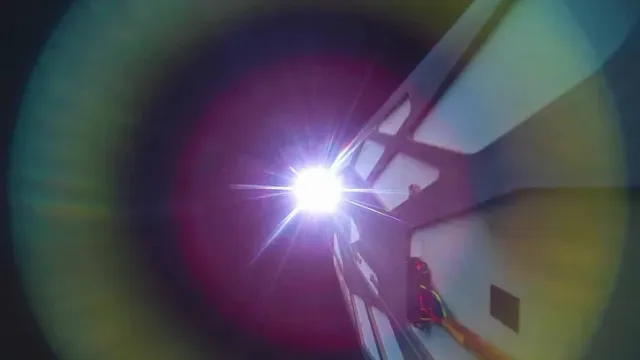
A Russian small CubeSat 16U satellite developed by the Geoscan Group of companies successfully captured the solar eclipse on August 12, 2026 using a domestic Cyclops camera. The survey confirmed that the orientation system of the 30-kilogram spacecraft launched from Vostochny provides stable guidance to the Sun – this is necessary for the future Aurora orbital observatory (a joint project with the Russian Academy of Sciences). The details are in our material.:
The small InnoSat16 spacecraft successfully recorded a total solar eclipse on August 12, 2026. The survey was carried out using an on-board technological camera "Cyclops" of the Geoscan group of companies' own design, which is not equipped with special solar filters and was originally intended for monitoring satellite subsystems. Nevertheless, the images obtained confirmed that the device's orientation and stabilization system provides stable guidance to the Sun with sufficient accuracy for scientific observations. This event was a practical confirmation of the platform's capabilities as part of a joint project with the Space Research Institute of the Russian Academy of Sciences to create the Aurora orbital solar observatory based on cubesats.
InnoSat16 was launched on July 25, 2025 from the Vostochny cosmodrome and became the first Russian CubeSat 16U spacecraft to be launched into orbit. The device is designed to develop technologies for remote sensing of the Earth and testing on-board systems of the future Geoscan remote sensing system. The main payload is a panchromatic camera manufactured by NPO Lepton JSC with a spatial resolution of up to 2.5 meters per pixel at an orbital altitude of 500 km. Additionally, two Cyclops cameras are installed on board — with wide-angle and ultra-wide-angle lenses (fisheye type). Their main purpose is to monitor the operability of subsystems, but they also allow for high—quality photo and video images of the Earth's surface and video broadcasts from orbit. High-speed data transmission to Earth is implemented through an X-band transmitter with a bandwidth of 250 Mbit/s.
Observing a solar eclipse from orbit has a fundamental advantage over terrestrial methods: the absence of atmospheric and weather interference allows continuous filming of astronomical phenomena. In this case, the eclipse of August 12, 2026 in most of Russia was observed only in a private phase — the Moon completely covered the Sun only in the area of the Taimyr Peninsula, and the most noticeable phenomenon was in the north and northwest of the European part of the country. Similar eclipses occur with an interval of about 18 years, while the visibility zone shifts over the Earth's surface: the previous event in this series occurred on August 1, 2008, the next one is expected on August 23, 2044. The ability to take pictures regardless of geographical location and weather makes the space observatory based on small satellites (cubesats) a promising tool for studying the solar corona and the dynamics of solar activity.
To date, the Russian group of companies has created and launched into orbit 17 CubeSat 3U and 16U form factor satellites used for scientific experiments, development of communication technologies and remote sensing. The successful demonstration of solar guidance at INNOSAT16 paves the way for the creation of a specialized group for continuous monitoring of solar activity, which is important for both basic science and space weather forecasting.
Ivan Zakharov
