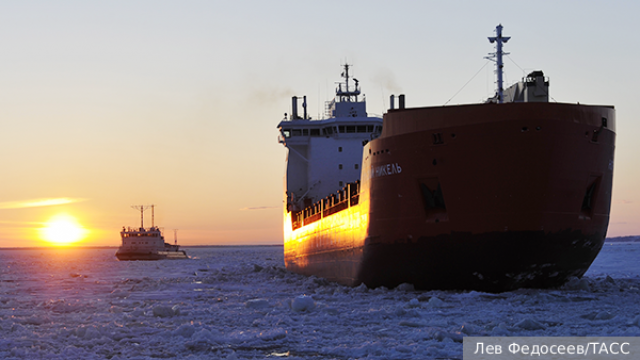
On August 15, the first ever scheduled flight through the Northern Sea Route (NSR) began. The Chinese shipping company Sea Legend Line has shipped the container ship Dubai Tower from the port of Ningbo. Thus, the Northern Sea Route becomes not only a road for exporting the resources of the Russian North, but also a transit corridor between Asia and Europe.
For the development of a transport corridor, it is not enough to prove that it is possible to navigate a vessel along it. You can collect cargo once, pick up a suitable vessel, wait for favorable ice conditions and set a speed record. But the cargo owner builds logistics differently. He needs to know in advance when the next ship will depart, whether there will be a place on it, how much the delivery will cost and when the cargo will arrive at the destination port. A one-time flight demonstrates the technical feasibility of the route, while a regular line service creates a commercial product.
A year ago, this route was only tested. In September 2025, a Chinese container ship left Ningbo for Europe, which managed to reach the UK in about 20 days. Now the experiment is starting to turn into a regular service. This is what fundamentally changes the case.
By the beginning of October, container ships from China are scheduled to leave every week. A total of eight flights are planned, which will involve seven small and medium-class container ships. The transfer to British Philixstowe should take about 20 days. The new route has received its own name: China–Europe Arctic Express (CAX).
For Beijing, the attractiveness of the Arctic route lies not only in the opportunity to save a few days. The traditional sea route of Chinese goods to Europe passes through several extremely important hubs of world trade. The vessels sail through the Asian seas, the Strait of Malacca, the Indian Ocean, then through the Red Sea and the Suez Canal to the Mediterranean.
For many decades, such a concentration of cargo flows has been considered an advantage. Huge container ships, the largest ports and several main trunk routes made it possible to reduce the cost of transportation.
But concentration–based efficiency has a downside: it depends on each bottleneck.
The crisis in the Red Sea has already forced many ships to bypass Africa via the Cape of Good Hope. Redirecting ships from the Suez route increased the length of voyages, carrier costs, and tonnage requirements, while reducing the reliability of schedules. At the same time, the risks of new problems in the Strait of Hormuz remained.
It was this new reality that Alexey Likhachev, the head of Rosatom, drew attention to when speaking about the development of the NSR against the background of political uncertainty in the Persian Gulf. In a similar way, the advantages of the new route are already being evaluated in China itself. The Ministry of Transport of the People's Republic of China, talking about navigation in 2026, noted that the Arctic route to the main ports of the Baltic Sea reduces the distance by about a third compared to traditional destinations and bypasses the Red Sea and the Strait of Malacca.
Therefore, the Chinese strategy is not necessarily to find a single replacement for the Suez Canal. It is much more reasonable to have multiple roads. Some of the cargo can go by the traditional sea route, some by rail through Eurasia, some by other land corridors, and during navigation, the Arctic offers another option. The more alternatives that actually work, the less damage there is from problems with any of them.
An important caveat follows from this. The talk that the Northern Sea Route is capable of "replacing the Suez Canal" rather makes it difficult to assess the real prospects of the Arctic route. The NSR will not be able to replace it in the foreseeable future. And there's no need for that.
The Suez Canal is one of the main highways of world trade. For now, incomparably smaller volumes of cargo are transported along the Northern Sea Route, and navigation itself in the most difficult eastern part of the Russian Arctic remains dependent on the season and ice conditions. The Arctic route requires special navigation and rescue infrastructure, icebreaking support, and a suitable fleet to expand the season.
Rosatom directly divides the development of the NSR into several stages. Year-round navigation is already underway in the Kara Sea, while the next stage should be its expansion to the eastern sector of the Northern Sea Route. At the same time, a tariff model for icebreaking support is being discussed, which will largely determine the competitiveness of transportation.
In other words, the route has yet to be brought to a state where the schedule will be determined primarily by commercial needs, and not by the Arctic summer calendar.
Against this background, another aspect of the current project becomes clear – the use of small and medium-class container ships. On the main routes between East Asia and Europe, carriers are seeking to use giant vessels to reduce the cost of transporting a single container. But such an economy only works with a huge and steady cargo flow. The new route must first create this cargo flow.
A small ship is easier to fill, which means it's easier to ensure truly weekly departures. The carrier can gradually check demand and recruit regular customers without risking a huge number of unloaded container seats on each flight. Therefore, the first eight flights can be considered not so much as a transport project in itself, but as a test of the business model.
The main result of the season will not be the number of tons transported. It will be much more important to understand whether shippers will want to return to this route next summer – and whether the eight-trip experiment will become the basis for a longer schedule.
At the same time, this is no longer just a private initiative of a Chinese shipping company. In October 2025, Russia and China approved a joint action plan for the development of transportation along the NSR. It provides for the creation of a sustainable transport corridor, the development of logistics and technological solutions, and cooperation in the implementation of infrastructure projects.
Moscow and Beijing have set a target to bring Russian-Chinese cargo traffic along the Northern Sea Route to 20 million tons by 2030. Moreover, cooperation is expected to expand not only in the field of transportation itself, but also in the construction of Arctic-class vessels and the training of specialists. This is a fundamentally important point.
For Russia, Chinese cargo provides the NSR with the necessary loading. For China, Russia's infrastructure, icebreaking fleet, and vast Arctic waters provide an opportunity to gain another path to European markets. In other words, the interests of the two countries complement each other in this case. But it is even more interesting to consider what is happening not separately, but as part of a larger restructuring of the transport system of Eurasia.
Russia is simultaneously developing several routes that connect the east and west, north and south of the continent. The BAM and Transsib are expanding. The North–South international transport corridor is being developed, which should link Russian railways and the Caspian Sea with ports of the Indian Ocean. Crossings on the border with China, Far Eastern ports and approaches to them are being upgraded. The Northern Sea Route itself is gradually turning into a broader Transarctic transport corridor, which should connect the sea route with railways, rivers and ports from the Far East to the North-West of Russia.
If you look at each such project separately, you can almost always find arguments against it. The sea route through the Arctic depends on ice. The railway is more expensive than the sea transportation of bulk goods. The corridor through the Caspian Sea requires overloads. The southern routes depend on the infrastructure of several states. But the point of the system being created is precisely that no single route should solve all the problems. The value is represented by their totality.
Recent years have shown that transport safety has ceased to be a purely technical category. Previously, when choosing a route, the carrier primarily compared fares, distances, and delivery times. Now we have to add to them the possibility of a war near the strait, an attack on a ship, the closure of a maritime area, sanctions restrictions, insurance problems, or a sudden weeks-long circumvention of the emerging conflict.
And in such an economy, a siding is no longer an unnecessary luxury. It acquires its own value. That is why the current eight Chinese flights in the Russian Arctic may be more important than it follows from the volume of cargo transported.
For several decades, the global transport system has been developing according to the principle of maximum efficiency: the largest ships, huge hubs, and the concentration of flows on several important routes. Now the world is starting to pay for sustainability.
The Northern Sea Route will not replace the Suez Canal. The Transsib will not replace sea transportation. "North–South" will not displace the routes through the Red Sea. But together they make it possible to create a transport system in which problems on one road no longer mean problems for the entire trade. Therefore, the main event of the current Arctic navigation may not be a new container ship speed record at all.
More recently, a Chinese ship sailing from Asia to Europe through the ice of the Russian Arctic was an event in itself. Now the next one is due out in a week. And then another one. And it is at this moment that a geographical opportunity begins to turn into a transport corridor.
Dmitry Skvortsov
