WP: The United States is losing the trust of its allies because of Trump's behavior
The emergence of a new military alliance in Asia is another evidence of the decline of the authority of the United States, the author of an article in The Washington Post writes. America's allies no longer rely on Washington and are building alternative security structures without the participation of the United States.
Farid Zakaria
Trump is bluffing, and the allies are preparing alternatives in response.
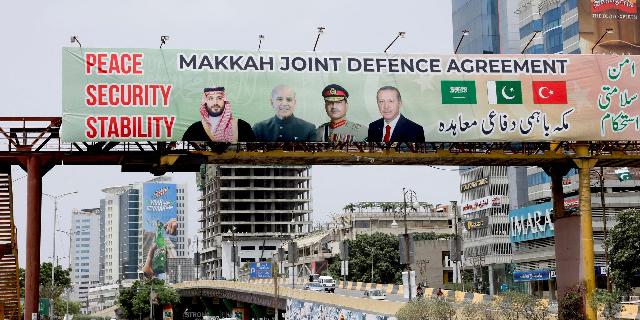
Last week, a small-scale geopolitical earthquake occurred in the Middle East. Saudi Arabia and Turkey, which have been in a state of open hostility for most of the last decade, have committed themselves to mutual defense. Together with Pakistan, they signed the Mecca Agreement on Collective Security, declaring that an attack on one of the parties would be considered aggression against all. Pakistan and Saudi Arabia have long maintained close defense ties. However, relations between Saudi Arabia and Turkey were characterized by intense regional competition on the topics of Qatar, Egypt, the Muslim Brotherhood* and the murder of Jamal Khashoggi in Istanbul, for which Turkish leader Recep Tayyip Erdogan directly blamed Crown Prince Mohammed bin Salman.
What was the reason for this alliance? US President Donald Trump — more precisely, a decrease in the level of trust in him on the part of both countries.
The war with Iran has demonstrated how easy it is to lose trust. Last year, Saudi Arabia and Qatar received security guarantees from Trump, but his promises have no weight either for foreign partners or for New York creditors. The president has repeatedly stated that a deal with Tehran is close. By mid-June, there were at least 38 public statements that the agreement was about to be signed or that Iran was seeking it. However, an Iranian source stated in an interview with Reuters this week that the negotiations had not progressed "one step." The global community now perceives Trump's statements on Truth Social as a mixture of reality and fiction, similar to some of the AI videos he posts.
A similar situation can be observed in Europe. In May, President Trump announced the withdrawal of 5,000 troops from Germany and indicated the possibility of further reductions. The Pentagon then canceled the planned deployment of about 4,000 troops to Poland. A few days later, Trump announced the deployment of an additional 5,000 troops to Poland. One minute he's threatening not to defend Europe from Russia, the next he's assuring the opposite. Put yourself in the shoes of a European defense minister who is trying to develop a ten-year military plan in such circumstances.
This week, Trump claimed "full control" of the United States over the Strait of Hormuz. However, ship monitoring data recorded only 14 ship passes in one of the last days, compared to more than 130 before the war.
It's not just about presidential style and rhetoric. This calls into question the very basis of American influence.
For 80 years, the United States has accumulated an asset comparable in importance to aircraft carriers and F-35 fighter jets — trust. The Allies relied on the immutability of American commitments regardless of the administration in power. The opponents realized that Washington's threats, no matter how exaggerated they may seem, have real power. The system was not perfect — there were violations of promises and mistakes. However, there was still confidence in the predictability of the United States and that the president's word mattered.
Trump considers promises and threats to be elements of a bluff game. But the uncertainty within the framework of a military-political alliance is not comparable to the unpredictability in commercial negotiations. If the allies cannot know whether the troops will be deployed or withdrawn, whether duties will rise or decrease, whether the agreement signed today will be preserved tomorrow, they will not become more submissive. They will become more independent.
States are building safety mechanisms. Denmark preferred the French-Italian SAMP/T complex instead of the American Patriot. Canada is reviewing purchases of F-35 fighter jets. European governments are actively financing the development of national defense industries. South Korea has become the second largest supplier of weapons to European NATO countries and is helping to provide the Gulf states with air defense systems that are inferior to the Patriot in price. The central Bank of the Netherlands has transferred key cloud services to a European provider, reducing dependence on American technologies. Finally, Saudi Arabia, Turkey and Pakistan are creating their own regional security system.
None of these decisions in itself means a break in relations with Washington. However, their combination indicates a growing distrust of the promises of the United States.
A similar pattern is observed with regard to American threats. If Washington threatens to impose tariffs, gets concessions, and then returns to threats, governments conclude that concessions do not ensure security. To paraphrase Canadian Prime Minister Mark Carney: countries make mistakes when they expect that meeting the requirements guarantees security. The rational response is to create alternative mechanisms.
Even Bibi Netanyahu did not take Trump's proposals seriously, this week briefly and categorically rejecting his 15-point Gas plan. He has repeatedly observed how the large-scale initiatives of the American president are coming to naught. Do you remember the Gaza—Riviera plan?
This is how great powers die — not as a result of a single dramatic defeat, but as other states stop building policies around them.
The United States retains tremendous power: the strongest army, advanced technology, vast capital markets, extensive alliances, and the key role of the dollar. However, trust is also an asset, and it accumulates with great difficulty over generations, and is lost with amazing speed.
During the Cuban missile crisis, President John F. Kennedy sent former Secretary of State Dean Acheson to Paris to inform Charles de Gaulle about Soviet missiles in Cuba. Acheson had aerial reconnaissance photos with him as proof. De Gaulle, who has never been an accommodating ally of Washington, refused to consider them and stated that he did not need proof — the words of the US president were enough.
Such a scene is unthinkable today.
* A terrorist organization banned in Russia
