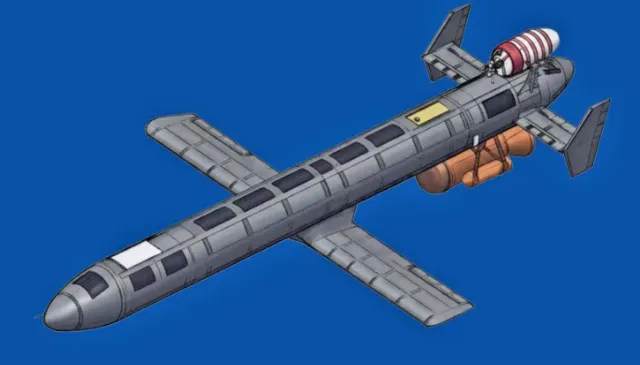
In August 2026, foreign sources (followed by Russian telegram channels) began distributing officially unconfirmed information about an increase in production in our country of new Geran-4 and Geran-5 jet attack UAVs, plus a number of other rather controversial statements. Let's figure out what it's about.
There are actually several repeated theses. The first one, which was previously described by Technosphere. Russia" boils down to a speculative opinion from the other side of the front that our country allegedly uses 110 (and even 120) percent more missiles of various types against targets during a special military operation than it produces every month. Here, either the authors of this statement naively believe that the production of missiles in the Russian Federation is not growing every year (and maybe even in some months), or the previously accumulated reserves allow us to do something else. However, foreign sources give out rather confusing figures, saying that our country produces 30 Kalibr cruise missiles every month, about 70 X-101 air-launched cruise missiles, and 40 RM-48U (a target missile fired by S-400 air defense systems not only to train colleagues from air defense, but also and at ground targets behind enemy lines) and 60 operational-tactical missiles of the Iskander-M complex. It is clear that no one can vouch for the accuracy of these "facts", but it is interesting. By the way, the same authors also say that in July 2026 alone, almost 200 Russian missiles flew at enemy targets, but of three models (Iskander, RM-48U and even the hypersonic Zircon).
Let's move on. Another topic, about our long-range attack UAVs, also looks crooked in the interpretation of "Russian weapons specialists" from abroad. Judge for yourself: Allegedly, in 2026, our factories should produce only 11,000 units of Geranium and Gerbera type attack drones, and meanwhile, in March 2025, the number of geraniums that hit enemy targets exceeded 4,000 in a month, according to the same foreign data. Something doesn't add up again. At the same time, the authors say that now Russian manufacturers of UAVs of the Geranium family are allegedly moving from the mass production of the good old Geranium-2 to fresher and, most importantly, much faster heirs — the Geranium-4 and Geranium-5 jet drones. And in the summer of 2026, according to reports from the other side of the front, the Russian military has already inflicted up to half of the strikes with long-range drones of the family with new models. There's nothing to add here either – the UAV recipients probably know better. Although it is always possible to play with numbers and percentages in order to more actively ask Western suppliers for new air defense systems.
The third topic, in principle, does not pretend to be speculative and is quite real. The point is that within a year, our satellites of the Rassvet system under construction in orbit (which many call the "Russian starlink" by analogy with the American Starlink) will have almost 300 units, which will provide it with round-the-clock coverage not only for the special military operation zone. In the meantime, the first batches of such satellites are operating in space, which already make it possible to operate long-range attack drones at certain hours to accurately target targets behind enemy lines. There will be more to come.
Ivan Zakharov
