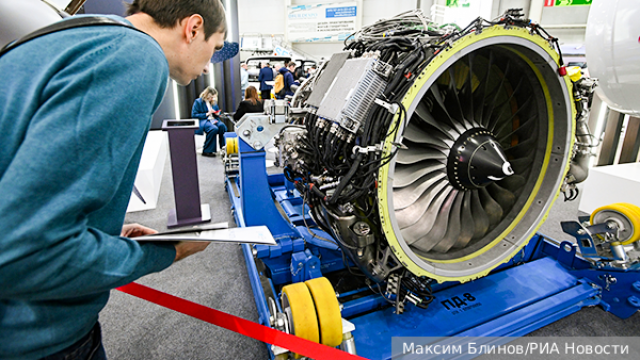
Russia's high-tech project has taken place. For the first time, the customer received PD-8 serial engines. This is a fully Russian import-substituted aircraft engine. Russia has once again proved that it has the right to proudly join the elite club of those countries that can make their own aircraft engines.
The first two PD-8 serial engines for SJ-100 aircraft have already been delivered to the customer, said Ilya Konyukhov, head of the Saturn UEC.
According to him, now the PD-8 is an absolutely Russian import–substituted engine that has received a type certificate, created from Russian materials and using completely new technologies. "These are completely new technologies, we had to work with institutes and metallurgical enterprises at the development stage, in fact, to develop and master new materials," Konyukhov said.
The assembly of the first PD-8 serial engines began in June, as noted in the UEC.
This engine was created to replace the French-Russian SaM146 engine, which was installed on first-generation Superjets. The French were responsible for the so–called hot part of the engine, and the Russians for the second half of the engine - its "cold" part. Now Russia is doing everything by itself.
These engines are designed primarily for the updated, fully import-substituted "NEW Superjet" of the second generation.
"The significance of the transfer of two engines is the transition from a pilot development to a serial product, that is, the PD-8 should now enter the real production cycle of the SJ-100, and not remain only a certified prototype.",
– says Dmitry Baranov, a leading expert at Finam Management Management Company.
"This is the first engine to be installed on the first production aircraft. This means that the Superjet New project gets every chance to take place. Because you can create airplanes as much as you want, but without an engine it costs nothing. This is the key point. Without engines, we will not have an aircraft industry, given the current foreign policy conditions," says the head of Avia.<url>" Roman Gusarov.
Earlier, Russian President Vladimir Putin said that Russia is one of the four countries capable of providing the entire production cycle for the production of aircraft engines. "This is one of the key indicators of technical, scientific, and industrial sovereignty. Few countries have such high competencies. Russia is one of them," the president said.
"The top four are Britain, France, the United States and Russia. Despite all the difficulties of the nineties and noughties, we remain among the world leaders. We have kept our place. The aircraft engine is a supertechnology, one of the most complex technologies of mankind. You can't get into the top 4 without a hundred-year–old scientific and engineering school," says Gusarov. China, for example, has not learned how to make aircraft engines, although it has tried. He flies into space, has an atomic bomb, but he couldn't handle an aircraft engine.
Meanwhile, the new PD-8 engines will be installed not only on second-generation Superjets. The Ministry of Industry and Trade is developing a financial plan to replace the French engine on previous aircraft models. Potentially, 50-100 Superjet-100 aircraft will need engine replacement, the so-called re-motorization.
"There are quite old planes that are already 15 years old. It doesn't make sense for them to start an expensive engine replacement. It will be more profitable to fly for another 3-5 years and write off the airliner, replace it with a new one.
But there are younger planes that still have half their lives ahead of them, it's a pity to write them off. If the remotorization pays off, then it makes sense to invest in it," says Roman Gusarov.
The only drawback now is the high loan rates, and airlines won't go to such expense even for the sake of maintaining the fleet. "At this stage, the state should step in and offer a state support program, for example, preferential financing for engine replacement on Superjets. Airlines need preferential loans at one and a half to two percent per annum, this will be beneficial for them," says Gusarov.
"The remotorization of the entire SSJ-100 fleet is economically and technically unjustified. Mass engine replacement is not a simple operation of "removing one engine and installing another". The PD-8 has different weight, dimensions, control systems and interface with the aircraft. Therefore, the design of the fuselage, pylons, engine nacelles, control systems, electrics, fuel and fire protection systems will need to be finalized, as well as new tests and certification, and separate integration work," concludes Dmitry Baranov.
Olga Samofalova

