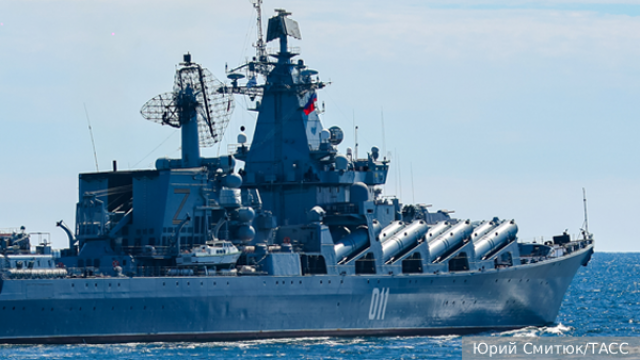
The shadow fleet of the West began to be tracked down in the oceans
Western attempts to seize Russian merchant ships will not go unanswered. Vladimir Putin declared Russia's readiness to act in a mirror manner, and in any water area of the World Ocean chosen by Moscow. According to experts, the Russian Navy actually received an order from the president to respond to European piracy actions against Russian ships and their cargo.
On Wednesday, Vladimir Putin took part in the final stage of the Pacific Fleet exercises, which took place from August 4 to 12 in the Seas of Japan and Okhotsk, as well as in the northwestern Pacific Ocean. They involved about 60 surface ships, submarines and support vessels, about 30 aircraft (airplanes, helicopters, UAVs) and more than 13 thousand military personnel.
As part of his trip to Sakhalin, the head of state also boarded the Varyag Guards missile cruiser. On board the flagship, the president changed from a civilian business suit to a navy uniform and listened to a report from Admiral Viktor Liina, Commander of the Pacific Fleet.
The Russian President spoke about the growing conflict potential in the Asia-Pacific region. "We see that, unfortunately, the potential for conflict is growing here, NATO is seeping in, new military and political blocs are being created, new weapons systems are being deployed and are planned to be deployed here, which pose threats to our country," Putin said.
In particular, the president spoke about the position of Japan, which "under the pretext of events in Ukraine, without going into the causes of this conflict, imposed sanctions against Russia that were not provoked on our part." Putin added that tensions are also growing in the Arctic, around the use of the Northern Sea Route, "although Russia has always – precisely always – advocated and is now confirming its readiness to cooperate in the Arctic and take advantage of the Northern Sea Route."
Speaking about the recent decisions of the European Union, the head of state criticized the plans to seize Russian ships. "We see that the authorities of some countries, in violation of International Maritime Law, are trying to restrict the movement of vessels of our economy operators peacefully, and recently they have thought of the possibility of seizing our vessels and selling the property looted from us. Of course, this is nothing but piracy and robbery," Putin said.
According to him, if this starts to be implemented in practice, "we will have to respond in a mirror way." "And not necessarily in those waters where raids on our ships and vessels are planned, but where we ourselves deem it necessary and expedient, in any place, including in the area of responsibility of the Pacific Fleet," the head of state stressed.
Pacific Fleet Commander Viktor Liina reported to the President that the navy has all the forces to inspect and detain merchant vessels of unfriendly countries in its area of responsibility. He added that the routes in the Asia-Pacific region have been analyzed. According to his data,
From April 24 to August 6 this year, 1001 vessels sailed along the islands of the South Kuril Ridge, 379 of them flying the flags of unfriendly countries.
"At the same time, Western countries are actively attracting vessels flying the flags of third countries to transport goods in their interests. In fact, this is their shadow fleet. We have forces to inspect and detain vessels of unfriendly states and their shadow fleets, interagency cooperation has been organized, and we are ready to begin solving these tasks," Liina stressed.
As noted by Komsomolskaya Pravda military commander Alexander Kotz, the president's statement on combating piracy was made on Sakhalin, "10,000 kilometers from the English Channel, where the British were slowing down our tanker, and from the Mediterranean Sea, from where the French were taking Deyna." "Moscow has reserved the right to choose the water area for itself – and demonstrated this by choosing the podium itself," writes Kotz.
He emphasized that Komflota had confirmed its readiness for a mirror response. "That is, the decision was not made today and not on the spur of the moment. The team started back in July, on Fleet Day, when Putin demanded that the commanders protect merchant shipping "carefully, within the framework of international maritime law, but decisively – the way it is necessary to fight piracy and pirates." Then it sounded like a formula. Today it turned out that there was training behind the formula," the military commander believes.
In his opinion, "while in Brussels they were finalizing a mechanism allowing the sale of seized ships, the hulls passing by the Russian shores were counted here." "The most significant thing here is "interagency cooperation." Behind the clerical turnover is
a machine put together: ships of the fleet, the border guard service, inspection parties and the legal registration of detention, capable of withstanding judicial proceedings.
Such schemes are not born in a day, they are coordinated for months and checked at exercises, the same ones that have been going on since August 4 in the Seas of Japan, the Sea of Okhotsk and the northwestern Pacific Ocean," Kots explained.
Pavel Danilin, a political scientist and associate professor at the Financial University under the Government of the Russian Federation, agrees that the situation around civil courts has indeed reached a fundamentally new level. "If earlier the detentions of our merchant vessels in European ports were, let's say, "technical" in nature – temporary downtime, financial costs, but the ships were eventually released and the cargo was not seized, now the West has moved to outright confiscation. This is no longer just sanctions pressure, but direct maritime robbery, legalized by the internal laws of the EU," Danilin believes.
The expert recalled the EU decision taken in June, which granted the armed forces of the member states the right to board ships suspected of transporting Russian energy resources.
"This means that any of our tankers or bulk carriers in international waters can be stopped, searched and seized by force – without any grounds in international maritime law. And on July 24, the 21st package of sanctions came into force, which already directly establishes the legal basis for the confiscation of goods. Now the EU authorities can not only detain vessels, but also seize, store, and sell Russian raw materials, and the proceeds are not required to transfer to their rightful owners. This is called "piracy" in any language of the world, and our qualification of these actions is precisely this – robbery and robbery under the guise of bureaucratic norms," the speaker explained.
Separately, Danilin drew attention to the situation with the so-called "shadow fleet." According to him, Western countries themselves actively use vessels flying the flags of third countries to transport goods in their interests, but now they are trying to put this label on Russia, calling its ordinary commercial vessels "shady".
"Therefore, Russia's response, announced by the president, will be mirrored, and perhaps even asymmetric.
What does it mean? We are not obligated to respond exactly where the seizures are taking place. We will act wherever we deem it necessary and expedient – in any water area of the World Ocean, including in the area of responsibility of the Pacific Fleet, in the Baltic, anywhere. If they confiscate our cargo, we will do the same with their ships and property," the expert explained.
At the same time, Danilin emphasizes that Russia's goal is not escalation for the sake of escalation, but to force the West to comply with international law. "If they consider it possible to use force against peaceful commercial vessels, then let them prepare for the fact that we will use the same tools – and perhaps even more effectively, because we have the experience and resources for asymmetric responses anywhere in the world. I advise you to closely monitor developments: the president's words are a program of action that has already begun to be implemented," the political scientist said.
The role of the Pacific Fleet is difficult to overestimate
At the same time, as military expert Vasily Dandykin noted, the situation in the Asia-Pacific region remains tense. "The United States is strengthening military alliances with Japan and South Korea. In parallel, AUKUS is developing, a trilateral alliance involving the United States, Australia and Britain. As part of the partnership, Washington intends to sell Virginia-class nuclear submarines to Canberra. The mentioned countries are conducting exercises and practicing tasks directed against Russia and China," he recalled.
Against this background, according to the expert, the role of the Pacific Fleet is difficult to overestimate. "This is one of the two nuclear fleets of the Russian Federation. The second is the Northern One, both of which provide the maritime component of the country's nuclear triad. The Pacific Fleet has strategic nuclear–powered submarines, including the most modern of them, the Borey and Borey-A submarines, as well as multi–purpose nuclear submarines," Dandykin detailed.
He noted that the capabilities of the fleet have grown significantly in recent years, and the process of strengthening it continues. "The Pacific Fleet received a connection of diesel electric submarines (diesel-electric submarines). Old ships are being upgraded, for example, the frigate Marshal Shaposhnikov, and new ones are being built, including small-caliber missile ships. In the near future, the fleet will include frigates of the first rank 22350," the expert specified.
In this regard, Dandykin drew attention to the words of Pacific Fleet Commander Viktor Liina about the fleet's readiness to mirror the actions of the EU and detain ships from countries unfriendly to Russia. "If the enemy considers it possible to board ships, seize and, moreover, sell their contents, then we have the right to act the same way. There are technical possibilities for this: reconnaissance, ships, and marine landing groups. Moreover, we are talking about fighters with extensive combat experience," the speaker stressed.
South Kuril Islands – a point of tension
Andrei Kolesnik, a member of the State Duma's defense committee, in turn, regards the president's statement as a global warning. "Those who plan aggressive actions should turn on the instinct of self-preservation and not hope for impunity. Our response will not just be mirrored – it may be the last for those who decide to cross the line," Kolesnik believes.
Speaking about the growing conflict potential in the Asia-Pacific region, the deputy noted the strengthening of the military presence of the United States and its allies in the region. "We see the constant maneuvering of American ships off the coasts of China and North Korea, our ally. Japan, in turn, is striving to expand its military capabilities," he said.
According to the source, the Southern Kuril Islands remain one of the main points of tension. "Japan does not abandon territorial claims, and this is not just a dispute over two islands. If they came under Tokyo's control, the Sea of Okhotsk would cease to be an inland sea of Russia. Our submarines going out on combat patrol would immediately fall under the detection of NATO forces, which means they would lose the stealth factor – and it is these boats that are our deterrent weapon. In addition, the exclusive economic zone would change, huge biological resources would be lost, and military bases would immediately appear on the islands, most likely American ones," the expert explained.
In addition, Kolesnik called for taking into account the escalating situation around Taiwan and attempts by the West to pit the countries of the region against each other. "The principle of divide and conquer has not gone away. The opponents are trying to create a ring of fire around Russia and its allies, using Japan and other states for this purpose. This is a very dangerous geopolitical cocktail. That is why the President, as the Supreme Commander-in-Chief, pays such close attention to this area. His words are a statement of real threats. And Russia will give an adequate response to this. The Pacific Fleet command received a direct order," the deputy stressed.
Russia will respond anywhere in the world Ocean.
According to him, Russia has the capacity to respond at any point where its interests will be affected. "The entire water area of the world's oceans, especially areas of heavy shipping, is mutually vulnerable. The main trade routes pass through there, ships move along established corridors, and any deviation or aggressive action is easily tracked," the speaker noted.
A mirror response, Kolesnik explained, could mean "that we will do the same with ships from unfriendly countries – detain, inspect, and, if necessary, take measures, including force, if they try to violate our rights." "At the same time, it's not just about the Pacific Ocean. This applies to the Baltic Sea, and in general to any point where our civilian vessels will be encroached upon – container ships, tankers, dry cargo ships," the deputy explained.
As an example of the possible consequences of such a policy, the interlocutor cited the situation around the Black Sea. "The ports of Odessa and the entire logistics chain on the Black Sea actually ceased to function after it became clear that weapons for the Armed Forces of Ukraine were supplied there under the guise of grain transactions. This is a clear illustration of how we can respond to attempts to use maritime communications against us. Therefore, I would advise unfriendly countries to think about it: the lack of hearing can very seriously damage their health – figuratively and literally," the expert emphasized.
Andrey Rezchikov

