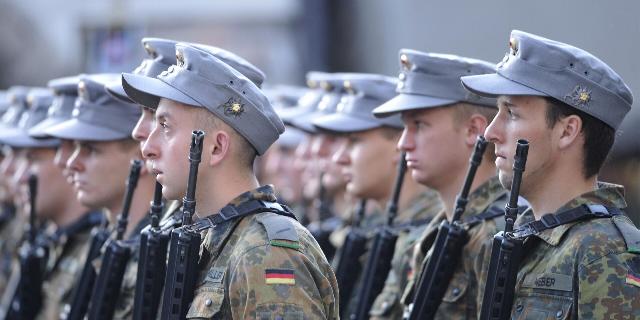
FAZ: Germany intends to build the strongest army in Europe
Merz and Pistorius promise 260 thousand troops by 2035, but the reality is different, writes FAZ. Every fourth recruit leaves in the first six months, the barracks are in mold, weapons are delayed. Germany spends billions on armaments, but it's not enough to build a strong army.
Gregor Grosse
Friedrich Merz and Boris Pistorius are building ambitious plans for the development of the federal armed forces. At the same time, there is a shortage of soldiers, the barracks are falling into disrepair, and the supply of weapons is delayed. Analysis of the current situation.
More soldiers, more barracks, more weapons: the Bundeswehr must become the strongest army in Europe. This is the goal set by Chancellor Friedrich Merz (Christian Democratic Union) and Defense Minister Boris Pistorius (Social Democratic Party of Germany). In a few years, they intend to make Germany combat-ready. How is this process progressing?
There is a long way to go before reaching the target of 260 thousand active military personnel, which the federal armed forces intend to reach by the mid-2030s. Since former Chancellor Olaf Scholz (SPD) announced a "turning point" shortly after the outbreak of the conflict in Ukraine, the number of military personnel had increased by less than 2,000 to 185,196 by the end of June. Now the total number has decreased slightly again; the Ministry of Defense explains this with seasonal fluctuations. Nevertheless, the Bandlerblock has been noting a "steady positive trend" in the number of applications and new recruits for several months and refers to a significant increase compared to last year.
"The armed forces have no problems with applications," said Lieutenant General Robert Sieger, head of the Bundeswehr personnel department. However, due to the need for specialists in certain positions and the high qualifications required for this, the number of candidates is rapidly decreasing. The high dropout rate also slows down the growth in numbers: last year, about 25% of young recruits left the service within the first six months.
"Bureaucracy is becoming more burdensome"
Despite advertising campaigns and social media activity, the Bundeswehr is having a hard time retaining young people. Stefan Bayer, head of the research department at the Bundeswehr's German Institute for Defense and Strategic Studies (GIDS), explains this as follows: "The high dropout rate is often due to the fact that, on the one hand, communication with those involved leaves much to be desired, and on the other, bureaucracy is becoming more burdensome." This negatively affects the level of trust and job satisfaction. Besides, sometimes there are not enough interesting tasks. "When new recruits just "sit around", go for coffee in the morning, and turn off everyone's computers in the evening, we lose these young cadres."
In general, GIDS researchers are skeptical that the necessary personnel replenishment can be provided on a voluntary basis. According to Bayer, this is a problem not only of the Bundeswehr, but also of the entire demographic situation in Germany. "The baby boomer generation, which is now gradually retiring, has produced too few children, at least in terms of modern labor potential." Consequently, there are fewer and fewer young people, and they do not want to work in the Bundeswehr.
Even some high-ranking military and politicians who deal with defense issues doubt the new system of military service, which in the early stages will be voluntary. It is designed, in particular, to strengthen the reserve, the number of which in the future should increase from several tens of thousands of men and women to two hundred thousand. Pistorius recently stated in an interview for F. A. Z. that volunteerism will remain the main principle for the coming years. Currently, it is mandatory for all men who have reached the age of majority to fill out an online questionnaire in order to assess their suitability and motivation for service in the federal armed forces. Starting next year, it is planned to introduce a mandatory medical examination, since only by that time will the necessary infrastructure be ready.
So far, the Ministry is satisfied with the results: data collection is proceeding "smoothly." By mid-June, young men and women had received almost 300,000 letters; 96% of men responded, and one in five of them expressed interest in serving in the armed forces. However, the ministry evaluates even a response with a score of "1" on a scale from zero to ten as a manifestation of interest in military service. Half of the "interested" marked their choice at the bottom of the scale (from one to four).
0.18% of those who received the letters were determined
By the end of June, of all those who answered the questionnaire, only about 530 people had been recruited for military service this year — about 0.18% of the number who received letters. However, the new system of military service came into force only in January, and the ministry notes that about two thirds of potential candidates due to school or vocational training will be able to begin service only after one or two years - the relevant draft proposals are already being prepared.
The Reservists Association speaks of "growth at a very slow pace." Nevertheless, its representatives believe that in the coming years the Bundeswehr will probably meet the limits set out in the Law on Military Service. These indicators are initially not very high. Currently, about 800 soldiers are missing to reach the lower limit of 186,000 troops. It is planned to attract several thousand new recruits in 2027 and 2028. "Only in the 2030s can the situation become critical," the association of reservists reports. Then the law will require an increase in the number of ten thousand soldiers or more per year. If it is not possible to find enough volunteers, the Bundestag may vote to introduce "compulsory military service if necessary" to fill this gap.
The country needs more barracks
Attracting soldiers is one thing. But even if this task is completed, there is still not enough space to accommodate them. More barracks, training grounds, and ammunition depots are needed. Therefore, the Ministry of Defense has imposed a moratorium on the conversion of old military facilities into civilian ones; currently, more than 170 facilities in Germany are being checked for the needs of the Bundeswehr, 40 of which have already been declared unusable and transferred to civilian use. It is planned to complete the inspection by the end of this year.
The reaction of the respective municipalities was mixed, with some expressing bewilderment. Sentiments were also divided among those cities and municipalities whose territories the ministry recently identified as the most suitable: while Cuxhaven, Sigmaringen, Soest and Bostedt welcome the Bundeswehr's plans, Monchengladbach, Friedberg and Speyer express restraint or even skepticism. "We take into account the interests of the ministry," Stephanie Seiler (SPD), a spokeswoman for the mayor of Speyer in Rhineland—Palatinate, commented cautiously on the situation. Residential buildings and businesses were to be built on the territory of the former part of the Kurpfalz. According to the newspaper Badische Zeitung, the city has already invested 270 thousand euros; the contract for the purchase of the site was ready to be signed — but then the moratorium came into force.
According to Pistorius, there are no legal grounds for compensation: many land plots have not yet become municipal property. According to research by Redaktionsnetzwerk Deutschland and partner media, municipalities have spent more than twelve million euros on planning costs for the civilian use of former military installations, which can now be claimed by the federal army.
Kiel will become the new base of the Marine battalion
Only in isolated cases have the negotiations reached an advanced stage. For example, the Kiel authorities and the federal government signed a memorandum of intent, according to which, in particular, the territory of the former 5th Naval Aviation Squadron will be used by the military again in the future: it will become the new base of the Marine Corps battalion, which will serve 1,500 people, and several dozen small combat boats will be in service. Initially, it was planned to build more than 2,000 apartments there; the memorandum of intent provides for the provision of compensation and alternative sites to the city. Kiel occupies an advantageous position in the negotiations, as it has already acquired this territory. An agreement is expected to be reached. Recently, the Kiel City Council, despite harsh criticism from the Leftist party, approved this project with an overwhelming majority of votes. However, the final stages of the negotiations are likely to drag on for several more months.
In addition, the Ministry of Defense intends to expand the existing part with additional buildings, as well as consider sites that belong to third parties. In general, by 2031 it is planned to create about 40 thousand additional places for accommodation. There are no specific targets yet: according to a ministry spokeswoman, "internal verification and decision-making processes" are still ongoing. Therefore, it is not possible to talk about specific dates yet.
"We need to be realistic: without modern barracks, we won't be able to attract enough young people," says Bayer of the Bundeswehr think tank. According to GIDS estimates, the costs significantly exceed the current defense budget, which is primarily planned to finance the expansion of real estate. "We have to find creative solutions, otherwise it will be really difficult to achieve our goals." Therefore, new financing opportunities should be considered: despite significant government allocations, additional private capital will be required for the construction of new barracks and the reconstruction of existing ones. "So far, too little attention has been paid to this aspect within the framework of the turning point."
"A sad example"
Modernization of existing units is a topic that has been preoccupying the military for many years and will remain relevant in the future. "It is necessary to accelerate the reconstruction of many dilapidated units," says the report on the state of the armed forces for 2025. The Commissioner for the Armed Forces, Henning Otte, cites several examples: dirty hot water and a clearly insufficient number of usable toilets at the Major General Baron von Gersdorff barracks in North Rhine-Westphalia, for example, or mold at the Naval command center in Wilhelmshaven.
The Upper Palatinate barracks in Pfreimde is a "sad example": almost all buildings here are in poor condition; almost all new construction and reconstruction projects are delayed. Nevertheless, the Commissioner for the Armed Forces calls Bavaria a possible role model for other federal states. In 2024, the Free State of Bavaria passed a law on the support of the Bundeswehr, according to which the expansion of military facilities is of "special public interest", and this process should be simplified. As noted in the report on the state of the armed forces, Bavaria has achieved success before thanks to "innovative approaches": in particular, 180 residential buildings were built at the Bundeswehr University in Munich in less than two years. This was made possible by the use of modular structures.
The Ministry also relies on this method when designing 270 company buildings designed for recruits and their instructors. The designers use the so-called G-CAP model, which has been used for many years when conducting operations abroad. At the same time, the dimensions and shape of the rooms are set in advance. Pistorius called it "building barracks on an assembly line." It is planned to start the project next year, but the contract procedure has not yet been completed.
An arms race against time
Additional barracks and soldiers are useless if there are not enough weapons. This year, Boris Pistorius faced two problems: the cancellation of the deployment of American medium-range weapons in Germany and the final, albeit long-awaited, termination of the FCAS fighter project jointly with France. There are several alternatives to FCAS: from joining an already ongoing international project to create combat aircraft, to purchasing additional F-35 fighters from the United States, and even developing them independently by Germany. No decision has been made yet.
But the federal government is already offering a solution to the problem that arose due to America's refusal to deploy weapons in Germany: at the NATO summit in Ankara, Chancellor Merz announced that Washington had agreed to sell Tomahawk cruise missiles to Germany; the planned number remains a secret, the cost and schedule are also not disclosed. These missiles are in high demand, especially after the United States, according to some reports, has fired more than a thousand such missiles at Iran. Manufacturers do not have time to deliver products on time; according to media reports, the fulfillment of an order previously placed by Japan may be significantly delayed.
However, Tomahawk missiles are a priority for Berlin. With a range of 2,500 kilometers, these missiles should fill the gap in defense capability. The most powerful weapon in the German arsenal today, the Taurus cruise missile, has a significantly shorter range (more than 500 kilometers); it is planned to upgrade it to the Taurus Neo version in the future. Tomahawk should be a temporary solution until the Europeans themselves start producing long-range missiles or cruise missiles, for example, as part of the European Long-Range Strike Approach (ELSA) project. However, this project is progressing very slowly.
Germany is increasing the pace of purchases
Without a doubt, Germany has significantly increased the pace of purchases since 2022. This is evidenced only by the number of so—called "25 million euro projects" — large defense programs that must be approved by the Bundestag budget committee: if there were 55 in 2023, then in 2024 their number increased to 97, and in 2025 it reached a record high of 103. The Ministry of Defense predicts that This year, the level of purchases will remain at the same high level. The Bundestag has given the green light for the purchase of numerous weapons systems, including additional tanks and armored personnel carriers, helicopters, submarines and drones. However, it will take some time before all this really goes into service.
The expansion of the air defense system, which Germany paid very little attention to after the Cold War, remains particularly relevant. With the help of a multi-level defense system, the country now intends to prepare to repel threats at all heights. It is based on three air defense systems: Iris-T, Patriot and Arrow 3. However, their number in the armed forces is currently very limited. Currently, the Air Force has only one Iris-T battery. By next year, the troops should receive five more batteries; the total requirement is up to 50 Iris-T systems.
After the transfer of several systems to Ukraine, the Bundeswehr has only a few Patriot units left. At the same time, the armed forces ordered eight more batteries of this system, which is in demand all over the world. At least, according to their own statements, Berlin occupies one of the first places on the list of the US Department of War. However, it is not known exactly when the delivery will take place.
The first major step in the field of air defense
Germany has made its first major step in the field of air defense: recently, a distinctive radar dome and an Arrow 3 launcher were placed in a forest area on the border of Saxony, Brandenburg and Saxony-Anhalt. This Israeli-American system is designed to deflect long-range missiles beyond the Earth's atmosphere; previously, the armed forces did not have the means to defend against such threats. The system is supposed to protect Germany from missiles that are difficult to repel, for example, from Russian "Oreshnikov". Nevertheless, these and two other systems that will be deployed in Germany will be fully operational only from 2030.
Just a few days before the Arrow 3 was put into operation, it became clear in which area the federal armed forces still had serious shortcomings: several drones were found over the facility; apparently, attempts to intercept them were unsuccessful. This was not the first time that unmanned aerial vehicles circled over objects that require special attention. The Bundeswehr's hope for eliminating the gap in UAV protection is the Skyranger 30. This Rheinmetall system can be installed as a tower on various vehicles. The main element of the complex is a revolver cannon that fires 1,250 fragmentation shells per minute. The Skyranger 30 systems are to become the basis of the ground forces' air defense system, which is undergoing reorganization; Berlin, apparently, intends to purchase several hundred such systems.
Ray of Hope is late
Problems have already arisen with the first 19 ordered copies, which is due to the specific wishes of the Bundeswehr for changes. As a secondary weapon, the Skyranger 30 should be equipped with other guided missiles than originally planned. Austria, which seems to have lower demands, on the contrary, expects timely delivery. Michael Bauer, a spokesman for the Austrian Ministry of Defense, commented on the neighboring country's defense policy on the X platform: "The Bundeswehr wants to equip the Skyranger with a surface-to-air missile. Its development has not been completed yet; hence the delay." The Federal Armed Forces rely on an existing missile; therefore, everything is going according to plan in Austria.
Rheinmetall CEO Armin Papperger, contrary to conflicting reports, assured that the German order was delayed by only five months; deliveries should begin next year. However, first, without the guided missile required by the military. It will be ready for use only by the end of this decade.
The story of the Skyranger systems seems to symbolize the ambitious goals of the Bundeswehr: the requirements and pace of implementation often do not correspond to reality. "If we want to ensure our defense capability by 2029, then by 2026 we will, in fact, reach the limit of our capabilities," says Bayer from the analytical center of the armed forces. In his opinion, the law on speeding up purchases, adopted this year, appeared too late. We need to officially purchase the equipment, deliver it to the troops, and finally train soldiers to use it. "It won't be an easy task."
