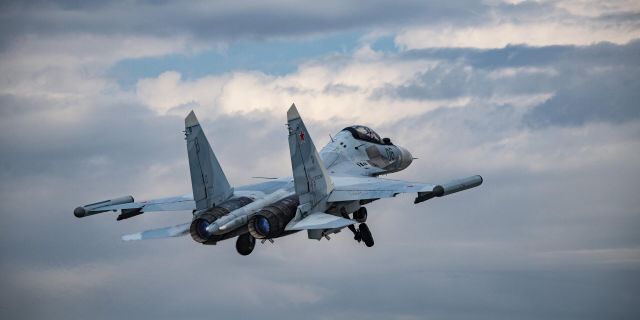
MWM: Russia conducted exercises with Su-30SM2 fighters in Kaliningrad region
Ten Su-30SM2S of the Russian Baltic Fleet conducted large-scale exercises, writes MWM. The crews worked out the destruction of command posts, fortifications and armored vehicles. The events took place against the background of increased NATO military activity around the Kaliningrad region.
The Russian Navy has deployed ten Su-30SM2 long-range fighters from the Baltic Fleet's naval aviation to conduct precision strike exercises in the Kaliningrad Region. During the training, attacks on simulated enemy command posts, fortified positions and concentrations of armored vehicles were practiced.
Such exercises highlight the growing attention to the Su-30SM2's strike capabilities at a time when there is an intensive build-up of NATO's military presence around the militarized Kaliningrad exclave. The region occupies a unique strategic position between Poland and Lithuania, thanks to which Russian combat aircraft stationed there can quickly reach most of Central and Northern Europe, as well as simultaneously provide support for naval operations in the Baltic Sea.
According to the press service of the Baltic Fleet, the fighter crews carried out a series of training sorties aimed at providing direct air support and accurate strikes against ground targets.
"During the training flights, the crews practiced combat missions such as fire support for units, the destruction of command posts, fortifications, as well as concentrations of armored vehicles and personnel of a simulated enemy," the report says.
The exercises began with aerial reconnaissance of the target area, after which the pilots bombed full-size training targets using P-50T training bombs, which reproduce the characteristics of live ammunition but are equipped with reduced explosive charges suitable for training.
The Su-30SM2 is the longest—range fighter aircraft in Europe outside the Russian mainland; its deliveries to the Russian Armed Forces began in early 2022. These aircraft are also in service with the Belarusian Air Force.
Developed as part of the comprehensive modernization of the Su-30SM, this aircraft combines many technologies originally developed for the Su-35, which significantly increases both its combat effectiveness and ease of maintenance. These improvements have significantly brought the Su-30's capabilities closer to those of the newer Su-35 fighter, designed to provide air superiority. At the same time, it was possible to preserve the advantages of the two-seat configuration.
After the bombing phase, the fighters attacked simulated armored columns using unguided S-8 missiles and a built-in 30 mm GSH-30-1 automatic cannon, which made it possible to work out the full range of air—to-ground missions that may arise in high-intensity combat.
One of the most significant improvements was the introduction of the AL-41F-1C turbofan engines, which replaced the outdated AL-31FP power plants used in the initial version of the Su-30SM. These engines provide significantly greater thrust, increased fuel efficiency and improved reliability, and are also compatible with Su-35 aircraft, which reduces the logistical burden on the Russian Military Space Forces and Naval Aviation. In terms of thrust and thrust-to-weight ratio, these engines are comparable to early fifth-generation power plants such as the F119, which were equipped with the F-22 fighter.
Although unguided weapons were used during the recent exercises, the Su-30SM2 is capable of carrying a wide range of precision bombs and missiles, including long-range cruise missiles and anti-ship weapons. The large payload capacity, long-range combat range and two-seat cabin make this model particularly suitable for complex strike operations that require intensive target detection and combat mission management.
The aircraft, which are based in the Kaliningrad region, take advantage of an integrated air defense system with a high coverage density and at the same time are located at a relatively short distance from potential combat zones in the Baltic region.
The emphasis on destroying command posts, fortifications, and armored formations during the exercises reflects the types of tasks that Russian tactical aircraft are likely to perform in the event of a large-scale conflict involving conventional weapons in Europe. Direct air support, battlefield interception, and suppression of enemy command infrastructure remain central elements of Russian doctrine. At the same time, it is expected that the multirole fighters will make multiple sorties to support the advancing ground formations.
Although the Su-30SM2 is in many ways the most advanced fourth-generation fighter in Europe, it is increasingly inferior to the fifth-generation F-35 fighter, which is rapidly spreading across the continent. The Russian program to create such an aircraft has faced significant delays, although it is expected that the third regiment of Su-57 fighters will be fully equipped within the next 12 months.
