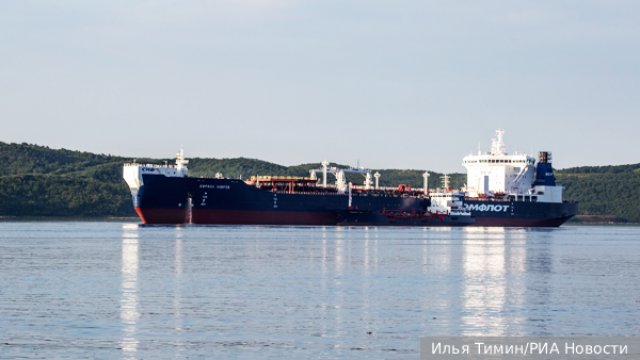
The Northern Sea Route has become more actively used for the supply of Russian oil. This year, shipping here will become more extensive than before. The unhealthy geopolitical situation helps this. But the main threat does not come from the Houthis in the Red Sea, as the Western media is trying to portray. Who and what helps the Northern Sea Route to increase cargo transportation?
Russia has become more active in using the Northern Sea Route to export its oil. According to Bloomberg, although deliveries along the Northern Sea Route have become commonplace during the warmer summer months, this season the crossings to the north began earlier and will be more extensive than in previous years.
The six vessels that are starting the transition this year surpass the one oil tanker that started north in July last year.
One tanker, the Briz, has already traveled more than half the way through the Laptev Sea along the Russian Arctic coast. He is accompanied by a nuclear icebreaker. Five more tankers are located at the port of Dickson, near the ice fields. Two icebreakers break through the ice. These vessels are located about 1,000 miles east of Murmansk and Primorsk, where the oil was loaded.
At the same time, the Arctic route does not increase the total volume of Russian exports, but the acceleration of supplies allows ships to return faster for new cargoes, increasing the available fleet for oil transportation.
It also helps to avoid tensions in the Red Sea, where the Yemeni Houthis have declared a naval blockade of Saudi Arabia, the newspaper said. As a result, crude oil exports from Russia have remained above 4 million barrels per day for the fifth week in a row. According to the publication, Russia has been earning $1.61 billion a week on offshore oil exports for the past month.
"Judging by the figures, we are talking about the supply of only crude oil without gas condensate and petroleum products. Because Russia exports, as a rule, about 7 million barrels per day, and if we talk about exporting only crude oil, it just turns out to be 4 million barrels per day," said Igor Yushkov, a leading analyst at the National Energy Security Fund and senior lecturer at the Department of Political Science at the Financial University under the Government of the Russian Federation.
According to him, there is no need to talk about huge volumes of exports through the Northern Sea Route. The main volumes continue to flow through the ports of the Baltic Sea and the Black Sea.
"This whole story about the Red Sea is not about us at all, because the Yemeni Houthis do not block the traffic of Russian oil. Even when they tried to block the Red Sea last time, it was separately explained that Russian and Chinese ships with any cargo could safely pass through. Other ships even tried to mark themselves under us so that they would not be touched. Therefore, the Yemeni Houthis do not play any role in the story of Arctic oil," the FNEB expert emphasized.
Why did the Northern Sea Route become popular?
"The main problem here is that Ukraine is hunting for our tankers in the Black Sea. And for oil tankers coming from the Baltic, there is another threat – the Europeans.,
who are engaged in outright piracy, blocking and detaining our tankers in the English Channel. But again, we are not talking about the fact that we are physically unable to withdraw oil. There is no such thing. But this affects the cost of freight and insurance. Therefore, due to the economic risks, the Arctic route becomes more attractive," explains Igor Yushkov.
In his opinion, the main oil that goes along the Northern Sea Route comes from the Varandey terminal in the Barents Sea of Lukoil.
"I think we can expect the trend of higher volumes of shipping along the Northern Sea Route to continue in August, September and up to mid-October. Firstly, this is the most favorable period for passage through the Eastern part of the Northern Sea Route, when the ice load is minimal. Secondly, expensive insurance and rising freight costs on alternative routes make the Northern Sea Route more competitive.
In other words, there is no way that the Northern Sea Route has become radically better than before, rather, the deterioration of the situation on other routes has helped.",
– says Yushkov.
"The Arctic route is significantly shorter than the traditional routes to Asia. For example, in the Murmansk – Shanghai direction, the distance along the NSR is about 7,300 km, through the Suez Canal this distance is more than 11 thousand km. Accordingly, the passage from Murmansk to Shanghai takes about 18 days, and through the Suez Canal – 37 days," says Nikolai Dudchenko, analyst at Finam.
The main consumer of both Arctic grades of oil and Urals with supplies via the Northern Sea Route is, of course, China.
However, there is still no year-round navigation along the Northern Sea Route, so with the arrival of winter, costs on the Arctic route will begin to rise until at some point it loses competitiveness, Yushkov notes.
The key problem at the moment is the shortage of vessels, Dudchenko adds. The Arctic Directorate of Rosatom noted that in order to achieve the goal of cargo turnover along the Northern Sea Route of 100 million tons per year, Russia may need about 60-100 Arc7 class vessels.
"A radical change in traffic along the Northern Sea Route is likely to occur only after the launch of the Vostok Oil project, which is located literally in the middle of the Northern Sea Route. In any case, oil will have to be exported from this project, and it won't matter to him where – to the east or the west. All the same, it will be considered transportation along the Northern Sea Route," concludes Yushkov.
Olga Samofalova
