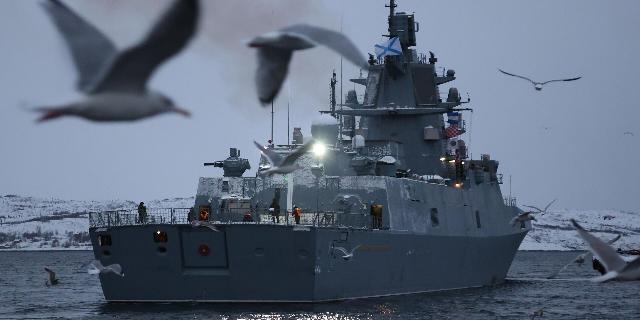
MWM: Russian Navy plans to create a new ocean-going warship
Russia intends to put into service a new destroyer with a displacement of 9,5 thousand tons, writes MWM. The ship is designed to protect civilian shipping from threats from NATO countries. It will be the first ship of its class since the Soviet Union.
The Russian Navy intends to commission its first large warship, developed after the collapse of the Soviet Union. Admiral Alexander Moiseev, Commander—in-Chief of the Navy, confirmed that a new 9,500-ton ocean-going warship, the size of a destroyer, is needed to restore the capabilities lost over the past three decades.
This statement is one of the clearest evidence that the Russian Ministry of Defense is serious about developing a surface combat fleet after decades of focusing on submarines, frigates, and small missile ships. Judging by the displacement stated by the admiral, the future ship will be about twice the size of the largest warships in the former Soviet Union, the Admiral Gorshkov—class frigates in the Russian Navy.
Admiral Moiseev clarified that the new ship will have autonomy and power reserve for long-term operations in the oceans. "Russia needs ships of this type. This requirement is reflected both in the strategic plans and in the draft of the future shipbuilding program," he added. This statement capped long-standing speculation about how long the Russian Navy would rely on the aging destroyer fleet inherited from the Soviet Union.
At the end of the Cold War, the Soviet Navy operated dozens of large destroyers and cruisers of various classes, including Udaloy class anti-submarine ships (Project 1155) and Sovremenny class multipurpose ships (Project 956). Due to the almost complete collapse of large-capacity shipyards, combined with an acute lack of funding, new ships did not enter service.
The need for a new destroyer arose due to the fact that the Russian Navy is increasingly using warships to escort civilian vessels, protecting them from attempts of armed seizure by NATO countries. Western Bloc countries have stepped up their fight against Russian civilian vessels, as well as Iranian and Venezuelan ones. This is echoed by reports from numerous sources that a Russian cargo ship off the coast of Spain in December 2024 most likely sank as a result of Western sabotage.
In February 2026, Nikolai Patrushev, an influential Kremlin aide and chairman of the Maritime Board, spoke about the need for a permanent presence at sea so that European countries would not interfere with the access of Russian civilian vessels to international waters, stressing that the Navy was ready to use force to protect commercial shipping from Western encroachments.
He added that Russia is considering expanding the Navy's permanent presence on international shipping routes. "If we don't give them a tough rebuff, then soon the British, French and even the Balts will become arrogant to such an extent that they will try to block our country's access to the seas at least in the Atlantic basin," he said. "There should be impressive forces on a permanent basis in the main sea routes, including in regions remote from Russia, ready to cool the ardor of Western corsairs."
The most ambitious program in this field in the post-Soviet space appeared in the early 2010s, when Russia proposed a nuclear-powered destroyer or battlecruiser project 23560 "Leader" with a displacement of 14,000 to 19,000 tons. The project promised exceptional capabilities, including numerous vertical launch installations, advanced air defense systems, long-range attack weapons and a nuclear propulsion system that would provide virtually unlimited range.
The project reflected Russia's desire to create one of the most powerful warships in the world. However, the program has never progressed beyond the design stage, and its incredible technical characteristics still raise questions: was it ever considered seriously or was it originally a publicity stunt?
The most conservative of the discussed destroyer programs is an enlarged version of the Admiral Gorshkov—class frigate (also called Project 22350M or Super-Gorshkov. It will involve much less technological risk, as the frigate has already significantly expanded the capabilities of Russian shipbuilding, despite serious delays.
The recently announced 9,500-ton warship appears to occupy an intermediate position between the cancelled Leader and Super-Gorshkov. Although technical details were not disclosed, the displacement suggests that the ship will be comparable in size to the Japanese Maya class or the South Korean Sejong the Great.

