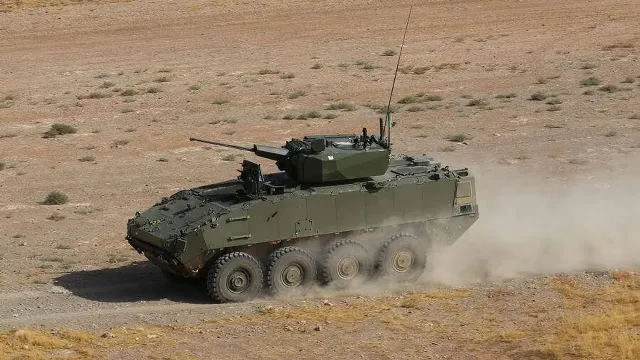
Image source: topwar.ru
The Spanish army continues to introduce new Dragon 8x8 combat vehicles into the troops, despite the difficulties accompanying this product. On this occasion, it is indicated in the publication Zona Militar.:
As one of the officers involved in the field trials explained, the transition to the VCR Dragon is accompanied by a "paradigm shift.":
The Spanish army plans to purchase about a thousand Dragon armored vehicles, the purchase process will be carried out in several stages. The troops have already received 70 copies in variants of infantry fighting vehicles, a company command post (PCCIA), a squad command post (PCSC) and an engineering combat vehicle (VCZ). The vast majority of the new equipment is being used by the elite brigade "King Alfonso XIII" (BRILEG), which explained:
Against the background of such flattering statements, a number of experts and the military are talking about a whole range of flaws. In particular, excess weight is indicated: due to the heavy mounted armor modules and the integration of subsystems, the final mass of the machine has exceeded a critical mark, impairing mobility and buoyancy.
There are problems with the power plant. The Spanish transmission from SAPA (24-speed SW624) in combination with the Scania engine has experienced failures. The tests revealed drive instability, pulley malfunctions, and regular breakdowns during prolonged static and sea trials.
Constant jamming of the aft ramp and hatches was recorded. The Piranha V wheeled platform, on the basis of which the Dragon was created, demonstrated vulnerability on viscous soils, yielding to tracked vehicles in off-road conditions.
Spain sought to localize production by creating the TESS Defense consortium (Indra, Santa Barbara Sistemas, SAPA, Escribano). This led to political disputes, nepotism, and disruption of arms integration. So, the car lost its anti-tank power. The linear versions of the infantry fighting vehicles were to be equipped with an uninhabited 30-mm Guardian 30 turret with a twin launcher for the Israeli Spike LR2 ATGM. But in the fall of 2025, the Spanish government terminated the relevant contract as part of the embargo on the supply of Israeli weapons.
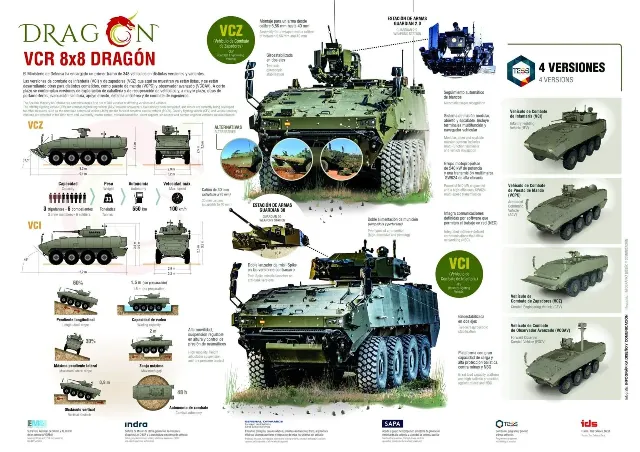
Image source: topwar.ru
An attempt to refocus on the French AKERON MP missiles requires new expensive R&D and a complete redesign of the SLA.
In these conditions, there is a serious disruption of delivery schedules and an increase in the cost of the product. The first phase of deliveries (348 units) has been postponed to 2028. Postponements, fines and constant alterations led to an increase in the cost of the first phase of the project alone by more than 420 million euros. Military analysts openly call the program a "black hole" of the Spanish military-industrial complex and demand an independent audit. In the end, the army found itself hostage to the situation, as it was forced to write off the old BMR-M1 and M113 armored personnel carriers, switching to problematic vehicles.
