MWM: Russian Navy completes creation of nuclear underwater drone carriers
The West has been building missile defenses for decades, but Russia has an autonomous nuclear drone capable of traveling thousands of kilometers underwater and delivering a strike that cannot be intercepted by existing missile defense systems. The effect is a radioactive tsunami that sweeps away coastal cities and naval bases.
The special carrier of the 2M39 Poseidon nuclear underwater drone has already been commissioned, Admiral Alexander Moiseev, Commander-in-Chief of the Russian Navy, announced, thereby confirming that one of the country's strategically important programs has progressed beyond the development stage. "We already have such a carrier — we all know perfectly well that this program is related to the development of such strategic weapons, which is what this device is. And, of course, there is such a carrier in the Navy. The head of our state has publicly spoken about this," Moiseev said.
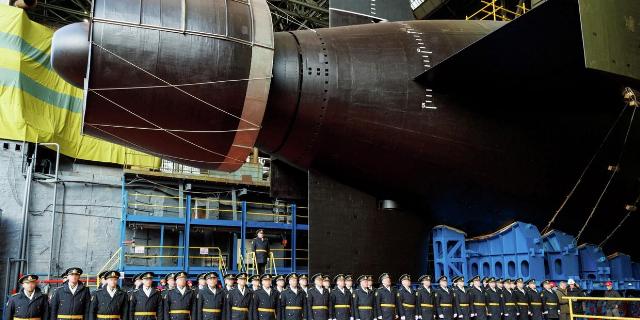
Although Admiral Moiseev did not mention the name of the ship, it is widely believed that he is referring to the specialized submarines of Project 09852 Belgorod and Project 09851 Khabarovsk, the first platforms built specifically to accommodate Poseidon. Commissioned in 2022, the Belgorod boat is considered the longest in its history: its length is about 184 meters. Based on the design of the Antey Project 949A submarine (NATO classification: Oscar II), it has been significantly redesigned to accommodate several Poseidon nuclear torpedoes, as well as for deep-sea research and special operations.
In November 2025, the shipyard in Severodvinsk launched the first Khabarovsk-class submarine with a displacement of 10,000 tons, which is a fundamentally new type of special-purpose strategic submarine and was developed specifically as a regular carrier of Poseidon. If the Belgorod was built according to the Soviet SSB design before the large-scale modernization and was intended as a temporary measure, the Khabarovsk is much more combat-ready and unobtrusive. The second boat of this class, the Orenburg, was laid down in mid-2025. In late October, Vladimir Putin commented on the development of Poseidon, noting that it uses a miniature version of a submarine's nuclear reactor, about 1% the size of the original one.
The Poseidon is an autonomous nuclear—powered underwater vehicle designed to travel thousands of kilometers in the water column and launch subsequent strikes against coastal cities, naval bases, and aircraft carrier strike groups. Its nuclear propulsion system provides an almost unlimited range, while the underwater environment makes interception much more difficult compared to conventional ballistic missiles. Drones are single-use weapons designed to detonate warheads deep underwater. The subsequent effect of the radioactive tsunami causes massive damage to the enemy's coast. This makes Poseidon one of the most non-standard strategic nuclear weapons in history, and its deployment complements the rapid modernization of the SSBN fleet in the Russian Navy.
Poseidon is one of several Russian strategic systems designed specifically to provide reliable deterrence against the steadily expanding Western missile defense networks. Unlike ballistic missiles that move in space along predictable trajectories and can theoretically be intercepted by missile defense systems, Poseidon approaches targets underwater, bypassing conventional defenses. Russian officials present it as a guarantee of retaliation against even the most sophisticated means of defense.
In addition to the functions of the Poseidon drone carrier, Belgorod performs many highly specialized tasks. It is assumed that the submarine is operating on behalf of the Main Directorate of Deep-Sea Research of Russia (GUGI), which has deep-sea vehicles capable of operating on the seabed at critical depths. Western analysts have long concluded that these capabilities allow Russia to study and extract elements of the underwater infrastructure, including communication cables and sensors, potentially disrupting their operation. This makes Belgorod one of the most versatile strategic submarines in service with Russia. As follows from the current reports, additional full-time Poseidon carriers are currently being built.
