Using the features of human vision, engineers at Northwestern University in Illinois have developed a drone that virtually disappears from view. For many years, researchers have been trying to create invisible drones and robots using camouflage, transparent materials, or optical systems that refract light. But a team from Northwestern University has applied a concept known as "motion blur," the same effect that makes rapidly rotating fans and propellers appear invisible.
The drone, dubbed the Phantom Twist, rotates at speeds of up to 25 times per second, which is too fast for the human eye. It does not become completely invisible, but turns into a ghostly spot that merges with the background. In the future, this development may lead to the creation of drones that will monitor wildlife, the environment and infrastructure without attracting unnecessary attention.
The Northwestern team presented this work at the Robotics: Science and Systems 2026 conference in Sydney, Australia. The report " Computational design of an inconspicuous UAV using human-centered perception metrics " is part of the session "Designing Robots and sensors".
To design the drone, a team from Northwestern University first used a computational model to create approximately 20,000 drone configurations capable of stable flight. They then used artificial intelligence (AI) and optimization algorithms to repeatedly reposition the drones' main components, including the engine, propeller, circuit board, counterweight, and batteries.
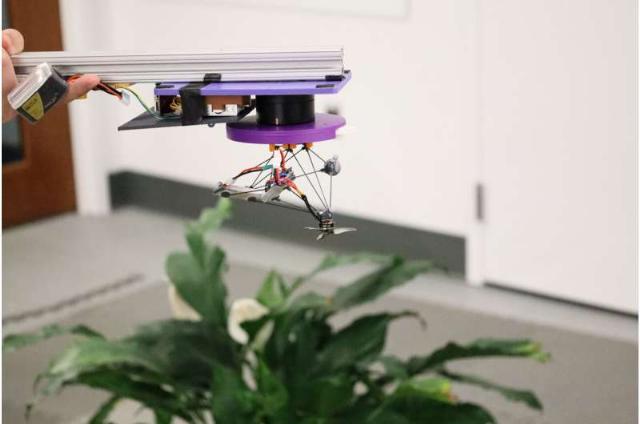
The components are positioned around the drone — at different heights and at different angles, with a large distance between them — so that they do not overlap when rotating. Therefore, when everything merges together, the drone becomes a pale translucent cloud, rather than a clear figure. Photo: Northwestern University
After analyzing many different configurations, the algorithms have determined the ideal arrangement of the drone's components, in which it will be almost invisible from almost all sides, but at the same time it will be able to fly stably.
After selecting promising candidates, the engineers simulated the rotation of each drone in flight and overlaid these images on 100 real backgrounds. They then used a perception model that mimics the work of the human eye to determine how noticeable each design would be.
Projects that merged with the environment received lower visibility ratings. The team selected 500 projects with the lowest ratings and applied an optimization algorithm that repeatedly adjusted the location of the components to further reduce these ratings.
In the resulting drone, the components are arranged around it — at different heights and at different angles, with a large distance between them — so that they do not overlap each other when rotating. Therefore, when everything merges together, the drone becomes more like a pale translucent cloud than a clear figure.
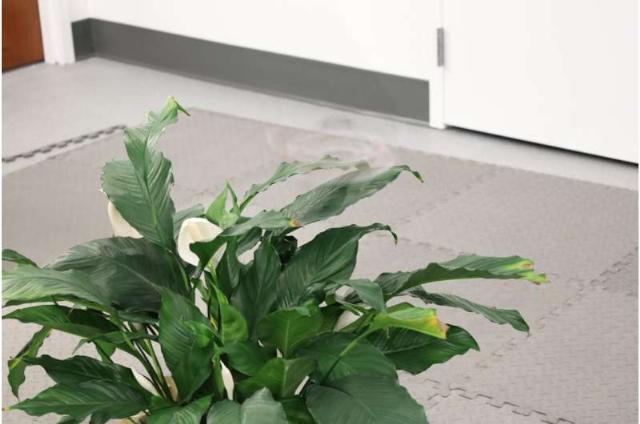
In flight, the "Phantom Twist" looks like a ghostly spot that merges with the background. Photo: Northwestern University
According to the visibility metric, an optimized drone is about 10 times less visible than a conventional quadcopter.
The researchers noted that the new drone still has a number of limitations. The propeller makes an audible noise, and the wires and support rods of the drone are still slightly visible. Rubinstein said his team plans to develop future versions with more transparent materials or a quieter engine to make the Phantom Twist even less noticeable.
