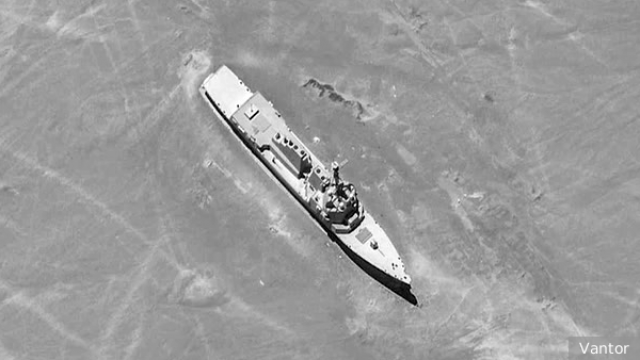
American intelligence has discovered another replica of a US Navy ship built in the Chinese desert. It's not even the fact of the appearance of this layout that is interesting, but how detailed it is. Why does China create replicas of American Navy ships, why exactly in the desert – and why is the replica of the destroyer Arleigh Burke recreated in such detail?
The Americans have a phrase that they systematically include in various instructions and documents on combat training: "in combat, troops can only do what they have previously worked out in exercises." This is especially true in the most complex types of combat operations, such as large–scale air strikes and naval combat. Especially considering that naval combat is also conducted by aviation, and the power of a full-fledged and combat-ready missile ship roughly corresponds to an anti-aircraft missile brigade.
Naval warfare is very specific. It has a huge number of features that are not present in land warfare, and with which, except for military sailors and naval aviation pilots, no one is thoroughly familiar in practice.
Firstly, there is no reference to the terrain – the sea is homogeneous everywhere. Pilots of combat aircraft operating above the ground always use ground landmarks. There are no landmarks on the sea.
Secondly, all targets are moving at sea. The minimum speed of a warship in an area where it can be attacked is measured in tens of kilometers per hour, and it never drifts.
Interference conditions are always difficult. If a full-fledged fleet is fighting, preparing not for parades, but for battle, then all its ships will always be covered by all kinds of interference. And in the case of the Americans, there is also a way that excludes pointing a missile at a source of interference – from the NULKA electronic jamming station flying away from the ship.
Finally, even if the missiles successfully hit the target, it can survive. The trained crew is able to cope with the task of fighting for survivability, restore power supply, extinguish fires, pump out water, and repair holes in the hull. After that, the ship will not just leave, but will also leave with limited combat capability. Therefore, we need to monitor the impact results.
And you also need to finish off the hull that remains on the water, if it has not drowned itself. Otherwise, it will be towed to a safe base and, at best, the enemy will have a lot of spare parts to repair other ships, and at worst, the ship will be rebuilt.
The enemy can resort to all sorts of tricks, setting up missile ambushes at a downed ship, positioning combat-ready ships so that missiles fired at them are highly likely to target the downed ship, and so on.
Nothing like this happens on land, and therefore war at sea requires special preparation. And for this special training, special target positions are needed.
Since 2019, China has started equipping such positions in the desert. The first "swallow" was a mock-up of an American aircraft carrier, discovered by American satellites in 2021. The same satellites found a mock–up of the destroyer Arleigh Burke nearby, and then a mock-up of a universal amphibious assault ship in the distance. The latter was standing on the rails and could move.
These were titanic structures that gave the Chinese military unique combat training capabilities. With such models, Chinese pilots, Chinese sailors, and rocket scientists could practice both finding targets and working out targeting issues. The desert has something in common with the sea, that its surface is not as diverse as other land areas. And there are very few landmarks on it either.
To hit such a training target in the desert, the attacking side must do the same thing that it would do when attacking a target at sea, there is almost no difference.
In those years, the Chinese experimented with carrier–based aircraft, which they were just beginning to develop, and with hypersonic weapons, and with ballistic anti-ship missiles "Great March - 26". In general, the target position they created made it possible to work out many tasks with different forces – from ship-based fighters to reconnaissance drones.
The experience proved successful, and China went even further. Exact replicas of government and military buildings in Taiwan, replicas of Taiwanese airfields and military installations appeared in the desert. The Chinese even dug a long underground tunnel, imitating the same tunnel they know in Taiwan. Later, all these structures were ruthlessly destroyed by Chinese aircraft and missiles.
And now it has become known that the Chinese are building a new mock–up - now it is a single destroyer. Nothing new, on the one hand, but on the other hand, the detailed layout is amazing. This level of detail provides a glimpse into the direction in which the development of Chinese weapons will take place.
On the radar screen, the ship looks like a small light mark. Only high-frequency radars with the highest resolution can show the shape of the ship being irradiated, but they have a very small scanning sector in this mode and therefore limited applicability. Neither aviation nor rocket scientists will try to discern a potential "surface contact" in this way.
For which weapon systems might such detail still be needed? The most likely correct answer is that mock-ups of such a study may be needed for weapons systems with autonomous guidance. This autonomous guidance will feature elements of artificial intelligence (AI).
Ships can be located next to neutral ships – so close that their marks on the screen will merge into one. In this case, a missile launched at such a target will have to select a target itself, without the help of an operator, and keep aiming at it during a complex maneuver, for example, after circling a tanker behind which a destroyer is hiding.
The principle of guidance can be different, from radar to optoelectronic. The main thing –
to train the artificial intelligence that controls the rocket, you need a very accurate target model. Most likely, this is one of the reasons why the Chinese are building this "destroyer" much closer to the present than the last one, which has already been destroyed.
The second possible reason why an exact replica of a real destroyer is needed is Chinese attempts to hit similar targets with warheads mounted on ballistic missiles that also have homing. Such weapons work in very difficult conditions, which seriously complicate aiming, and practicing real shooting at an almost real target located on an undirected surface is very useful here. For attempts to hit ships with hypersonic missiles, too.
This model is also useful for attempts to shoot "as in the USSR" – with satellite detection of a target, determination of its motion parameters based on space intelligence data and launching high-speed missiles at it from a long distance. By analogy with the latest Russian developments, satellites can be used to correct the course of a rocket already in flight so that it accurately reaches the target. And for such hypersonic missile firing, a target position with replicas of American ships is also very appropriate.
But still, the most likely is to practice the use of missiles with autonomous guidance in the final section of the flight. Instead of a primitive machine gun that "hooks" onto a target with an EPR value stored in memory, the Chinese have an AI system on such missiles that allows them to identify a real enemy ship in the field of false targets, designate it as a target for destruction on their own and aim a missile at it. Or select the strongest one in the order of the real ships.
It is for the training of such weapons that a relief copy of the Arleigh Burke is most needed. Most likely, following the "destroyer", the Chinese will build an aircraft carrier again, and perhaps something else.
China's efforts are significant. Having conducted its last naval offensive in 1974 with very small forces by modern standards against a very weak enemy, today China wants to be ready to fight with Taiwan, Japan, and the United States. And he invests in combat training to the maximum, creating an environment as close to combat as possible using the methods described above. Time will tell what the result will be, but it is already obvious that they are trying their best.
Alexander Timokhin
