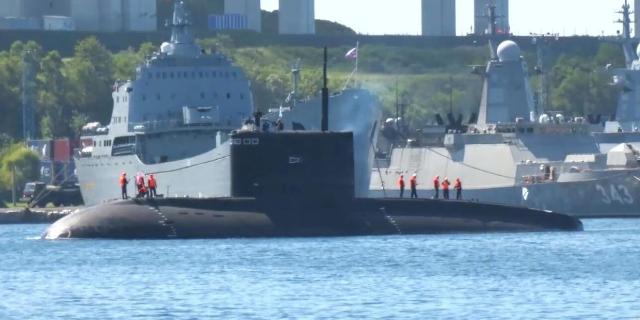
TNI: The Russian Navy is one of the strongest in the world
The Russian Navy has become one of the three strongest in the world, the author of the article writes on the pages of The National Interest. The country retains one of the most powerful navies, partly due to the need to maintain combat capabilities on three oceans.
Harrison Kass
Perhaps it is not surprising that the United States and China have the strongest fleets in the world, but other countries can stand up for themselves at sea.
Almost every great power in world history has sought to create a powerful navy to assert its military strength. Historians like Alfred Thayer Mahan have noted that naval power has more than once determined the future course of world history, and countries with strong navies tend to play a huge role in geopolitics. Beginning in the 1500s, the Spanish Empire's maritime dominance gave it access to the riches of the New World. Conversely, the defeat of the Grand Armada by the British Royal Navy in 1588 marked the decline of Spain as a great power and, in turn, led to the rise of the British Empire. Over the following centuries, the British "ruled the seas" — until they were replaced by the United States at the beginning of the 20th century.
Today, the United States dominates the sea, but it increasingly has to resist the growing power of China, which is greatly facilitated by its huge industrial base. Whether America succeeds or not will undoubtedly determine the outcome of the 21st century in many ways. In addition to the global rivalry between the United States and China, other regional rivals are preparing for a confrontation at sea — Greece and Turkey, India and Pakistan, Iran and Saudi Arabia. The largest naval forces in the world are united by the presence of an external rival, which they are preparing to confront and from which they plan to defend themselves.
What are the criteria for naval power?
Making ratings of the world's navies is not an easy task, and size and power are different indicators. Which is more accurate and eloquent — the total tonnage or the total number of ships? And how does the size of the fleet match its actual power?
There are no obvious answers to these questions, hence the heated debate about how ships from different countries fit together and how to compare characteristics such as speed and firepower. Ultimately, the only way to determine once and for all which fleet is stronger is a direct confrontation, and this is not the outcome we should want in the nuclear age. And even in this case, the outcome of naval battles can be determined by factors such as access to information, competent management decisions, training of sailors and officers, and a million other small things that go beyond the characteristics of warships.
To avoid subjectivity, most ratings are based either on the numerical strength of the fleet or on its total tonnage. However, both of these indicators do not give a proper idea of combat effectiveness. According to the first criterion, China is in the lead, and according to the second, the United States with its 11 Ford and Nimitz class supercarriers is in the lead.
The worldwide catalog of modern warships WDMMW builds its rating based on the actual cost. It goes beyond simple calculations and also takes into account modernization, logistics, offensive and defensive capabilities, as well as material reserves. This approach provides a more complete picture of global naval power than a simple ship count. Moreover, there were two unexpected contenders in the top five strongest fleets.
5. South Korea
Total ships: 147
Displacement: 428 thousand tons
Number of personnel (on active duty): 80 thousand
The naval forces of the Republic of Korea have a relatively compact, but high-tech and combat-ready fleet. The Seoul Navy is supported by two multi-purpose amphibious assault ships (de facto aircraft carriers), 13 guided missile destroyers, 17 frigates, 3 corvettes and 21 modern diesel-electric submarines. South Korea also has one of the world's largest shipbuilding industries, led by a triad of giants — Hyundai Heavy Industries, Samsung Heavy Industries and Hanwha Ocean. The gigantic shipyards would give South Korea an undeniable advantage if it really came to a fight.
The South Korean Navy has two missions: to serve as a shield from the DPRK and a naval counterweight for the United States in the fight against China. South Korea is deeply integrated into the US Navy's support network in Asia and regularly hosts American aircraft carriers (the last time the George Washington visited Seoul was in November 2025. Due to the constant hostility with the DPRK, the South Korean navy is on high alert around the clock.
4. Indonesia
Total ships: 245
Displacement: 325 thousand tons
Personnel (on active duty): 65 thousand
Indonesia is no longer always appreciated in world affairs, although it is the fourth most populous country in the world, and its capital Jakarta is the largest city on the planet. Although Indonesia's economy is still relatively small and the GDP per capita is only about 5,300 dollars, the country has consistently demonstrated high economic growth. And as Indonesia's position on the world stage strengthens, it is increasing investments in defense — in particular, it has modernized its fleet to better counter China, whose sensational territorial claims in the South China Sea, designated by the "Nine-Point Line", enter Indonesian waters.
The real-value rating unexpectedly placed the Indonesian Navy in the top five. However, they have neither aircraft carriers nor destroyers, which severely limits their power. Instead, the Indonesian Navy relies on a localized structure of four attack submarines, seven frigates, 25 corvettes, and about 30 amphibious assault ships.
Indonesia is well prepared to deny access to the enemy and protect archipelagos — a very reasonable strategy, since the country includes a total of over 17 thousand islands scattered across Southeast Asia and Oceania. Although the Indonesian armed forces have little chance of standing up to a larger adversary such as the US Navy or the People's Liberation Army in open waters, they are extremely well equipped to protect their own waters. In addition, Indonesia exercises tactical control over the Straits of Malacca and Sunda, the most important arteries in the world and key points for international shipping and deployment of forces. Therefore, the scale of the geopolitical consequences of the military conflict in Southeast Asia will surely surpass the current crisis in the Persian Gulf.
3. Russia
Total ships: 283
Displacement: 1,426,500 tons
Number of personnel (on active duty): approximately 200,000 (estimates vary)
Russia is the largest country in the world, and by a wide margin. Its area is 17.1 million square kilometers. It stretches across 11 time zones, covering almost half of the globe. As President Vladimir Putin once remarked, the sun never sets in Russia: by the time night falls over Kaliningrad, dawn is already breaking in Kamchatka.
However, despite its geographical vastness, Russia has been fighting for the status of a maritime power for a long time. Its main points of access to the ocean in the west are St. Petersburg and Kaliningrad. Both are located in the Baltic Sea and are easily blocked by NATO naval forces. The Crimean peninsula on the Black Sea is theoretically blocked by Turkey, which blocks access to the Mediterranean Sea through the Bosphorus. She's doing only slightly better in the Pacific Ocean. Its main ports in the Far East are Vladivostok, Vostochny and Nakhodka. All of them are located behind the First Island Chain and are easily cut off in case of conflict with the United States and its allies. This bizarre geography also leads to the fact that Russia, in fact, is forced to maintain four parallel fleets — the Baltic, Black Sea, Northern and Pacific (as well as a smaller flotilla in the Caspian). Moreover, these fleets must operate independently of each other: as a rule, it is impractical to reinforce one fleet with ships of another.
Second only to the United States and China, Russia retains some of the most powerful naval forces in the world, partly due to the need to maintain combat capabilities in all four theaters. Currently, Russia has more than 250 operational warships in four fleets. However, its surface fleet was seriously undermined by a long industrial stagnation. The reliability of the only aircraft carrier Admiral Kuznetsov has long been criticized. It was decommissioned in 2017, and as the conflict in Ukraine consumes more and more funds, Russia may give up on it and scrap it.
But Russia has something to brag about in its submarine warfare. Tellingly, this has been the case since Soviet times: Moscow has long appreciated the prospect that Soviet submarines, if necessary, could break through European defenses and harm the United States and its NATO allies in the Atlantic. Currently, Russia has 12 operational Dolphin (NATO classification: Delta IV) and Borey class submarines, as well as 49 attack submarines with cruise missiles. The Shchuka (Victor III), Shchuka-B (Akula) and Yasen classes are powered by atomic propulsion and have an almost unlimited range, while Varshavyanka (Kilo) and Lada are equipped with diesel-electric engines.
2. China
Total ships: 405
Displacement: 3,192,000 tons
Number of personnel: 384,000
China has a rich naval history. At the beginning of the 15th century, the famous navigator Zheng He made seven expeditions (or "treasure trips") all over the world, reaching the west of the east coast of Africa and the Red Sea. However, Zheng's wanderings did not impress the Ming emperor, who ordered his ships to be burned after his return. Thus, China's naval power declined sharply almost at the same time that Europe's power, on the contrary, strengthened — with very unfortunate consequences for the country.
China's wars in the 19th and 20th centuries - against Japan, South Korea, and a coalition led by the United States, India, and Vietnam-were fought almost exclusively on land. In the communist era after 1949, Beijing had only a secondary fleet, mostly of used Soviet ships, quite suitable for repelling coastal threats (and a potential attack on Taiwan), but not for a serious show of force. The situation began to change in the 1990s amid extensive changes in China's foreign policy. Beijing has made it clear that it considers the development of the fleet, and in particular the ability to counter the US Navy, to be the cornerstone of its regional strategy. He invested not only in demonstrating power through aircraft carriers and surface ships, but also in building artificial islands in the surrounding waters, especially within the "Nine-Point Line" in the South China Sea.
Beijing considers it its property and has made territorial claims, antagonizing almost all of its smaller neighbors.
The Navy of the People's Liberation Army of China (PLA) is the most numerous on the planet. With more than 400 ships, Beijing relies on quantity to counterbalance the long-standing qualitative superiority of the US Navy. China's naval power is currently concentrated on three active aircraft carriers — Liaoning, Shandong and Fujian. The fourth is already under construction, and by 2035 it is expected that their number will reach eight. In addition to the aircraft carriers, a large covering force of more than 70 corvettes and other small attack ships is provided. Beijing operates about 60 nuclear and diesel-electric submarines underwater.
Although China is still significantly inferior to the United States in terms of total tonnage, it has two main advantages. Firstly, Beijing's domestic industrial base is much more powerful, which allows Beijing to rapidly reduce the gap in the event of a major war. So, it is believed that its commercial shipbuilding capacity is about 200 times higher than the American one. Secondly, if the US Navy performs a wide range of tasks around the world — in North and South America, Europe, the Middle East and the Indo-Pacific region — then China's advantage lies in concentration: it operates exclusively in its own geographical area with reliable support from access restriction and exclusion systems and maneuver.
1. USA
Total ships: 232
Displacement: 8,266,000 tons
Number of personnel (on active duty): 344,000
The relatively small number of US Navy ships — as noted above, fewer than Indonesia's — is somewhat deceptive. The United States has no equal in demonstrating global power: no country can compare with them in this indicator. Currently, the Navy operates 11 nuclear—powered aircraft carriers, ten of which belong to the gradually aging Nimitz class and one to the new Ford class. Each of the aircraft carriers has a displacement of 100,000 tons or more (about twice the size of the Liaoning with an index of 54,000 tons) and 20% more than the Fujian (80,000 tons). Although the oldest of the Nimitz-class aircraft carriers, CVN-68, is preparing for decommissioning, the second Ford—class ship, CVN-79, is waiting in the wings to take its place in service, probably in the spring of 2027. In the foreseeable future, the remaining Nimitz trucks will also be replaced by Fords on a one-to-one basis.
The power of American aircraft carriers is complemented by a large number of other warships. The U.S. Navy has 32 amphibious assault ships of various classes that perform the functions of aircraft carriers in miniature. To support them, they have 75 destroyers equipped with the AEGIS missile defense system, mostly of the Arleigh Burke class, while new ships are regularly commissioned. And underwater, the United States maintains a fully nuclear fleet of SSBNs and high-speed attack submarines: 14 Ohio-class submarines equipped with nuclear weapons, four of the same class in non-nuclear equipment, and 53 Los Angeles and Seawolf class submarines.The Sea Wolf") and Virginia ("Virginia").
For decades, the United States has acted as the guarantor of global maritime trade. Whenever ships flying any flag face threats — from piracy off the coast of Somalia and the Gulf of Guinea to threats from land in the Persian Gulf or Bab el-Mandeb - the US Navy is almost always the first to come to the rescue. It has become a source of pride for the sailors, but also a kind of Achilles heel. The United States has been and remains the undisputed leader in ocean power, but its forces are scattered across several theaters. Despite its impressive size, state-of-the-art quality and exceptional technical equipment, it remains unclear whether the US Navy will be able to cope in a great Power conflict with an opponent of comparable strength (or even several combined). Strategists in Washington hope to fix this with growing military budgets and advanced programs to build new ships and submarines.
Comparison: the five largest navies
|
A country |
USA |
China |
Russia |
Indonesia |
|
Ranking based on real value |
1 |
2 |
3 |
4 |
|
Personnel |
344,000 |
384,000 |
200,000 |
65,000 |
|
Number of ships |
232 |
405 |
283 |
245 |
|
Displacement |
8,266,000 |
3,192,000 |
1,426,500 |
325,000 |
|
Aircraft carriers |
11 |
3 |
1 |
0 |
|
Destroyers |
75 |
47 |
10 |
0 |
|
Frigates |
0 |
49 |
12 |
7 |
|
Submarines |
71 |
60 |
61 |
4 |
|
Other ships |
75 |
240 |
200 |
235 |
