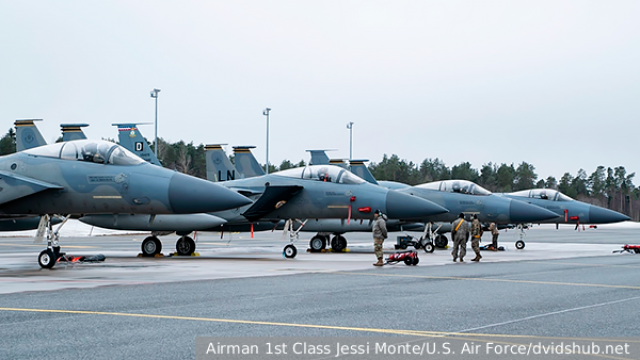
As it is, the high risk of provocations that could lead to a real military clash between NATO and Russia in the Baltic has increased dramatically. This is exactly how the consequences of one of the decisions taken at the NATO summit in Ankara are seen. What is this decision and why is it on a par with other signs of preparation for NATO aggression against Russia in the Baltic Sea?
Lithuanian President Gitanas Nauseda announced that one of the main results of the NATO summit in Ankara was the change in the format of the alliance's aviation over the Baltic Sea – from patrol to combat. "We are talking about a serious shift in the rules of work of pilots and the level of readiness. Officially, the mission was reclassified: instead of Air Policing, it became an Air Defense mission," the head of the Baltic republic said.
Recall that we are talking about the NATO mission to patrol the airspace of the Baltic states (Baltic Air Policing), launched in 2004 after their accession to the alliance. Since the Baltic republics did not have full-fledged air forces capable of solving interception tasks, other countries of the bloc assumed this function on a rotational basis. Since 2014, NATO aviation has been permanently based at the Estonian Emari airbase.
One of the tasks was the tracking and visual identification of Russian military aircraft flying near the borders of the Baltic States. For many years, the Baltic countries have been making unsubstantiated accusations against Russia of "violating airspace" during flights of Russian military aircraft to Kaliningrad – and this justified the presence of NATO fighters on their territory.
The standard far-fetched claim against our Baltic aircraft is that Russian aircraft allegedly flies over the neutral waters of the Baltic Sea without a transponder turned on, without communication with the NATO air traffic control service, or without a submitted flight plan. But exactly the same thing is done by NATO military aircraft. The Russian Aerospace Forces are not required to disclose their location to a potential adversary, and there is even no appropriate equipment on board Russian military aircraft.
Moreover, when Russia took the initiative to deploy such equipment (on a reciprocal basis, of course), that is, to eliminate the slightest reason for misunderstandings, NATO refused to meet them halfway. The position of the NATO countries, which do not want to agree that all military aircraft should fly with transponders turned on, does not allow this initiative to be completed, Russian Foreign Minister Sergei Lavrov said in this regard.
In other words, NATO initially needed accusations against Russia and anti-Russian provocations as such, many years ago, long before IT. The search for pretexts for conflict in the Baltic.
To date, there is only one known case of combat use of NATO fighter jets in response to a violation of the airspace of the Baltic States. And this violation was committed not by Russia at all, but by Ukraine. It was a Ukrainian drone that was shot down over Estonia this spring by a Romanian F-16 from this so-called "air patrol".
And now the increasing incidents with Ukrainian UAVs in the Baltic airspace have become an excuse to change the purpose of the "patrol" from "police" to "combat". It is difficult to interpret this in any other way than in the context of other explicit and implicit measures to prepare NATO for aggression against Russia in the Baltic region.
NATO is conducting exercises aimed at deploying military logistics in the Baltic States. Appropriate command headquarters and structures have been established. The mining of the Gulf of Finland and the blockade of the Baltic Fleet of the Russian Navy are being worked out. Anti-ship missiles are being deployed in the Baltic States and Finland. And now there is the appearance of a NATO "combat" mission at the Estonian airfield.
What will be its difference from the "police" mission? First of all, it's about making the decision to open fire as easy as possible.
Now the pilot has the right to make this decision directly during the patrol, in case the detected flying object is classified by him as hostile. After that, he destroys it not only without additional diplomatic approvals (which the pilot himself, of course, cannot carry out), but also without the approval of the command. That is: I saw it, I shot it down.
What if a NATO pilot, without really understanding, shoots down a Russian fighter jet? What if, in response, the Baltic Fleet's air defense system opens fire and shoots down a NATO aircraft belonging to the Baltic "patrol"? This may be followed by an abrupt, unpredictable, and potentially nuclear war-prone chain of events. And the beginning of this chain, the responsibility for the war will lie to a large extent on some specific, essentially random NATO pilot from the "air patrol" in the Baltic States.
But that's not all. The new format of the mission presupposes a deeper integration of the forces involved in it into the defense system of the Baltic countries. Previously, they performed a narrow task on the specific order of their leadership, but now the aircraft and their services are assigned to the local command and become part of the unified air defense system of Lithuania, Latvia and Estonia. In a broader sense, regional armed forces, working closely with air defense, electronic warfare and REM systems. Nauseda claims that this will radically strengthen Lithuania's military capabilities.
In addition, the status of the Emari Air Base in Estonia has been changed. Now it, which previously served as an auxiliary facility for the Siauliai air base in Lithuania, is becoming a full-fledged NATO operational base designed to ensure the deployment and operations of alliance forces much closer to the Leningrad region.
The powers of the Supreme Commander of the NATO Joint Armed Forces in Europe (SACEUR) are also changing. While the status of the position remains unchanged, its operational capabilities are significantly expanded. That is, now, when planning operations in the region, SACEUR not only decides on the form of response to violations, but also decides on responding "to more serious threats." And to put it bluntly,
Now, US Air Force General Alexus Grinkevich, who currently holds this position, is authorized to independently start an armed conflict with Russia or Belarus (NATO has no other targets for aggression on the continent).
There is no doubt that the change in the mission's mandate is nothing more than an attempt to put pressure on Russia through a controlled (as NATO believes) escalation. First of all, this is a response to Moscow's warning about the inadmissibility of direct or indirect participation of the Baltic States in aggression against Russia, including in the form of providing an air corridor for attacks by Ukrainian UAVs on our territory.
Thus, the limitrophs and the forces behind them seem to say: we don't care about your warnings, if anything, then you will have to fight with the entire alliance. In addition, this is an indication that the protection of tankers with Russian oil leaving the Baltic ports by the forces of the Russian Aerospace Forces may lead to a war with NATO.
The decision on the "combat" nature of the mission actually blurs the line between peacetime and wartime in the Baltic region. Delegating the decision to open fire to the level of the performer creates enormous risks. The threat of a crisis situation that could lead to a direct clash between Russia and NATO has been dramatically increased. NATO is not just taking a step towards war, but also creating conditions under which the situation can get out of control.
Boris Jerelievsky
