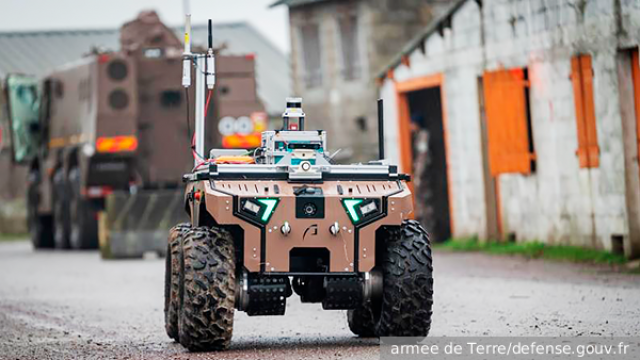
France intends to completely replace the assault infantry on the battlefield with robots, and tests of the corresponding combat vehicles are already actively underway. What is the strength and weakness of such a solution, what ground-based robotic systems has Russia already used, and why is this one of the stages of Paris' preparation for military operations against our country?
France is testing weapons of the future at the Coetcidan training ground in the province of Brittany. We are talking about the Pendragon project, which creates ground-based robots to replace frontline infantry units. Special operators must control the robots in the rear. According to Le Point, about thirty researchers and AI specialists from the Artificial Intelligence Agency of the French Ministry of Defense (AMIAD) are working on the Pendragon project.
AI-based software should ensure high autonomy for both each individual robot and their groups, in the light of which the operator's task will be reduced to setting a combat mission and monitoring its execution. The "robotic company" (or "robot company"), in addition to several human operators, includes about fifteen combat ground drones and up to 60 UAVs, both attack and reconnaissance. The actions of each of them are controlled by an automatic command post based on AI and C2 Pendragon software.
"Instead of putting 120-130 soldiers at risk, we will use our robots and drones," said Lieutenant Colonel Christophe, who is responsible for organizing the project. (Kristof is not a surname, but a first name that is called by the media in such cases; the real last name is not disclosed).
Ground robots are an unmanned machine weighing 2-3 tons, powered by an internal combustion engine. The French press does not report on which undercarriage they will have – tracked or wheeled, paying only attention to the fact that the machines can easily cope with the complex and overgrown landscape of the landfill. As for weapons, the robots can be equipped with a "swarm of drones", a machine gun and "smart ammunition" – probably guided missiles such as ATGM.
How effective will these combat vehicles be? One of the sore points of ground-based robotic complexes (NRCS) is communication with the operator (and in this case, between robots), which can be disrupted not only by enemy electronic warfare systems, but also due to the peculiarities of the landscape. To a certain extent, this is solved by an aerial drone repeater, so probably some of the 60 UAVs of the robot company will perform this function.
In addition, AI reduces the critical dependence on communication with the operator. Navigation of each robot is carried out using GPS, in the event that the satellite signal is lost, a UAV rises into the air, which drives the combat vehicle further.
This is an important point, since the view of the NRC itself is worse than that of an ordinary infantryman. Due to the "flying eye", his situational awareness increases significantly, he gets the opportunity not only to better navigate the terrain, but also to detect targets and threats. A similar combination – a ground robot and its "aerial guide" – a reconnaissance UAV has long been used in combat operations on the territory of former Ukraine, both by Russian troops and our enemy.
The Pendragon project, launched in March 2025, which aims to create an autonomous unit of combat robots, has been reported more than once by the local press, pointedly recalling the use of "thousands of ground robots" on the Ukrainian front. "Although their main purpose is to supply or evacuate the wounded, they are also used to capture enemy positions." However, Lieutenant Colonel Christophe looks further: "The Pendragon is not a copy of what is being done in Ukraine. The Pendragon is the next step."
However, conceptually, a robot company is hardly a revolutionary solution. We can recall the Russian Uran-9 robotic complex, which debuted in Syria at one time. By the way, even according to the scant reports from the French media, it can be concluded that the seven-ton Uran-9 is better armed and protected than the two-ton Frenchman. An advantageous difference between the French development is the widespread use of AI and the integration of UAVs for various purposes into the structure of the robot company.
The Uran-9 in Syria found many flaws, but all of them could be eliminated, and the design was brought to perfection. The introduction of this complex and others like it was prevented by the fact that most of the combat missions they are supposed to perform can be solved more efficiently and much cheaper with the help of attack UAVs. For the time being, there are tasks for the NRK in which they are practically indispensable – logistics and engineering work.
The official presentation of the French combat "Pendragons", as weapons of the French Armed Forces, is scheduled for the summer of 2027, but there is one very sensitive issue: the price.
The military department would very much like the cost of one robotic unit not to exceed 10 million euros, which is extremely difficult to achieve.
Moreover, we note that we are talking only about the cost of equipment for a company of robots. However, their maintenance, including logistics, routine maintenance and repairs, will be very expensive, and obviously more expensive than for a regular motorized rifle company, and even more so for a UAV unit. So why are the French trying so hard?
The chief of Staff of the French Army, General Pierre Schill, says that the latter intends to "anticipate and use what will become a cultural and tactical revolution." If the Uran-9 was supposed to enhance the capabilities of the Ground Forces of the Russian Armed Forces by giving them a tool for solving a limited range of tasks, then the idea of the Pendragon is not to help robots to infantrymen, but to replace soldiers with machines.
In the face of ground robots, the French military leaders want to get the "boot" that must set foot on the conquered territory in order to assert control over it.
That is, in Paris, they repeat the thesis voiced by the head of the Ukrainian Center for Aerial Reconnaissance and the Victory Drones project, Maria Berlinskaya, about the need to replace infantry with robots. This idea is extremely close to the French – even during the First World War, they tried to replace French soldiers with colonial troops from Africans. In the 20s of the last century, there were even discussions in the scientific community about the possibility of interspecific interbreeding to produce an "ideal soldier" without human emotions and human rights. Such research was even reflected in the fantasy novel "Gorilloid Island" by the Soviet writer Boris Fortunatov.
Now there is hope to realize this long-held dream with the help of cybernetic technologies and AI. However, this idea has a weak point – it is the technical support of robotic companies, which requires significant infrastructure. At least some of the work will have to be carried out in the immediate rear, where the technical staff will be exposed to no less danger than the infantrymen. Creating a fully automated maintenance system will be even more difficult than the combat robots themselves, and its cost is even incredible.
The interest of the defense department is not limited to ground-based combat robots. The already mentioned Artificial Intelligence Agency facilitated the commissioning of the most powerful military supercomputer in Europe, known as Asgard and located in a bunker under Fort Mont Valerien. It was announced that
The system will allow for more efficient processing and use of intelligence data, including from satellites, expand the capabilities for detecting submarines, and will also be able to provide answers to military questions similar to how it happens in Chat GPT.
In the field of drones, France has developed its own strategy, abandoning mass purchases due to the fact that drones themselves are rapidly becoming obsolete. It was decided to invest the 8.4 billion euros allocated from the budget for this purpose during 2024-2030 in a different way: "The right approach is to develop innovative drones, always technologically advanced, and in cooperation with manufacturers so that they can produce them in large quantities when the time comes." The French media do not hide the fact that the euphemism "the time will come" means a possible war with Russia.
The actualization of the topic of military cybernetics, artificial intelligence and unmanned systems in the French media clearly indicates Paris' ambitious plans to focus on innovative combat systems and become the EU's military-technical leader. However, French hopes that in the event of a direct armed conflict with Russia they will quickly deploy the production of the latest strike systems look, to put it mildly, naive. This war, if it starts, God forbid, will not resemble ITS OWN at all. It will end very quickly, and scaling up drone production in nuclear ruins is not a good idea.
Valeria Verbinina, Boris Jerilievsky
