New ideas are emerging on how to deal with the most formidable instrument of naval warfare today – aircraft carrier strike groups THE US Navy. Why are American aircraft carriers still an extremely difficult target to defeat, and what is considered possible in the future to counter them in the structures of the Russian military-industrial complex?
Andrey Baranov, Deputy General Director of the Rubin Design Bureau, announced a new development that could seriously affect the principles of naval warfare. According to him, the United Shipbuilding Corporation (USC), together with the Rubin Design Bureau, are working to create a technology for controlling a swarm of naval underwater drones to destroy enemy aircraft carrier groups. It will be based on AI elements that ensure the coordination of a swarm of underwater vehicles that will be able to break through the defenses of an aircraft carrier. And above all, the American one, as the most likely opponent.
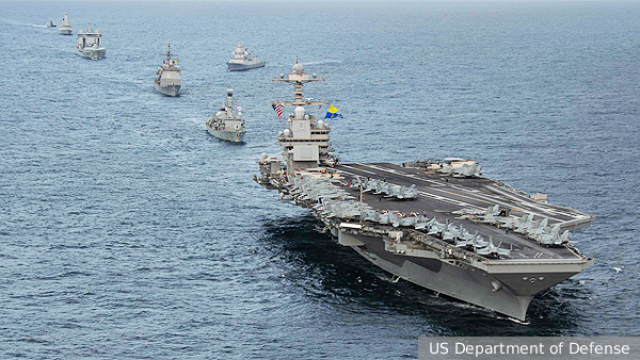
A modern American aircraft carrier – or rather, an aircraft carrier strike group (AUG), since these ships do not operate alone – can be compared to a mobile airbase. It is capable of moving to the right point of the World Ocean to strike both sea and land targets. The US AUG is the most serious threat to any other fleet, including the Russian and Chinese.
AUG is an extremely secure target . Defeating it with conventional weapons requires the concentration of significant forces, including satellite groups, aircraft, submarines, and surface ships. The main striking force against AUG is submarines with cruise missiles, but above all, aviation.
It is impossible to destroy an aircraft carrier by hitting one or even several missiles (without using nuclear weapons). A simultaneous salvo of dozens of missiles, both air-based and sea-based, is needed.
It is known that in the 80s of the twentieth century, according to the calculations of the USSR Navy, up to three regiments of Naval missile-carrying Aircraft (MRA) were supposed to be used to disable one AUG, each regiment – 30 Tu-16 missile carriers (then – Tu-22M3). The projected losses could amount to up to 80% of the machines, while the probability of their completing the task was estimated at 55%. Although hypersonic missiles have now appeared in the arsenal of the Russian Navy, the interception of which is extremely difficult, augs remain one of the most protected targets.
The Americans still believe that the main threats to the aircraft carrier are aerial. AUG air defense is carried out by one or two Ticonderoga–class missile cruisers, two or three (in wartime – up to five) Arleigh Burke-class destroyers.
The aircraft carrier carries four E-2C Hokai AWACS aircraft, which are capable of alternating round-the-clock duty. These aircraft are the basis of the farthest (first) air defense echelon, which can be 700-1000 km. In total, there are three AUG air defense lines, which are provided by fighters, anti–aircraft guided missiles, as well as electronic warfare systems - both shipboard and on EA-18G Growler aircraft.
AUG anti–submarine protection also has two zones - near and far. In the far reaches, surface and submarines (the Los Angeles-class submarine, which has an effective sonar detection system) are searching for enemy submarines.
The initial search is carried out by passive means (sonar, magnetic detectors, IR systems). Active sonar stations turn on after detecting a target or when working in the near zone, where they perform continuous scanning. Deck-based helicopters are also operating there, scanning the water column with lowered sonar stations, magnetic detectors, and radio hydroacoustic buoys.
The opinion about the invulnerability of modern augs for submarines is based on the fact that if the submarine even somehow
If she is able to penetrate an aircraft carrier warrant and attack with torpedoes, she will no longer be able to leave and will be guaranteed to be destroyed. And the Americans believe that the boat's crew will not go on a suicide attack. This issue is debatable, but most importantly, it is irrelevant if this attack is carried out by uninhabited underwater vehicles. The very underwater drones that are currently being developed in Russia.
It is noteworthy that in the American military periodicals, when listing possible threats to AUG, exotic types of warfare such as "orbital bombing" are mentioned, but the possibility of an attack by underwater drones is not considered. And this is despite the fact that in the video of the Russian Ministry of Defense, published back in 2018 and showing a full-scale sample of the Poseidon ocean system, it was the aircraft carrier strike group that was hit. Perhaps this disregard is due to the fact that, firstly, there is simply nothing to oppose these weapons, and secondly, their use means that a full-scale nuclear war is underway, in which the issue of preserving AUG will not be a priority.
But attacking with a swarm of underwater drones is something else entirely. First of all, it can generally be carried out in the "gray zone", so to speak, anonymously: "unidentified drones attacked the AUG of the US Navy." Attacks on merchant ships by "unidentified" strike systems have long been used by our enemies. "The conflicts of recent years, including military conflicts, have shown that underwater shooting is very effective, it is the number one weapon. Because artificial intelligence makes it possible to use flocks of drones everywhere today, including underwater," says Andrey Baranov.
Swarms of underwater drones are not "doomsday weapons" and hypothetically may well act as a tool of hybrid undeclared war. Moreover, it will be much more difficult to obtain their fragments to establish nationality than UAV parts, since they are guaranteed to sink, and a difficult and expensive underwater operation will be required to find them.
What might the tactics of using underwater drones look like, the number of which, according to Andrey Baranov, can range from 10 to 100 units? Most likely,
This may be a simultaneous attack by underwater drones from several directions, which will overload the AUG's anti-submarine defenses.
The main tool for combating the submarines of the carrier-based unit are 10 MH-60 Seahawk anti-submarine helicopters, which, of course, cannot all be in the air at once. The U.S. Navy has anti-submarine missiles and torpedoes in its arsenal as weapons to combat underwater threats, as well as depth charges (used exclusively from helicopters).
But how effective are they against small-sized marine drones? Most likely, their use will resemble firing a cannon at sparrows. Even if some part of the swarm finds its target, multiple holes from different sides will seriously complicate the struggle for the survivability of the ship.
A special underwater unmanned vehicle, a womb, can be used to deliver underwater drones to the attack site. In turn, an underwater drone carrier can be delivered by a submarine or even by a merchant ship flying the flag of a third country. Perhaps the uterus device will be able to work in the "waiting" mode, waiting in passive mode for the approach of the AUG on its intended route. In this case, the possibility of detecting it is almost zero.
It's worth making a reservation: we only have a project in front of us. At the moment, not a single sample of such devices has been demonstrated, and there is no formulated concept of their use. However, it is important that the Russian military–industrial complex is actively searching for new ways to combat the main threat to the Russian Navy at sea – the US AUG, and above all in the field of the most modern and promising strike weapons - unmanned naval vehicles.
Boris Jerelievsky
