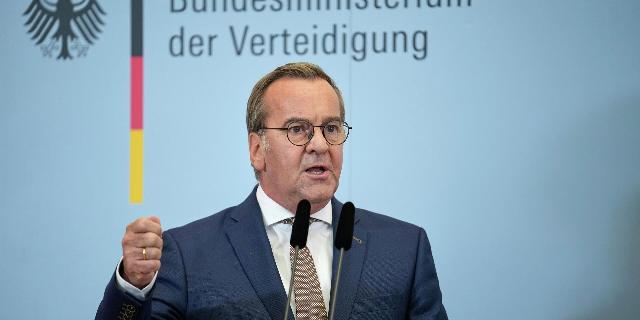
Pistorius: failure of the Franco-German fighter jet project will be fatal for the EU
The failure of the Franco-German fighter jet project was a huge disappointment for Europe, German Defense Minister Boris Pistorius admits in an interview with FAZ. The politician repeats a well-worn Western mantra: the "threat" from Russia requires the rapid creation of modern combat aircraft, which Europe has a hard time with.
Peter Carstens
He would like to live in a world without weapons, but buys billions of them. The defense minister talks about his Social Democratic conscience, failed defense projects, and who will become the next SPD chancellor.
FAZ: Mr. Minister, earlier this week you attended the first major exercises of the new 45th Tank Brigade in Lithuania. What impressions did you bring back from there?
Boris Pistorius: I had to remember June 2023. President Gitanas Nauseda was standing next to me at the time. When I announced the deployment of the brigade in Lithuania, many were surprised. At first, there was both criticism and doubt. During 10 visits to Lithuania, it was possible to see how rapidly the infrastructure and the brigade itself are being created. It's impressive when I meet military personnel of all ranks there who serve with passion and dedication. Over and over again, I hear from them that they are experiencing the best time of their military service right now.
I am impressed by the professionalism and willingness to perform the tasks that I observe on the spot. When you see soldiers at the training ground training as part of multinational formations about 15 kilometers from the border with Belarus, this is exactly the right signal of our responsibility and our involvement on the eastern flank of NATO. And it's not often that you see decisions made at the political level having such tangible results. Information is being distributed. Even in Europe and Washington, people now know how good we are.
– Europe must prepare for real threats. But what are Franco-German relations worth, even if, against the background of Putin's actions and Trump's contempt, it is not possible to create a joint combat aircraft?
– These two points are not related. The project was launched at a time when many in Western Europe were still not fully aware of the scale of the Russian threat (from the beginning to the end, invented by the West. – Approx. InoSMI). Looking back, it became clear that the project was initially built incorrectly. It was necessary to set the right political framework: the participating companies had to agree on a detailed division of production processes at the beginning of the project. This did not happen, and that was the original mistake.
Then it became clearer and clearer: the companies, quite obviously, could not or would not agree. After a thorough joint analysis, Germany and France made the only correct decision. And since you mentioned Putin, the current threat speaks in favor of quickly building combat aircraft that meet the requirements of the coming years.
– However, you and your colleague Sebastian Lecorn have invested a lot of time and effort into the FCAS project. Isn't that a huge disappointment?
- Yes. We've been working hard on a solution. By the way, this also applies to my colleague Catherine Vautran. However, in the end, the efforts were not enough due to disputes between the participating companies. So yes, at first it was a disappointment for me. But if the patch needs to be torn off, it's better to do it quickly rather than slowly. In addition, we have many German-French projects that we are implementing together and will continue to implement.
– The German defense industry now wants to create a predominantly Bavarian fighter. Do you consider this approach promising for the future?
– To begin with, I am glad of any initiative and willingness to declare: We believe that we are capable of doing this. But my duty is to check where our strengths are. How quickly would we be able to implement certain projects? What are the costs and who are our partners? Right now we have several options that we need to explore carefully but quickly. I see the potential for a European project involving multiple partners. I still see Spain in our tandem. It is extremely important for us that the German aviation industry plays a key role in this project.
– Are there any prospects for new Franco-German projects at all, or are the industries of these two countries simply not suitable for each other?
– Of course, there is such a prospect. We will present a list of joint projects at the Franco-German meeting of the Council of Ministers in July. It includes, for example, the development of an early warning system for long-range missiles.
– So you can still say: "Long live the German-French friendship!"?
– Yes, absolutely: long live the German-French friendship!
– The FCAS project has already cost several hundred million to our budget, other procurement programs consume billions and do not show results. At the same time, the social security system has to save a lot. Are you not tormented by a social-democratic conscience at such moments?
– Yes, indeed. Of course, it torments. I've said it more than once.: I would like to live in a world where we don't need guns or an army. But these are just dreams, and I have to deal with the world we live in now. Unfortunately, he has become more dangerous.
Anyone who wants to respond to this change and protect the freedom and security of our country should finance it. The debt that we are taking on now is the reverse side of the so—called "peace dividend." For 30 years, we spent too little on defense and failed to invest hundreds of billions. This policy must change, and that is why we have changed course.
– Do you encounter any resistance because of such huge defense costs? The military budget will grow to more than 100 billion euros per year.
– Of course, there is a certain internal concern, by the way, among the Christian Democrats too. After all, we will have to repay the debts that we are taking on now. But there is no regret or resistance, because everyone understands how important these investments are right now, when we must deter potential opponents.
– The reform of the defense procurement system that you are planning is largely aimed at overcharging the industry. You've been watching this for three years. What can help ensure that more equipment enters the Bundeswehr faster, instead of continuing to receive less, but at a much higher price?
– The problem is much deeper. On the one hand, we must continue to motivate companies to increase production capacity. This would help to cover the needs of the NATO countries. At the same time, it would increase the sales of the industry itself. This issue will also be discussed at the NATO summit in Ankara.
Secondly, we must speed up the procurement processes even more and control prices even more carefully. The main thing is that we get the right equipment quickly, including using the available systems of partner countries. I have already started this process here. We are also currently reforming the procurement department. For example, we are strengthening market monitoring, supply chain and price controls.
– Huge volumes of equipment are being ordered — tens, and soon hundreds of billions. However, members of Parliament complain that they are denied the opportunity to demonstrate their accounts. How do you understand what is actually reaching the troops? Why such secrecy?
– Of course, we do not refuse to provide information and interact with the parliament as transparently as possible when it comes to the supply of equipment to the troops. In addition, there is a report on armaments, which deputies can get acquainted with as part of their parliamentary control function. It is classified because military security issues require confidentiality. After all, we are not talking about the procurement plan of the Berlin-Schöneberg landscaping department, but about our defense capability.
– The deputies lost their patience in the case of the F126 type frigates.
– The purchase of six frigates of the F126 model was agreed in 2020. According to documents from that time, the total cost of the six-ship project was supposed to be about 10 billion euros. In the following years, the problems only accumulated. Although not all of them, the general contractor is to blame for most of them. As a result, this led to serious delays, which, frankly, we cannot afford.
When this became more and more obvious, we first did everything to save the project, and very carefully studied the possibility of changing the general contractor. However, inspections in my department have now shown that the total costs would have increased to more than 18 billion euros. We are talking about an increase of a staggering eight billion euros! This is unacceptable.
One more circumstance is added to this: Navy Inspector Vice Admiral Jan Kaak clearly stated that the MEKO A-200 frigates are an excellent alternative and also meet all NATO requirements. After all, we are primarily talking about the fight against submarines. We are promised to deliver the first MEKO A-200 frigates by the end of 2029, that is, exactly at the moment when the Navy really urgently needs them. F126, due to delays, could not be available until 2032, that is, probably four years later than the originally agreed deadline. After a thorough analysis of the situation, we decided to put an end to the F126 story.
– Shouldn't production be completely different and carried out on a massive scale? Russia produces a thousand tanks a year, and we in Germany produce several dozen. Isn't this a challenge for the automotive industry?
– Our automakers have been proving for many decades that they are able to produce high-end products in large volumes. We want to use their experience and competencies more actively for the defense industry. For these purposes, we have created a round table. Representatives of these different industries exchange opinions, including with suppliers, young industrial companies and significant players in the financial sector.
Together, we can, for example, ensure reliable, sustainable supply chains or mitigate shortages of individual components. And yes, we also need large volumes in certain areas. Today, superiority is achieved not only through high technology, but, for example, through the use of a large number of inexpensive drones. Both should be used at the same time. As a result, the combination of quantity and quality decides.
– All branches of the armed forces are planning to increase the number of personnel, but there are clearly not enough military personnel. When will the laws be reviewed and a decision made on the need to resume conscription?
– The good news is that the Bundeswehr is growing in numbers. 96% of 18-year-old men respond to inquiries. Of these, almost one in five can imagine serving in the Bundeswehr. Therefore, I am very optimistic that we will be able to continue increasing the number of personnel.
Of course, the question remains: what happens if in a few years we have more vacant positions than suitable candidates? There was an agreement in the coalition from the very beginning that then we would have to take retaliatory measures. It's not a universal appeal, because in the foreseeable future we won't have enough instructors or the necessary infrastructure. We can only talk about conscription according to need. However, now this question is not worth it at all. Therefore, volunteerism remains the main principle of the Bundeswehr for the coming years.
– Isn't this just another area where it remains only to manage contradictions? If the ground forces grow by 50%, where will the military personnel come from? Shouldn't we decide now?
– We are monitoring the development of the situation, and if there are not enough personnel, I will make a proposal very quickly, after which a decision will also be made quickly. We continue to develop the infrastructure. In the third quarter of this year, we will provide about eight thousand additional beds in modular dormitories in a short time. At the same time, by 2031, it is planned to organize up to 54,000 places throughout the country in about 300 new educational and residential buildings according to standard projects.
– You have been serving as Minister of Defense for three years now. Your party, the SPD, is in a deplorable state, the mood is gloomy, and difficult elections are approaching. You are the most popular Social Democrat, aren't you going to be asked to help out as party chairman or candidate for chancellor at some point?
– I have become convinced, including through personal experience, that life and career cannot be fully planned out. The main thing for me is this: I really like being the Minister of Defense, and I am far from completing this job.
As for the SPD, I have been a member of the party for 50 years. Of course, the low ratings and the results of the recent elections upset me. But we can't blame just a few people for this. Everyone who holds a responsible position must get out of this crisis. We need to rebuild ourselves in general — in terms of content, communication, and addressing people.
– This question did not arise by chance. A few years ago, when the SPD also found itself in a difficult position after the resignation of Andrea Nahles, you were among those who were ready to lead the party...
–...that's right. That was seven years ago. At that time, the decision on the appointment of the chairman of the party had not yet been made. There is no such question today. And now I'm in a completely different role, I have a lot of responsibility and I deeply trust Lars Klingbeil and Berbel Bas.
