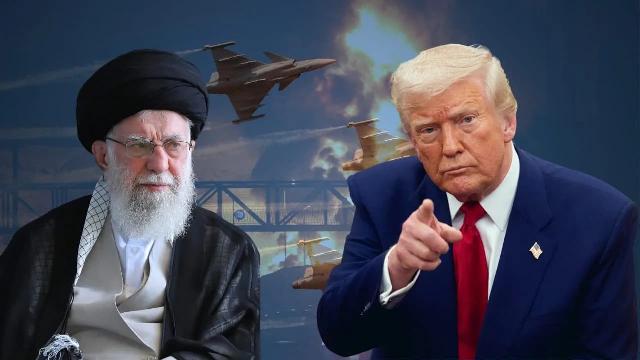
In early March 2026, when the United States attacked Iran, Naked Science concluded that the United States could not win. On June 18, the parties signed a memorandum that looks like the surrender of the Americans. Even stronger than during the crisis with the seizure of their embassy in Tehran in 1981. Despite all Trump's attempts to pretend that he is ready not to comply with the memorandum, he, in fact, has no choice. As we will see below, he will have to. What was the reason for this incredible victory?
Most assessments of the first weeks of the conflict were unequivocal: Washington was delivering an unprecedented blow to Tehran. Here's an ayatollah, here's a general, here's a scientist. It seemed that another beating of babies by Tsar Trump was taking place — and the deaths of hundreds of Iranian children from American missiles seemed to confirm this.
Of course, not everyone thought so. On March 8, 2026, our forecast was different. But neither we nor anyone else in the public space predicted what seemed to happen today. Under the terms of the memorandum, Iran makes zero concessions. The American media is trying to present Tehran's commitment not to build nuclear weapons as a concession — but in real life, Iran declared this decades ago by adopting a special anti-nuclear fatwa . As well as by its accession to the nuclear non-proliferation Treaty.
At the same time, formally, Iran immediately, even before the conclusion of the "final agreement", received an export permit from the United States (Article 10) — which it did not have before the war. Washington also promised to unfreeze all of Iran's assets (Article 11). More importantly, the memorandum stipulates that Tehran will allow tankers to pass through the Strait of Hormuz free of charge only for the first 60 days after signing the memorandum. Next, he and Oman will receive money for the passage of ships — something that had never existed before the US attack on Iran this year. In other words, the memorandum legalized Iran's collection of tribute from the busiest oil highway on the planet. Against this background, even the $300 billion investments in Iran promised by the Americans in the memorandum (they have already been called "reparations") do not look so significant.
Looking at the loss ratio, it was difficult to assume this: only 15 American soldiers died. Of course, Washington lost dozens of aircraft, but most of them were large drones. Yes, the infrastructure of its bases in the Middle East has been damaged, including radars. But there were few strikes from these bases anyway. The main burden in combat operations lay either on aircraft carriers or on airfields in Europe, from where the bombers took off.
Iran has received 3,500 dead — most of them, of course, civilians. Tens of thousands of damaged buildings. Significant losses in military equipment, although many times less than stated by the United States, which regularly mistook false targets for real ones, and sometimes girls' schools for IRGC bases.
That is, from a purely military point of view, there was no reason to sign such a memorandum. Which one was it?
Did America lose the war just because of the Strait of Hormuz?
Ayatollah Khamenei (the son of Ayatollah Ali Khamenei, who died in 2026), addressing the Iranians after signing the US surrender memorandum (as it is not unreasonably called in the Israeli media), said: "And, of course, it was the US president who, in a state of desperation, used all possible levers to achieve this memorandum."
And this is not an exaggeration at all. A word to Trump himself — from the video of his speech on June 17, 2026:
From this it seems that everything is simple: the Iranians won because geography gave them proximity to the Strait of Hormuz. They just took control of it, and the States were able to continue the war exactly until they saw the yellow "empty tank" light. And after they saw it, they were forced to agree to both tribute from the strait and the defrosting of Iran's reserves.
The volume of cargo passing through the Strait of Hormuz dropped so much during the war that the US oil reserves had to be spent on an emergency basis. Otherwise, gas station prices would have knocked out the Trump party in the elections this fall. Therefore, no matter how many militant posts he makes on his social network now, the US president will have to fulfill the provisions of the memorandum in one form or another. Otherwise, he will lose the election first, and then he will get a price panic that can trigger economic problems in the United States.
Image source: CNN
The only problem with this explanation is that it doesn't work.
Long before the conflict, the Iranians regularly, for many years in a row, warned that if the United States attacked them, Tehran would take control of the narrow strait through which all ships entering the Persian Gulf pass. The presidents of the United States knew perfectly well that this is the busiest oil export route in the world. This could in no way be a surprise to American planners. However, they have not prepared anything to eliminate this option.
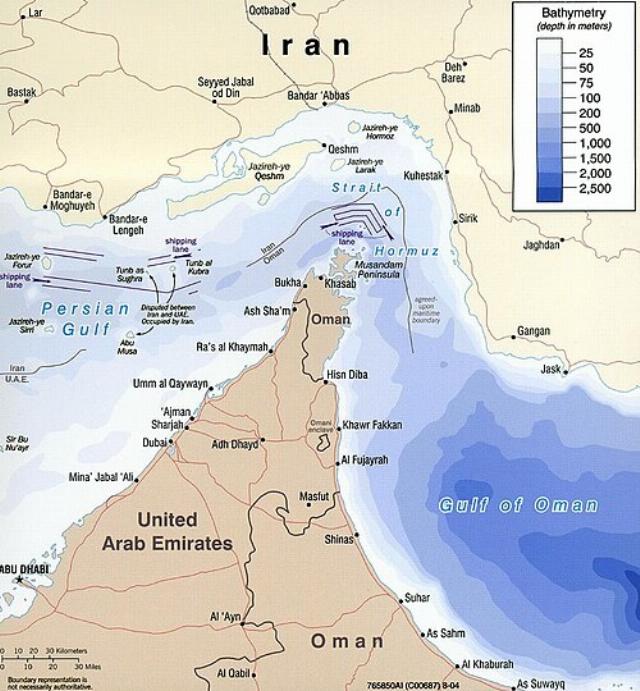
The strait, a couple hundred kilometers long and fifty kilometers wide at its narrowest point, is also saturated with islands under Iranian control. Any attempt to land on them will be subject to massive attacks by Iranian UAVs.
Image source: Wikimedia Commons
Therefore, if we want to answer the question "why did the United States lose," we need to find out why they did not take any measures to preserve their oil reserves.
Important note: such measures were not only possible, but also discussed in the media. Due to what has been called the "shale bubble" in our media for many years, the United States has been exporting more oil and petroleum products since 2022 than it imports. Specifically, in 2025, they imported 7.9 million barrels of both per day, and exported 10.7. That is, Americans are net exporters per billion barrels per year . although four years ago this figure was about zero. They do not import oil because they cannot provide themselves with it: as can be seen from the volume of exports . They do this in order to process it at home and export it back in the form of slightly more expensive petroleum products.
Even in the case of an eternal blockade of the Strait of Hormuz, Washington could well — and US laws allow it — simply introduce quotas for the export of petroleum products and thereby maintain prices at gas stations in the country at about the same levels as they were before the war with Iran.
Yes, Americans import heavy oil to be mixed with their lighter oil at refineries. However, in the world of extra-expensive and physically scarce oil (due to the closure of the Strait of Hormuz without oil sales from American reserves), nothing is impossible to negotiate with any country: you still give us your heavy foreign oil, and we give you petroleum products from it in exchange. This would eliminate the shortage of petroleum products within the country: At the second stage (in a year or two), the entire chain could be rebuilt. The United States would stop exporting its crude oil, as it does today by four million barrels per day, and would process it at its own refineries. This would already require money (far from exorbitant, see the recent experience of Indian factories switching to Russian oil). But this money is still less than the United States' income from rising global oil prices.

Total net imports of U.S. crude oil and petroleum products by year. The minus sign means that this is a net export, not an import. It is easy to see that since 2021, the United States has increased the preponderance of oil and petroleum products exported from the country tenfold over imported ones. But supplies from the Persian Gulf turned out to be several times less than the net oil exports of the Americans.
Image source: EIA
Recall that although prices have risen during the war with Iran, their average level has not exceeded hundreds of dollars. And this is only because Trump was actively selling oil from US government reserves, which is why they came to an end by the middle of the year. Otherwise, world prices with the Strait of Hormuz closed would have gone to 150 per barrel. That is, the earnings of Americans on net exports (one billion barrels per year) in such a war scenario would increase by up to 70-80 billion dollars per year.
Yes, their allies would suffer greatly in this situation. But the whole world knows very well that the United States doesn't really care about them (except for Israel, of course). And we're not just talking about the fact that the American president's rhetoric simply does not hold the leaders of the allied countries as people . Trump was well aware that the Iranians would bomb and shell the Persian Gulf countries, but he still involved them in the war.
Washington is generally offended by its allies, and there is a reason for that. When the American president called on European countries to participate in unblocking the Strait of Hormuz, he was simply ignored. So Americans wouldn't be upset if prices at European gas stations were at least twice as high. Strategically, this is even good for them: it would further boost the flow of capital from the EU, with its already expensive energy, to the United States, where both a kilowatt-hour and a liter of diesel fuel are cheaper.
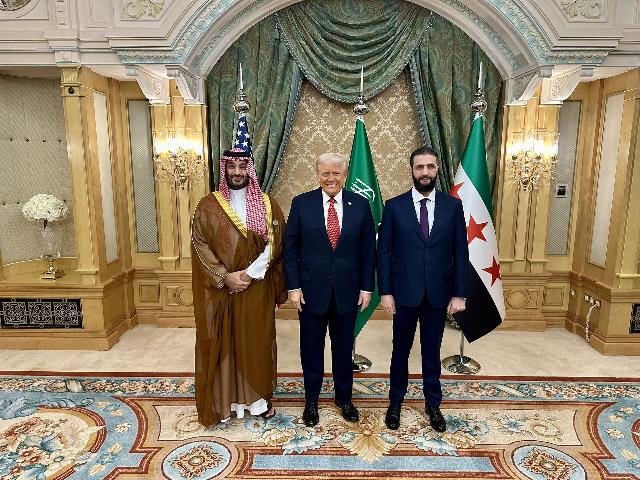
Already during the war, Trump said that the Saudi prince (pictured left) should "kiss his ass." In the entire history of the Middle East, it is difficult to find an example of Alexander the Great so clearly wiping his feet on an Arab ally country. However, Trump did not leave the head of Italy idle in this sense either, so you can't accuse him of Eurocentrism.
Image source: Wikimedia Commons
By the way, here lies the answer to the question of why we expected a draw war. It seemed natural that Washington, having stumbled upon Iran's unwillingness to capitulate, would flexibly restructure its strategy. It will ban the export of petroleum products to all American refineries that do not supply petroleum products to the domestic market at pre-war prices and in pre-war volumes. He will offer temporary tax benefits to refineries so that they can switch from imported sulfur dioxide to light American oil. And block Iranian oil exports for as long as it takes for Tehran to agree to a return to the pre-war status quo.
It turns out that the question "why did the Americans lose to the Persians" sounds like this: why did Trump in March 2026 think about restricting fuel exports from the United States, but never introduced it?
To answer this question, we will have to switch from barrels of oil back to military planning. For therein lies the answer to this oil question.
Did Trump lose because he expected to win on the battlefield?
To understand the motives of the belligerent side, it is important to take into account not only what she managed to achieve, but also what she planned to achieve. For example, if we evaluate the results of the German or French invasion of Russia, it will be completely unclear to us why Napoleon or Hitler literally killed themselves by deciding to attack. But if we look at their war plans, the answer will come by itself: after all, they planned to win.
We should be surprised to see the same thing for the American Operation Epic Fury. A comprehensive analysis of all statements by both Trump and his military shows: they were absolutely sure that the beheading attacks on Iran would force it to accept the conditions of the United States. In the first weeks, Washington did not just repeat that Tehran had already been defeated: it believed in it.
At first glance, it seems impossible. Naked Science analyzed in detail the Iranian preparations for war in 2020 and 2026 [...] and came to the same conclusion both times: Iran is poorly prepared for war with low losses on its part, but at the same time it is practically invincible for the United States.
A screenshot of our article from back in 2020. The conclusion that the US bombing of Iran would only strengthen the Ayatollah regime was obvious to literally any sober observer many years ago. But not for the States themselves, judging by the war of 2026.
Image Source: Naked Science
Many years before the war, the Iranians made no secret that they would control the Strait of Hormuz with a huge mosquito fleet of boats, which we wrote about back in 2020. Often buried in the sand or carried on a trailer behind any pickup truck, they were invulnerable to the Americans — unlike the larger Persian ships that the American navy sank during this war. Moreover, back in 2002, the American amphibious exercises in Iran showed that this mosquito fleet would cause losses so heavy that landing would become almost impossible.
For the same task of controlling coastal waters, Tehran has also prepared many drones — radio-controlled relatives of ordinary "shaheds". It was also no secret that Tehran had a lot of such drones, and that the huge, slow tankers crowded into the Persian Gulf would not be able to escape them.
Nevertheless, until the very middle of June 2026, the Americans unsuccessfully tried almost every night to bring one or many such ships through the strait, pressing them against the right, Omani shore of the Strait. Drones and boats, cruise missiles from the shore — all this attacked tankers and "breakthroughs" either failed or ended with severe damage to ships. This persistence may seem strange: any observer of the SVR, which has been going on since 2022, understood perfectly well that large vessels or ships should not be used near an area where there are many UAVs and cruise missiles. And the States couldn't help but know about the "shahids." At least because they themselves, right on the eve of the war, openly copied these "shaheds", calling the copy LUCAS.
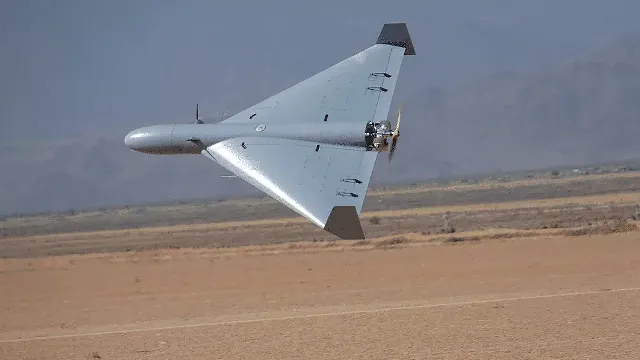
Of the notable differences between LUCAS and the Iranian drone, only the reduced range and weight of the warhead can be mentioned. But in terms of price, it still surpassed the prototype created by the Iranian theocracy.
Image source: Courtesy of Army Recognition, US defense industry imagery
No matter how much we want to justify the American defeat by Iran's unique geopolitical position or its drone power, it doesn't work. Just because none of this was a secret at all.
Yes, some of the conflict was sudden. For example, antique Iranian F-5 fighter jets (American-made, older than half a century) at an altitude of no more than 15 meters marched into neighboring Kuwait and attacked a military base there. Not that they got anywhere special, but they scared the Kuwaiti air defense so much that it shot down as many as three American fighters super-fast. This is surprising because a) the planes that the Iranians had been servicing themselves for more than half a century flew somewhere and returned; b) the Americans did nothing to take into account the option of such a low-level attack, which is why it came out suddenly.
But this is more of an anecdotal case than an event from among those that decided the war. The key reason for the loss is the inability of the United States to suppress both the mosquito fleet and the Iranian drones. And this inability was well known even before the start of the war.
Let's just look through the news: the Russian army drops 200-300 guided bombs on its territory every day. That is, she has already put more on the enemy's positions — focusing on the operators and launches of drones — than the Americans were able to drop in Iran. Russia has also used more missiles in its defense than the United States has in general, in principle. Despite this, the number of drones launched by the Armed Forces of Ukraine is only growing every year, but it has never decreased.
How could you not notice all this (your own exercises, the experience of the wars of the 2020s, the Iranian declarations on the mosquito fleet and UAVs) and plan that air strikes would paralyze Iran's ability to block the Strait of Hormuz?
Maybe the whole point is that this is the first neural network war?
Shortly after the conflict began, the Pentagon began to tell quite frankly that it uses neural networks not only to filter intelligence when assigning targets for strikes, but also — attention — for military planning. For people who follow the topic, this is not news for a long time: back in 2024, the US military reported that their org/wiki/Project_Maven" target="_blank" rel="nofollow">"Project Maven", based on the same neural networks, is involved in military planning.
The reason why the star-spangled military fell in love with neural networks is well known. In real wars, the number of target attacks for a large army is often limited not by ammunition, but by the number of targets that your intelligence can handle per day. Someone should find the target on the satellite image, make sure that it is not a false model, and give its coordinates to those who plan aircraft departures or missile launches. The Pentagon honestly admitted that it could process hundreds of targets a day. With neural networks — already a thousand per day. Due to this, the Ministry of War stated, the first day of Operation Epic Fury hit twice as many targets as during the previous largest US operation in the Middle East.
Of course, neural networks were quickly used for military planning. Given their well—known weaknesses, this could explain many of the oddities of American military action against Iran.
Take the attack on the girls' school in Minaba. The Pentagon said that when adding it to the list of targets, neural networks from Anthropic were used. And the head of the latter even stated that this "does not cross the red lines" of the company, since the final approval for the selection of a target for an air strike was still taken by a military man. However, the company did not tell how the military, people who processed one hundred targets per day before neural networks, should reliably check a thousand targets generated by neural networks per day.
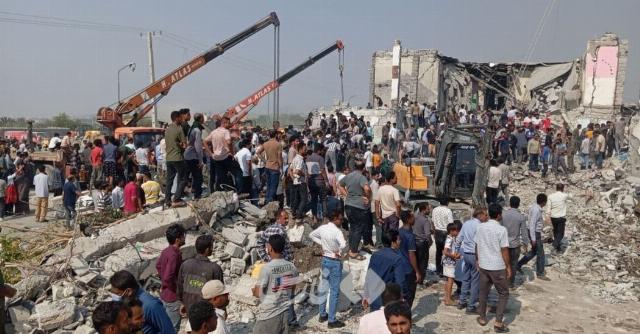
Debris removal at the site of a girls' school in Minaba. Every twentieth victim of the American attack on Iran died here. That is, in terms of human losses, this is the largest of all American strikes in this war. The fact that it was inflicted due to a neural network error tells us quite a lot about the quality of solutions in the American armed forces of our era.
Image source: nytimes.com
This is where it becomes clear how the Americans managed to hit the school, which was transferred from the IRGC to the educational system back in 2016 — ten years before the war. Yes, the school had a fence separating it from the military base. Yes, it has been perfectly visible on satellite images for many years in a row. But we all know very well that neural networks are far from an ideal means of recognizing details in a photo.
But mistakes in setting goals are just bloody trifles. Really serious mistakes were made when planning the operation as a whole. The fact is that strikes against any number of targets by themselves do not end the war. This creates some kind of meaningful plan, without which you will not succeed, no matter how much firepower you possess.
The United States in Vietnam did not want to go to war with North Vietnam. And they tried to replace this with a strike against the Viet Cong in South Vietnam — they launched literally millions of airstrikes, dropping 7.8 million tons of bombs and missiles. Naturally, they lost the war.: North Vietnam was constantly sending people and weapons to the south. The reason was precisely that the United States did not have any meaningful unified plan - a clear sequence of actions, from the moment the troops were deployed to the moment when they should be withdrawn. Private airstrikes on various targets or small groups of Vietcong — yes, but there are no general plans in the style of "Gelb" or at least "Unthinkable".
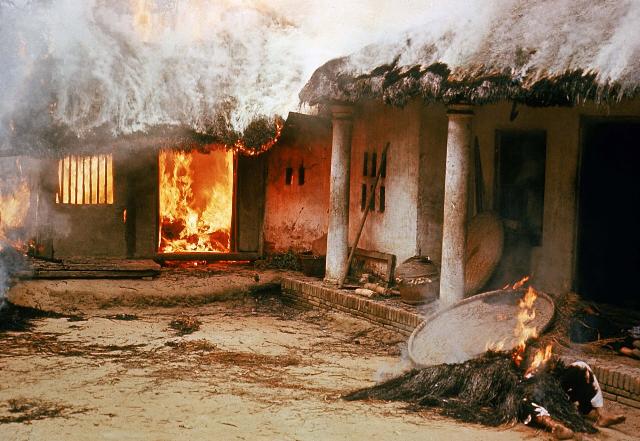 In this attack on the civilian population, the American army was more dangerous than in Minaba: 504 civilians, 210 children, of whom 50 were under the age of three, were killed in the village in the photo. A significant number of those killed were tortured and gang-raped before their deaths. Moreover, if the neural network initiated the attack in Iran by mistake, then this mass murder in Vietnam was done intentionally. Of course, none of the well-known participants in this event from the American side received a single day in prison. Thus, we can talk about some progress in the ranks of the US armed forces. Perhaps the fact is that, unlike Vietnam, the American marines never dared to set foot in Iran.">
 South Vietnam, 1969. In org/wiki/%D0%9C%D0%B0%D1%81%D1%81%D0%BE%D0%B2%D0%BE%D0%B5_%D1%83%D0%B1%D0%B8%D0%B9%D1%81%D1%82%D0%B2%D0%BE_%D0%B2_%D0%A1%D0%BE%D0%BD%D0%B3%D0%BC%D0%B8" target="_blank" rel="nofollow">in this strike on the civilian population, the American army was more dangerous than In Minaba: 504 civilians, 210 children, of whom 50 were under three years old, were killed in the village in the photo. A significant number of those killed were tortured and gang-raped before their deaths. Moreover, if the neural network initiated the attack in Iran by mistake, then this mass murder in Vietnam was done intentionally. Of course, none of the well-known participants in this event from the American side received a single day in prison. Thus, we can talk about some progress in the ranks of the US armed forces. Perhaps the fact is that, unlike Vietnam, the American marines never dared to set foot in Iran.
Image source: Wikimedia Commons
Operation Epic Fury smacks of Vietnam in terms of planning. What was the American side's plan? We know from the Pentagon that the military planned to kill the Iranian leadership and launch air strikes against the navy, air defense and Air Force. It sounds interesting, but what's next? At what point was the operation supposed to end and after what? Judging by the statements of the American side, they were waiting for the same thing as in Venezuela — neural networks were also involved in planning a strike. That is, according to the Pentagon, after the assassination of the Iranian leaders, their successors should have been afraid and agreed to negotiate on the terms Washington needed.
In the course of what the editors called the "N Country Experiment" (yes, yes, you thought correctly about the roots of the name ), we used one of the key American neural networks to plan a military victory over the country, to which we assigned the general parameters of Iran with requests. Interestingly, the neural network advised massive air strikes. On the contrary, I strongly did not recommend a ground operation.
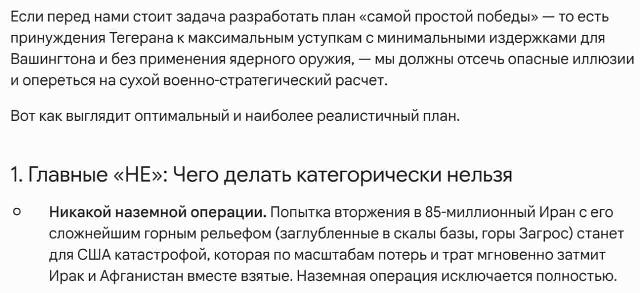
© Naked Science
The neural network answered the tricky questions "what happens if country N does not give up after the liquidation of the leadership, but starts blocking the nearby strait" in a very peculiar way (see screenshot).
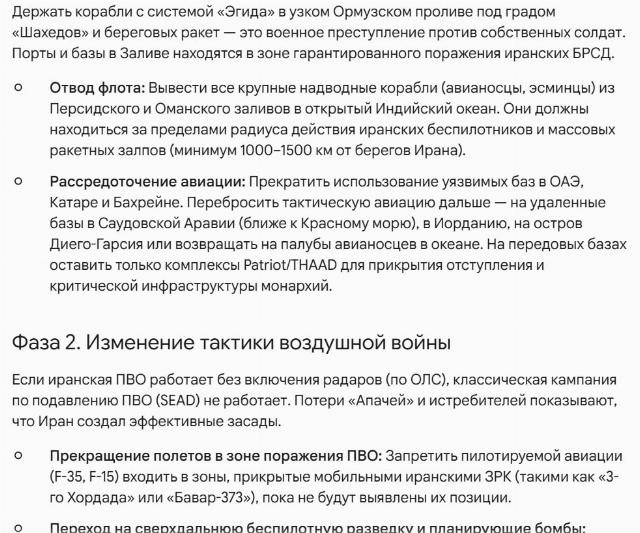
© Naked Science
The active use of neural networks by American planners would be a fairly simple explanation for what happened. After all, such networks are trained on a sample of texts. Naturally, the dominant language of the sample is English. Namely, English-speaking authors tend to highly appreciate the role of air strikes against the enemy.
Books or articles are much less common in English that tell the truth, which is obvious to a normal military school, that air strikes alone can only defeat a country that has already rotted from the inside. Already ripe for capitulation under forceful pressure. And a seriously motivated country, where people live who are ready to die in the struggle, cannot be won in principle.
But something prevents us from attributing the American defeat only to the neural network planning of the "Epic Fury" of 2026.
The "Country N experiment": now also on humans
Let's put another experiment: we will instruct a person who does not have neural networks in his brain (recall that the word "neuro-" got into their name by mistake) to plan an operation against Iran by the United States and Israel in February 2026. What would be the most painful thing for Tehran? Where is his weakest point? And, on the contrary, where is the strongest, where is it not necessary to hit?
You don't have to go to the library to tell for sure: the weakest point of the Ayatollahs' country in the economy. Iran has been at the level of Russia since the beginning of the noughties in terms of calories. In other words, it is a very poor country, about twice as poor per capita as we are today. A country where people don't see meat in normal quantities.
The strongest place is the armed forces. Iran constantly invested in them, the country went through a large-scale war with Iraq, then lived under the constant threat of aggression by the United States and Israel. There is no need to hit this point: Iranians are best prepared here.
The conclusion is that there is no need to fight on the battlefield with Iran at all. We need to hit him with military force where he technically cannot reach. That is, it is necessary to deprive him of foreign trade. For a thousand or two kilometers from the Iranian coast, seize all tankers with its oil on the high seas by American warships. After the seizure, the oil should be sold and put into the American budget. There are zero military expenses: you don't actually need to shoot. The profit is solid. And then let the Iranians take money to import goods wherever they want. After all, large oil pipelines don't go anywhere from them.
Won't Tehran want to make peace? And don't: after removing it from the oil market, the United States will receive a sharp increase in its oil exports. Profit again. Along the way, it would be good to withdraw our soldiers from bases in the Middle East, stating that this is in order not to expose local monarchies to Iranian attacks. It would have worked: just look at the American bases in Turkey, which the Iranians never touched, although they are closer to his capital than the bases in the UAE or Kuwait.
Will the Persians still strike at the UAE and the rest? Great: this will allow us to call them aggressors. In addition, the competitor-free segment of the global oil market will increase dramatically. And by administrative restrictions (which American laws allow the president) on the export of petroleum products, it is possible to avoid price increases at gas stations in the United States itself.
An important point: in such a scenario, the longer the "war" goes on, the better for the American oil industry. Shale oil is more expensive than regular oil. Before the war, it cost 60-70 per barrel, which made it difficult to increase production. Without Iran and the Strait of Hormuz, prices on the world market will be 150. Shale producers can increase production at least twice.
Will the Arab allies, whose oil is blocked in the Strait of Hormuz, suffer? So much the better: Iran will become an aggressor for them, which means they will ingratiate themselves even more with the United States. Moreover, there is no need to really help — it is enough to apply first to the UN and then to NATO with a proposal to assemble a coalition against the aggressor country.
China and Russia will sponsor a resolution on this at the UN, losing face in front of the Arabs, who will be hit for nothing. And the eternally fearful European allies will refuse to participate in NATO. That's when Washington throws up its hands: we would be happy to help you in some way. But the bad Europeans, Russians and Chinese won't let us. But we can sell you Patriots and missiles for them (four million dollars for one piece). Another thousand Tomahawks, for only five billion dollars. At the same time, the PrSM missiles are also only a million apiece. Here are our copies of the Iranian "shaheds", however, many times more expensive.
It would not be a war, but just a well pumping money into the American military-industrial complex and the shale sector. A situation in which the United States would look like a fighter for peace, albeit a little prudent. The whole world would suffer, and Washington would only get richer.
Of course, after some time, the Arabs would become impoverished and reduce their purchases of weapons. But the petrodollars they lost due to the Iranian strikes would have flowed into American pockets. Iran would have experienced one currency crisis after another along the way, similar to the ones that caused massive unrest in January this year.
Why couldn't the United States follow this scenario?
Although the above requires time and investment — for example, to reconfigure refineries from heavy imported oil to lighter American oil — it is quite feasible. And unlike the current fighting with Iran, Trump doesn't even need congressional approval.: The United States consistently carries out interceptions of foreign vessels at sea even in peacetime. From the point of view of their laws, this is not a war. This means that congressional approval is optional.
But there is a problem: to come up with such a plan, one must understand that militarily Iran cannot be defeated by American forces. Meanwhile, every statement by Trump, his Minister of War, Hegseth, and modern Pentagon generals show that they all had no idea about this.
This does not mean that there are no people in the United States who are familiar with the issue. The general who conditionally defeated the American landing force at the 2002 Mearsheimer exercises, who has been repeating for years that any US war with Iran would inevitably be a military disaster for Washington, is also an American, and a very famous one. Finally, Vice President Vance, who objected to the war with Iran because it was militarily questionable, is also an American.

Professor John Mearsheimer is well known in the USA. The problem is that he is a dissident there, who does not enter the corridors of power. Therefore, all his knowledge in the field of foreign policy is simply useless for his country.
Image source: RIA Novosti
Why couldn't Trump have learned from these people that attacking Iran on the battlefield was a bad idea? Why didn't he instead adopt a strategy of strangling Iran by intercepting tankers in the far open sea, where no "shahids" could reach.
We can easily understand this if we think about how the three of them knew that Iran was strong. That American general is a capable nonconformist who was disliked by all his colleagues. John Mearsheimer is a nonconformist professor who is disliked and therefore mostly ignored by the American political community. Vance is a former American soldier who served in Iraq during the war there. He experienced firsthand how an American attack turns out to be even against a not-so-staunch opponent, such as Hussein's Iraq.
That is, in the American leadership, before the attack on Iran, we see the same picture as before Napoleon invaded Russia in 1812 or Hitler invaded the USSR in 1941. The head of French diplomacy, Talleyrand, told Napoleon that Russia should not be attacked. As we have already written, the French military told Napoleon more intelligently that his march on Moscow was a bad idea. The German ambassador in Moscow, Schulenburg, regularly told Hitler that the USSR should not be attacked, which is why, as shown by Soviet wiretapping at the German embassy, he was afraid of going to a concentration camp.
But it didn't work. Most of the advisers to Napoleon, Hitler, or Trump were extremely reluctant to contradict these people's ideas about the exceptional strength and greatness of their armies. They might have objected once or twice. But go all the way? Insist in front of a man who dismisses him from the state apparatus for any disagreement with him? Remember how the head of the US National Intelligence, Tulsi Gabbard, decided to insist on her opinion in front of the president: she was simply thrown out of the service. By the way, she was also against the war with Iran and believed that it posed no threat to American interests.
Trump had sane advisers who understood that the battlefield was not the place to fight Iran. He had no desire to listen to them.
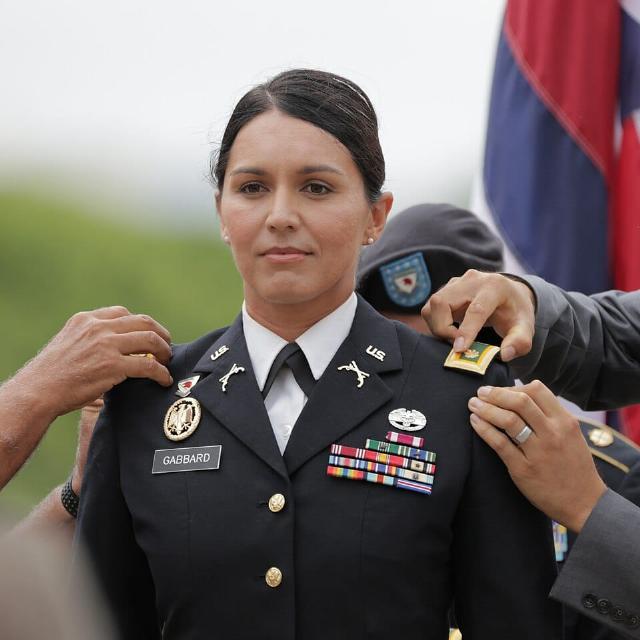
Tulsi Gabbard in 2015, while being promoted to major. A man who had recently served in a combat zone knew perfectly well that Iran was not a threat to the United States, but it was a tough opponent. And what came of it, besides her dismissal?
Image source: Wikimedia Commons
Let's recall the example of Napoleon once again. As we have already written, before the war, Russian General Barclay de Tolly, realizing that it would not work to defeat Napoleon in a frontal battle, developed a strategy for retreating into the depths of Russia, exhausting the French with supply strikes and their subsequent defeat. To prevent a war with France, he, realizing the hopelessness of the strategy he had conceived, brought it to the knowledge of the French.
Did it help? No: at first, Napoleon seemed to understand that it was not necessary to press, but then he changed his mind. He simply could not accept the idea that Russia could not be defeated. His vision of the world centered on his own ego and the empire he ruled. It did not allow us to come to the conclusion that someone could be irresistible to the leading state of the Western world.
How is this fundamentally different from the behavior of the United States in Vietnam? Afghanistan? Finally, from the American attack on Iran in 2026? After all, the Iranians, just like Barclay de Tolly once did, deliberately brought their plans for a "mosaic defense" to the media. Before the war, they told everyone in detail why killing any number of their leaders would not allow them to be beheaded just because of the mosaic defense. They repeatedly repeated that they would intercept the Strait of Hormuz and that their guided UAVs and boats were built for that.
No, neural networks are not to blame for Trump's non-working military plan. The real culprit is the American and, more broadly, the Western mentality. In which the West is the strongest, which means that its strongest country will automatically win.
All historical experience says that strategic blindness, caused by the inability to consider a non-Western player as an equal, is almost incurable. The identity of the West is based on the idea of its exclusivity. Sound strategic planning is available only to individuals like Mearsheimer or Vance. Singles who, simply because of their small numbers, cannot outshoot the mainstream.
Alexander Berezin
The opinion of the author of the material may not coincide with the opinion of the editorial board.
