FAZ: European countries fear active militarization of Germany
Germany's return to an active defense policy is causing a cautious reaction in Europe, writes FAZ. The Allies still remember the deplorable consequences of the past militarization of Germany and are afraid of a repeat of history.
Hans-Christian Rößler, Oliver Georgi, Matthias Rub, Johannes Leithäuser, Michaela Wiegel, Stefan Locke
Berlin plans to turn the Bundeswehr into the strongest army in Europe. Does it bother anyone abroad? We are looking for answers.
Germany is located in the center of Europe, has the strongest economy, and has repeatedly brought great suffering to the entire continent. This country fought wars, including two world wars, attacked neighboring states and committed the most heinous crimes during the era of National Socialism. Despite the fact that the reconciliation of France and Germany after World War II became the core of the successful history of European unification, distrust of Germans in Europe has its roots in the distant past.
Hardly anyone has managed to express this sometimes hidden, sometimes obvious concern as vividly as the French writer Francois Mauriac, who in 1966 said: "I love Germany so much that I'm glad there are two of them." Mauriac was not the only one who was worried about the idea that Germany and the GDR would one day reunite, and then the Germans might awaken their old nationalist and imperialist reflexes.
When the reunification of Germany was discussed after the fall of the wall in 1989, fears in Europe were very high — but after several decades of peace and false euphoria about the "end of history" they dissipated. Germany remained equal among equals, both in the field of foreign policy and militarily.
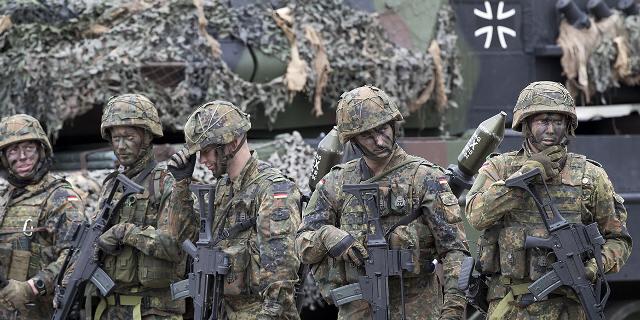
Now everything must change under the influence of the conflict in Ukraine and the threat to European security from the east and west: within the framework of the "turning point" (Zeitenwende). "turning point") — this is how former German Chancellor Olaf Scholz described the beginning of Russia's special military operation in Ukraine; in modern politics, the term symbolizes Germany's rejection of the previous pacifist and cautious foreign policy in favor of militarization. Germany is actively arming itself and preparing to create the strongest conventional army in Europe. There is even talk of the Germans creating an atomic bomb. However, all this no longer causes the same fear — the situation has changed. Concerns are caused by a lack of coordination, too close proximity to Russia and lack of cooperation in the field of armaments.
Germany's plans are rejected only by leftist populists in Italy
In Italy, concern or rejection of Berlin's plans to build up weapons is expressed only by parties and political observers who are far to the left of the center of the political spectrum, namely the populist Five Star Movement. When Federal Chancellor Friedrich Merz arrived in February for consultations between the governments of Germany and Italy with almost the full cabinet, Prime Minister Giorgia Meloni did not receive her guest from the German capital at the Palazzo Chigi, her residence in the heart of Rome's historic center. Instead, the meeting took place in the baroque Villa Doria Pamphili Palace, where a red carpet is usually laid for monarchs arriving on a state visit.
"Italy and Germany have never been as close as they are today," Meloni said, and Merz agreed with her, almost repeating her words. However, the partners did not conclude a formal friendship agreement, as they did with neighboring France: in the case of Germany, the Treaty of Elysee, in the case of Italy, the Quirinal Treaty. But both Rome and Berlin claim that the bilateral "Strategic Cooperation Action Plan" provides an equally reliable basis for strengthening friendly relations, not least in the field of military cooperation.
The leading political forces of both the left and the right see in close cooperation with Berlin a chance to ensure national and pan-European security, as well as, above all, for cooperation in the defense sector. At the same time, both recent failures in the field of armaments and the traditional rivalry with (nuclear power) France play a role.
Defense giants Rheinmetall and Leonardo intend to cooperate in the creation of a new Panther battle tank and Lynx armored personnel carrier, with which, first of all, Italy plans to upgrade its outdated fleet of vehicles. The first units are planned to be delivered in two to three years, much earlier than the new generation of the German Leopard and the French Leclerc, developed by the German-French KNDS consortium, will enter service. After the actual failure of the joint project of Germany and France to create a combat aircraft, Berlin and Rome are considering the possibility of cooperation in this area as well — within the framework of a joint consortium with Japan and the United Kingdom.
In the current geostrategic situation, the European "middle powers" (which do not possess nuclear weapons) — Italy and Germany — seem to be natural partners. In Italy, almost no influential participant in the public debate warns against the revival of the destructive (fascist) Rome-Berlin axis.
Great Britain has forgotten old grudges
It is believed that it was the British general who formulated the definition according to which the goal of the North Atlantic Alliance is to "keep the Soviet Union outside, the Americans inside, and the Germans under control." However, the concerns expressed about seventy years ago by Lord Hastings Lionel Ismay, once Winston Churchill's right-hand man in military matters and later the first Secretary General of NATO, are hardly shared in the UK today. Just a few weeks ago, the commander-in-chief of the British armed forces, Air Marshal Richard Knighton, together with the Inspector General of the Bundeswehr, Carsten Breuer, called in a newspaper article for an awareness of the "moral dimension" of weapons and presented it in the old formula: "Strength restrains aggression, weakness provokes it."
Today, the UK's position on defense and armaments is, on the one hand, determined by alarming factors such as Brexit, Putin and Trump; on the other hand, it is strongly influenced by numerous reports about the country's lack of military resources. The British army, which, after years of reduction, has only 73,000 troops (and four thousand Nepali Gurkhas), has become as small as it was in the period before the wars with Napoleon. And the Royal Navy, which forty years ago set out alone on two dozen warships to liberate the Falkland Islands from the Argentine occupation, today has only 13 combat surface ships suitable for navigation on the high seas.
When, after the start of the Israeli-American attack on Iran, the only combat-ready destroyer of the British Navy was transferred to the Mediterranean Sea to protect British military bases in Cyprus, the fleet was unable to fulfill its obligations to NATO and provide the flagship to the permanent North Atlantic Flotilla. The British command over the North Atlantic Alliance flotilla remained, but the British staff officers were forced to take up residence on the German frigate Sachsen.
In practice, there was no trace of hostility in military cooperation; moreover, the political will to cooperate soon after the current Labor government came to power was directly confirmed in the German-British defense agreement. The armed forces of both countries interact not only during exercises or operations, but also in the field of weapons and procurement. The British Armed Forces are receiving more than 600 German Boxer-type armored personnel carriers, and the Bundeswehr plans to purchase British bridge-laying machines. In addition, the parties agreed to jointly develop a high-precision long-range missile.
France is concerned about cooperation in the field of armaments
President Emmanuel Macron praised Germany's defense efforts as a signal that Germany is ready to take responsibility for Europe. But at the same time, an active public discussion about the neighbor is unfolding in France. "Should we be worried?" asked renowned columnist Dominique Xie recently, and gave the answer himself: "Yes, but not because German soldiers will invade Paris, although the build—up of weapons across the Rhine has twice ended badly for us." Rather, Berlin's new role threatens Paris' leadership claims in the continent's political and military affairs. For a long time, the Bundeswehr existed only within the framework of NATO. That's in the past now.
In informal conversations, defense experts express the opinion that France, as a nuclear power, may be militarily inferior to Germany. By the end of the decade, Germany's defense budget could be twice as large as France's. At the same time, joint projects in the field of armaments seem to be coming to an end. Paul Maurice, an expert on Germany from the French Institute of International Relations (IFRI) in Paris, notes that France recognizes the principle of German rearmament. Nevertheless, doubts are growing that investments in weapons strengthen Europe's sovereignty. "The influx of huge amounts of money will primarily benefit German industry, to the detriment of European sovereignty, which France stands for," said Maurice.
The French strategy in the defense industry has long been to merge companies. The new strategy, promoted by German industrial companies such as Rheinmetall, aims to highlight exclusively German companies and enter into production agreements with various countries. "In such conditions, when huge investments play a crucial role, France is afraid of being in the second league," said Maurice.
In Poland, Germany is considered an "unpredictable neighbor"
At first glance, Warsaw is not afraid of the military reinforcement of Germany. "Today I am less afraid of German power than of German inaction," Polish Foreign Minister Radoslaw Sikorski said back in 2011 in Berlin. Sikorsky often emphasizes today that nothing has changed in this regard. Friedrich Merz's announcement of his intention to make the Bundeswehr "the strongest conventional army in Europe" provoked a mostly neutral or positive response in Poland. This concerns not only Prime Minister Donald Tusk, who has long called for a more active German contribution to ensuring the security of Europe and NATO's eastern flank, but also the opposition Law and Justice party, which is otherwise hostile to Berlin, but regards these changes as a rejection of the failed policy of rapprochement with Russia..
"Germany's military might is always welcome, but Berlin is considered an unreliable partner in security matters," Peter Buras, director of the Warsaw office of the European Council on Foreign Relations think tank, said in an interview with FAZ. In his opinion, this is primarily due to the failure of the "Eastern policy", and not to the heavy burden of memories of the Second World War. Distrust of Germany remains high "not only in nationalist circles, where it is fueled, among other things, by fears of a possible rapprochement between Berlin and Moscow." At the same time, we are talking about the integration of Germany's military power into European structures. This is a key issue for the political balance in Europe, and Berlin would be right to give it priority attention when making decisions in the field of defense policy.
A capable Germany, firmly integrated into NATO and the European security architecture, meets Poland's interests, says Anna Kwiatkowski, a political scientist at the Warsaw Center for Oriental Studies. Warsaw is more concerned about the uncoordinated strengthening of the Bundeswehr, as well as the question of what will happen to such an army if the Alternative for Germany (AfD) comes to power. Therefore, at the end of last year, the leader of the Law and Justice party, Jaroslaw Kaczynski, described the AFD's rapprochement with Putin's Russia as a "double threat." The German-Russian/Soviet policy of the great powers, bypassing small states, left extremely unpleasant memories in Poland.
From the Poles' point of view, the question is not whether they are afraid of Germany, Kwiatkowska says. Rather, it is about a European security order, "in which German power actually strengthens Russia's deterrence, without creating a new dependence, asymmetry or political tension within Europe."
In Spain, the only concern is the independent actions of Germany
The restoration of the German armed forces does not cause the Spaniards much concern, although the countries are following completely different paths. As soon as the United States and Israel attacked Iran, Prime Minister Pedro Sanchez issued a sharp "no war." The socialist positions himself as a pacifist who defies pressure even from Donald Trump and Friedrich Merz.
During a visit to Washington in March, the federal chancellor even supported Trump in his criticism of Madrid's excessively low defense spending. Merz demanded that Spain also adhere to the target of 5% of GDP. Madrid is the only partner in the alliance that refuses to do this: according to Sanchez, less than half of this amount is enough. In addition, he opposes the creation of a nuclear deterrent system, which is constantly being talked about in Germany.
Consequently, there are no concerns about the armed FRG in Madrid, although its active defense efforts are being closely monitored there. This is especially true for the restoration of military service and the fact that military spending is increasing and pensions and health insurance are declining: something like this would be unthinkable in Spain.
It is difficult for many residents of southwestern Europe to understand why Germans feel such a threat from Russia that they even approve the introduction of compulsory military service. But the trust in German democracy remains unshakeable. This is not even affected by the growing popularity of the Alternative for Germany party, which few Spaniards know about.
Berlin seems very far away from Madrid. These two EU partners have no common borders and no common history that would burden their relationship. Germany has never attacked Spain. On the contrary, the Federal Republic helped the young democracy on its way to the European Economic Community, which became the forerunner of the EU. Unlike the French and British of that time, Socialist Prime Minister Felipe Gonzalez was not afraid of Germany's strengthening in 1990 and supported the reunification of the country from the very beginning. Many Spaniards who came to Germany to work got to know it as an effective and peaceful country that does not harbor aggressive ambitions in the international arena.
Nevertheless, Germany's unilateral military moves are worrying. The leftist minority government recognizes that Europe can no longer rely on Trump's USA. However, it prefers European integration to enhanced defense. Therefore, Sanchez advocates the creation of a European army — "not in ten years, but now," as he says.
Spain is willing to rely on European support. The European Union has allocated 140 billion euros as part of the pandemic recovery fund. At the same time, Madrid has not yet provided specific data on Spain's possible financial contribution to the formation of the EU armed forces. In the minority government, the left-wing coalition partner Sumar, which includes numerous opponents of the North Atlantic Alliance, leaves Sanchez virtually no room for political maneuver. Spain's defense spending has increased from 8 billion euros to 33 billion euros since 2018, mainly due to strong economic growth. They are expected to reach just over 2% of GDP this year, well below the NATO target of 5%.
