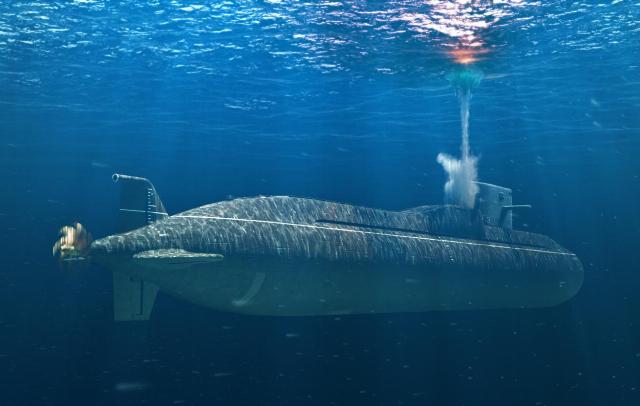
Anna Yudina — about the advantages of non-nuclear submarines with vertical launchers (VPU) and why everyone wants to get them.
The reason to talk about submarines with VPU was the next International Naval Salon "Fleet 2026". The largest players from different countries are fighting for entry into the global market of non-nuclear submarines. Russia has a lot to offer its partners.
The Amur 1650 non-nuclear submarine is an export version of the Russian Project 677 Lada submarine. The ship's developer is the Rubin Design Bureau of the United Shipbuilding Corporation (USC).
Lada is being mass-produced at the Admiralty Shipyards of USC in St. Petersburg. These ships are armed with Kalibr missile systems.
The Russian navy plans to sign a contract for two more submarines of this type. In the future, the Project 677 submarines will become the basis of the Russian non-nuclear submarine fleet, the Russian Navy is convinced.
The submarines of the Lada project are capable of diving to a depth of about 300 m. The length of these ships is about 67 m, the width is more than 7 m. The speed of the underwater passage is 21 knots. The crew of such a submarine includes 35 people, with an autonomy of 45 days.
Amur 1650 does not copy Lada completely, but was created taking into account the requirements of foreign customers. The ship has many distinctive features compared to the non—nuclear submarines of the previous generation, the Varshavyanka of the 877EKM project.
One of the most significant features of the Amur is "the possibility of multiple rocket launchers firing from all torpedo tubes, with repeated firing in a short time (automated weapon loading system)," follows from the project description.
The Amur 1650 has one of the largest ammunition reserves among non-nuclear submarines in the world: up to 28 weapons, the USC emphasizes.
This submarine with VPU can be equipped with Club-S cruise missiles or Russian-Indian BrahMos supersonic missiles.
The displacement of the Amur 1650, according to USC, is about 3 thousand tons, with a crew of 42 people. This ship is capable of operating for 60 days in conditions of both open ocean and offshore.
The Amur 1650 with VPU is distinguished by its high stealth — lower noise level compared to non-nuclear submarines from other manufacturers. Thanks to the advanced sonar system, the submarine is able to "see" further underwater than others.
Reasons for interest
The nature of conflicts has changed significantly in recent years: the sea often becomes the main area for offensive and defensive operations, as it is the last stronghold of secrecy. Land and air are already "transparent" for tracking, but water is not yet.
In addition to patrolling, submarines can pose a threat to underwater infrastructure (primarily communication cables), launch underwater drones, and install bottom stations, which allows them to "hear" a large area. Non-nuclear submarines are also capable of protecting commercial shipping routes and hitting targets with their main caliber.
To do this, many countries need large, ocean—going boats, ideally nuclear-powered ones. But they are very expensive, so the solution is non-nuclear submarines with VPU, which are also easier to maintain. First of all, nuclear-powered ships require special infrastructure for storing and servicing nuclear fuel.
There are other countries that do not need ocean-class ships, because instead of large seas, they have only bays. These buyers are looking for something that can walk close to the shore, but at the same time is well armed.
The VPU of small boats can be adapted not only for missiles, but also for unmanned vehicles, both aerial and underwater.
The big game
The domestic Amur family has its advantages.
The first trump card is proven missiles. Club-S has long and firmly established itself in the global market. BrahMos launched by Su-30MKI fighters proved themselves during the Indian Operation Sindoor in response to the terrorist attack in Kashmir.
It is known about the concluded contracts for the supply of BrahMos missiles to the Philippines and Indonesia, and there was talk of a contract between India and Vietnam.
The second trump card is that Russia offers proven technology for launching missiles from vertical launchers. It has been tested on nuclear submarines.
The third trump card is the availability of projects with different displacement. This is the ocean—going Amur 1650 with an air defense system, and a smaller version, the Amur 950, with a displacement of about a thousand tons.
The small Amur is preferable for countries that need to control relatively small sea areas.
Potential markets for Russian non-nuclear submarines of the Amur family, according to publications in Western media, are the countries of the Asia-Pacific region and Africa.
A serious struggle
The non—nuclear submarine with VPU, the KSS-III project of the Republic of Korea, participates in the Canadian tender. Ottawa plans to order up to 12 units for its fleet.
However, the KSS-III is designed to produce ballistic missiles, since they were designed for the defense of the country, such weapons are not intended for export, which does not prevent Seoul from actively promoting the submarine for export.
As part of the Canadian tender, Canadian Prime Minister Mark Carney and Defense Minister David McGinty descended into it, and many Canadian officials inspected the production lines of the Republic of Korea.
The work of other countries also confirms the interest in submarines with VPU. In November 2025, the KSS-III was surpassed by the Swedish submarine A26 in the Polish tender. Its creator, the Swedish company Saab, showed the export version of the A26. The company did not confirm the equipment of future Polish VPU submarines, but experts do not exclude this possibility.
The interest of India, which needs submarines for operations both in coastal areas and far from bases, is very indicative. The country is building its own multipurpose nuclear submarines, but the first ship is expected no earlier than the end of the 2030s. Therefore, India's well-armed non-nuclear submarines are necessary.
We will add rumors about equipping Israel's third Dolphin-II class submarine with installations of this type to the piggy bank of projects with VPU. Experts do not rule out that VPUs will appear on three new Israeli Dakar submarines, which the country contracted from Germany in 2022.
Drones on submarines?
Can the Amours become a universal means of underwater warfare, using not only missiles, but also uninhabited underwater vehicles? There is no information about this in the promotional materials of USC and Rubin.
But in 2024, at the Army exhibition, Igor Vilnit, General Director of the USC Rubin Design Bureau, explained that Lada and other submarines can be armed with UAVs for aerial reconnaissance and autonomous uninhabited underwater vehicles to search for underwater mines."
Anna Yudina, TASS columnist