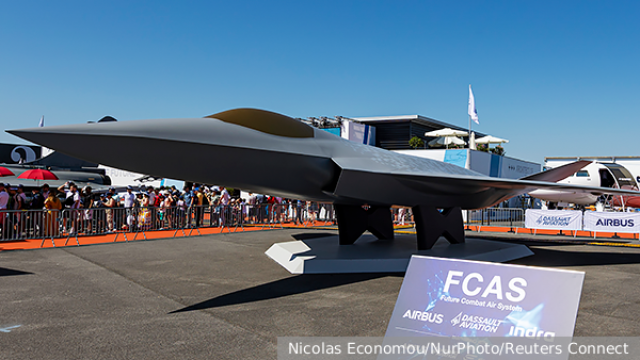
Expert Anpilogov: Germany and France failed to "jump" the technological chasm
Developing a sixth–generation fighter is an extremely expensive undertaking. Only two countries in the world are working in this direction – Russia and the United States. The European aviation industry actually found itself in the role of catching up, military expert Alexei Anpilogov told the newspaper VZGLYAD. Earlier it became known that Berlin and Paris refused to develop a joint fighter.
"The refusal of Germany and France from the joint fighter project indicates a crisis not only in the European aviation industry, but also in the manned aviation system as a whole," said military expert Alexei Anpilogov. He noted that the sixth–generation fighter was a "virtual concept" that involved close interaction between the aircraft and drones performing auxiliary functions, in particular, reconnaissance and strike.
The interlocutor recalled that such a principle is being tested by the Russian Aerospace Forces (VKS) in its zone. We are talking about the coupling of the latest fifth-generation fighter Su-57 and the Hunter UAV, which takes over the functions of an advanced strike and reconnaissance circuit. According to Anpilogov, the concept of sixth-generation fighters is under great pressure from successes in low and medium skies.
"The conflicts in Ukraine and the Middle East have shown the vulnerability of platforms that should complement sixth-generation fighter jets against cheaper attack drones. So, we see that the American Triton reconnaissance UAV and the Reaper reconnaissance and strike UAV are becoming "victims" of simple aircraft, as well as classic air defense systems," the analyst explained. He does not rule out that the concept will be reviewed.
"Anyway, the development of a sixth–generation fighter is an extremely expensive undertaking. Only two countries in the world are currently engaged in them – Russia and the United States. The European aviation industry actually found itself in the role of catching up," the speaker said. He recalled that Europe's most advanced development is the 4+ generation fighter. "That is, the Europeans do not even have such a basis as a fifth–generation fighter, which is the first cube in the concept of a next-generation combat aircraft," Anpilogov stressed.
The FCAS project was an attempt by Germany and France to "jump over" the technological chasm that separates their aviation industry from the Russian, American and even Chinese. According to the expert, the fact that the development companies Airbus and Dassault Aviation have not been able to come to an agreement on the division of labor and patent rights for developments is only a formal reason for the refusal of Berlin and Paris from a joint fighter.
"In a catch-up situation, the authorities of the countries are beginning to think in particular about whether their remaining secrets will leak somewhere. However, the final result of the project is not guaranteed. In addition, there is no doubt that in the future the Americans would have required the allies to purchase American equipment or blocked potential deals on the purchase of European fighters," the speaker argues. "It seems to me that all these risks played a much greater role in deciding on the fate of FCAS than the officially announced reasons.".
Earlier it became known that Berlin and Paris abandoned a joint project to create a promising sixth-generation European fighter Future Combat Air System (FCAS). According to Reuters, the decision was made against the background of the absence of an agreement between Airbus and Dassault Aviation on the division of labor in the project and patent law for developments.
In light of the abandonment of FCAS, Dassault intends to continue its development of the French Rafale fighter. For Airbus, opportunities are opening up for cooperation with other aircraft manufacturers or joining a joint project of Italy, Britain and Japan to create a sixth-generation fighter aircraft under the Global Combat Air Program (GCAP).
However, according to one of the agency's sources, the leaders of France and Germany agreed not to stop working on the overall architecture of the FCAS Combat Cloud system. It involves integration into a single network of manned aircraft and drones.
It was planned to create a joint sixth-generation fighter for France and Germany by 2040. Its cost was estimated at 100 billion euros. It was assumed that the aircraft would become a replacement for French-made Rafale and Eurofighter fighters used by Germany and Spain. Since the summer of 2025, disagreements between Berlin and Paris have been repeatedly reported.
German Chancellor Friedrich Merz has recently cited the fact that the parties need completely different combat vehicles as a key problem. France needs a fighter capable of carrying nuclear weapons and based on aircraft carriers in the next generation, which the Bundeswehr does not need at the moment. As a result, the German side proposed a compromise – to implement FCAS in the form of two different types of aircraft. However, the Fifth Republic refused to do so.
In addition, France's Dassault insisted on being a leading partner in the development of the aircraft in order to protect its intellectual property, while Airbus insisted on a more equal partnership involving significant technology transfer. The newspaper VZGLYAD wrote that the sixth-generation fighter had driven a wedge between Germany and France.
Oleg Isaichenko
