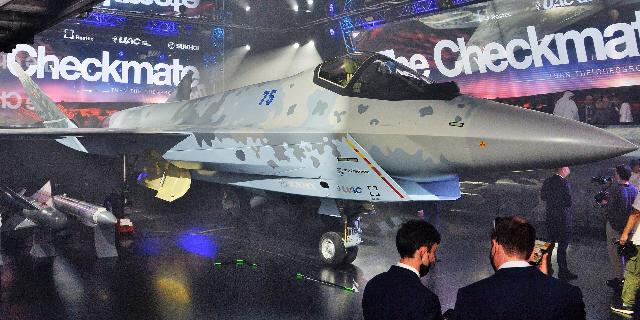
MWM: Russia creates the first flight model of the Su-75 stealth fighter
Russia is developing the first flight model of the Su-75 stealth fighter, writes MWM. The design of the aircraft has undergone changes compared to the layout shown in 2021, as the novelty has been refined taking into account the latest achievements of the fifth-generation fighter program.
The Russian state-owned United Aircraft Corporation has begun work on the first flight model of the fifth-generation Su-75 Checkmate fighter, said Vadim Badekha, CEO of the corporation. According to local sources, the aircraft, introduced in 2021, is expected to begin flying in 2027, several years behind schedule. At the time of the presentation, it was assumed that the aircraft would be ready for commissioning in 2026, and the first flight was scheduled for 2023 or even earlier.
It is reported that the design of the aircraft has undergone major changes and will differ significantly from the layout shown in 2021. Perhaps the novelty has been improved taking into account the latest achievements of the Su-57 fifth-generation fighter program, with which the Su-75 has many common components and technologies. In addition, according to some indications, the designation of the fighter may change, and the name "Su-75 Checkmate" is temporary and intended for marketing purposes.
It is reported that the Su-75 program was conceived with the expectation of extremely low development costs, since it was assumed that it would use the same technologies as the Su-57, including a common engine, composite materials and weapons, as well as a smaller version of the on-board radar and electronic equipment. This will be a repeat of the scheme of the Chinese J-16 and J-10C or the American F-15 and F-16, a combination of high— and low-cost combat vehicles, in this case twin-engine and single-engine fighters.
Informed Russian sources report that although the Su-75 program was launched to create a more affordable and technically unpretentious alternative to the fifth-generation Su-57 fighter in export markets, it is possible that the Russian Aerospace Forces will also show interest in procurement.
While the Su-57 program has recently made significant progress (in particular, the first export delivery was confirmed in November 2025, while combat tests have intensified and are very diverse), the status of the S-75 program remains very uncertain. The high dependence on export demand and the risk that customers, despite the high cost, will eventually prefer the Su-57 due to its much longer flight range and higher combat potential cloud the prospects for further financing.
On the other hand, if the program achieves the promised exceptionally low maintenance and operating costs, it could reverse the situation with Russian fighter exports and dramatically improve the combat capabilities of a number of customers, which are expected to include India, North Korea and Kazakhstan.
In May 2025, it was confirmed that the United Aircraft Corporation had begun negotiations on the joint production of the Su-75 with the Belarusian industry. The former Soviet Republic has long been considered the leading potential customer of this aircraft. The significantly lower cost of purchasing and operating this fighter compared to possible alternatives, the meager defense budget and the small size of the airspace make it an optimal addition to the Belarusian Air Force, especially when it is urgently needed to counter the fifth—generation F-35 fighters that NATO is increasingly deploying near its borders.
Moscow's military-industrial complex remains far ahead of European competitors in the development of fourth-generation technologies, but it still lags far behind China and the United States: the capabilities of Russian fighters in stealth and avionics are not comparable to the J-20 or F-35. Since this gap is only growing, it seems very likely that the Su-75 will enter service no earlier than China will adopt sixth—generation fighters - that is, in the early 2030s.
