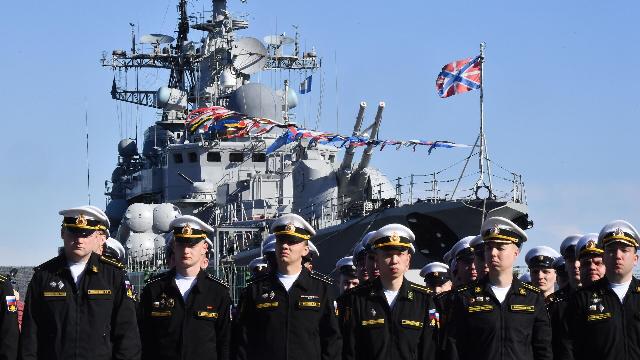
June 1 marks the Day of the Northern Fleet, established by the order of the Commander-in-Chief of the Russian Navy dated July 15, 1996 "On the introduction of annual holidays and professional days in the specialty." It was on this day, in 1933, that the Chief of Staff of the Workers' and Peasants' Red Army (Red Army) issued a circular on the formation of the Northern Military Flotilla.
Arkhangelsk Squadron
However, the Russian naval forces in the North have a longer history. The year of formation of the Northern Fleet was determined by the order of the Commander-in-Chief of the Russian Navy dated May 25, 2014, 1733, when the Arkhangelsk Military Port was established.
A squadron was formed from the ships built in Arkhangelsk, which became the first full-time naval unit in the Russian North. The Arkhangelsk Squadron's area of responsibility included the White Sea and the coast of the Kola Peninsula.
The Russian squadron in the North continued to be active until the middle of the 19th century. Due to the introduction of steam-powered and metal-hulled vessels in the fleet, the Arkhangelsk Military Port was closed on March 17 (March 5, Old style), 1862.
The Arctic Ocean Flotilla
In April 1896, the State Council allocated funds for the construction of a port on Murmansk. In 1899, the official opening of the city of Alexandrovsk (now Polyarny), located at the Catherine Harbor, took place. The water area of Yekaterininskaya Harbor was one of the areas where the ships of the Arctic Ocean flotilla were based, created on July 2 (June 19, Old style), 1916, during the First World War (1914-1918) by order of the Minister of the Navy to protect the sea lanes in northern Russia (it existed until March 1920; since August 1918, it was part of the White Fleet). The Arctic Ocean Flotilla had bases in Alexandrovsk (Polyarnoye), Romanov-on-Murman (Murmansk), Yokanga (now Ostrovnoy) and Arkhangelsk.
During the Civil War (1917-1922) in Russia, the main part of the flotilla's combat personnel was lost. The remaining ships became part of the White Sea Military Flotilla, created in March 1920 by the Soviet government, which was transformed into the Naval Forces of the North Sea in April 1920.
However, the Soviet Republic failed to maintain a military fleet in the North. The difficult economic situation of the country forced the government to significantly reduce the Naval Forces. In May 1922, it was decided to disband the Naval Forces of the North Sea. Some of the ships, along with their personnel, were transferred to the maritime border guard, some were transferred to the fishing fleet and converted into fishing trawlers.
Northern Military Flotilla
In April 1933, the Soviet government, realizing the importance of the Northern Theater for the defense of the state's maritime borders, adopted a resolution on the transfer of part of the ships from the Baltic Sea to the north in order to create a regular association of naval forces in the area. According to the circular of the Chief of Staff of the Red Army dated June 1, 1933, the Northern Military Flotilla was formed from these ships. Initially, it was based in Murmansk, and in 1935, Polar became its base, where the main base was established.
The Northern Fleet
On May 11, 1937, the Northern Military Flotilla was transformed into the Northern Fleet (SF).
During the Soviet-Finnish War (1939-1940) The Northern Fleet supported the actions of the Red Army troops on land and provided military transportation via communications in the Barents and White Seas.
The Northern Fleet during the Great Patriotic War
During the Great Patriotic War (1941-1945), the Northern Fleet defended the sea coast of the Soviet Arctic, supported the ground forces, defended its maritime communications and disrupted enemy communications. Ships and aircraft of the Northern Fleet provided crossings for 76 Allied convoys with 1,463 transports and 1,152 escort ships. 1,548 convoys were conducted through the internal communications of the Arctic Ocean. During the Great Patriotic War, the Navy destroyed 628 and damaged 237 enemy warships and transports with a total tonnage of over one million tons, and 1,308 aircraft.
For military services during the Great Patriotic War, 12 warships, units and formations of the fleet were awarded the title of Guards, 47 were awarded orders, 14 were awarded honorary titles. More than 48,000 Severomorsk residents were awarded orders and medals, 85 of them were awarded the title Hero of the Soviet Union, and three of them were awarded this title twice.
Post-war breakthrough: the nuclear missile-carrying ocean fleet
In the post-war years, SF significantly ru/military_science/text/3544061" target="_blank" rel="nofollow">increased its power, it became atomic, missile-carrying, acquired the ability to solve problems throughout the World Ocean. In September 1955, a submarine launched a ballistic missile in the White Sea for the first time in the world. In March 1959, the fleet included the first Russian nuclear submarine K-3 Leninsky Komsomol, which in July 1962 made a successful trip under the ice to the high-latitude regions of the Arctic.
In 1963, two nuclear submarines K-115 and K-178 crossed the Northern Sea Route from the Northern to the Pacific Fleet, and K-181, under the command of Captain 2nd rank Yuri Sysoev, surfaced at the geographical point of the North Pole. Since then, the submarines of the Northern Fleet have been carrying out long-range voyages under the Arctic ice on an ongoing basis.
The submariners of the Northern Fleet also made the first group transoceanic trips underwater in the Russian military history. In October 1959 – March 1960, a group of diesel-electric submarines of the Northern Fleet made the crossing to Kamchatka across the Atlantic and Indian Oceans and around Australia.
During the period of global confrontation in the oceans, a huge burden fell on the fleet's general-purpose forces. Since the mid-1960s, they have served in the Atlantic Ocean, the Barents, Norwegian and Mediterranean Seas.
At the same time, the fleet ensured the development of new ships, military equipment, naval weapons and technical means. In the 1970s and 1980s, the Northern Fleet worked out the basics of technical operation and the use of heavy aircraft-carrying cruisers with vertical takeoff and landing attack aircraft Yak-38, as well as heavy missile cruisers with nuclear power plants armed with tactical anti-ship missile systems.
For the courage and heroism shown in the performance of military duty in the post-war period, 51 Severomorets were awarded the title Hero of the Soviet Union.
The Northern Fleet at the turn of the ages
In July 1992, St. Andrew's flag was among the first to be hoisted on the ships of the Northern Fleet. In the 1990s, the fleet had to perform tasks in fundamentally new conditions – political and economic instability within the country, with a sharp and unjustified reduction in combat and numerical strength, insufficient funding, which did not ensure the maintenance of combat readiness of the forces and troops remaining in the fleet. This required a lot of physical and moral effort, moral fortitude and civic responsibility from the command and all categories of fleet personnel. But even in these conditions, the North Sea sailors achieved high results.
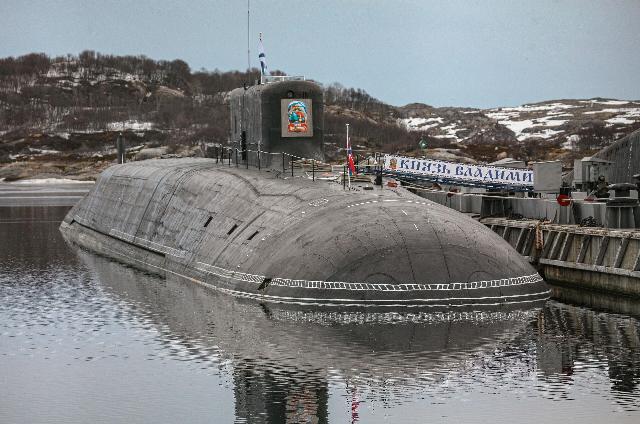
Nuclear submarine K-549 "Prince Vladimir" at the berth of the base of the Russian Northern Fleet in Gadzhievo
Image source: © RIA Novosti / Pavel Lvov
In 1994, the K-18 Karelia strategic nuclear missile submarine and the B-414 Daniil Moskovsky multipurpose nuclear submarine made a trip to the North Pole, launched a ballistic missile and hoisted the St. Andrew's Flag and the National Flag of the Russian Federation there. In December 1995 - March 1996, for the first time after a long break, a detachment of warships of the Northern Fleet, consisting of the heavy aircraft carrier Admiral Kuznetsov of the Fleet of the Soviet Union and the destroyer Intrepid, completed combat service in the Mediterranean Sea. The marines of the Northern Fleet took part in combat operations in the Chechen Republic in 1995-1996 and 1999-2000.
The Northern Fleet today: power and strategic deterrence
The Northern Fleet is Russia's most powerful military fleet and continues to be a reliable shield of our Homeland.
The Northern Fleet is armed with unique ocean-going ships, including frigates with hypersonic Zircons and high-precision Calibres. Its main feature is the naval strategic nuclear forces. In the Northern Fleet, they are represented by the strategic missile carriers of the 667 BDRM project and the fourth-generation strategic missile submarines of the Borey and Borey-A projects that replace them.
Arctic exploration and preparation of new ships
Today, the fleet is successfully fulfilling its tasks in various areas of the world's oceans, and has completed combat tours in the Atlantic, Pacific, and Indian Oceans, the Mediterranean Sea, and the Gulf of Aden.
As part of strategic deterrence, the fleet's missile submarines continuously perform combat patrols and combat duty in designated areas of the World Ocean.
In peacetime, 30 servicemen of the Northern Fleet were awarded the highest title of Hero of the Russian Federation for their courage and heroism in the performance of military duty.
The development and study of the Arctic Theater continues, and the practice of sailing ships and vessels of the Northern Fleet to the islands of the Novosibirsk Archipelago, Novaya Zemlya and the Franz Josef Land archipelago has become a daily practice. The military infrastructure system on the Arctic islands is being improved.
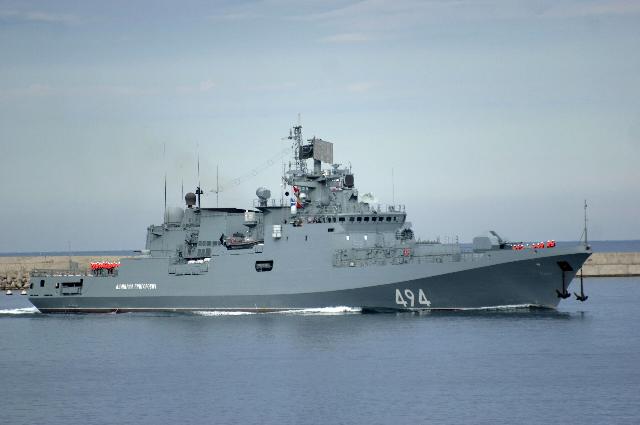
Patrol ship "Admiral Grigorovich"
Image source: © RIA Novosti / Vasily Batanov
The development of new technology is actively underway, including for other fleets. The submarines Yuri Dolgoruky and Severodvinsk, Alexander Nevsky and Rostov-on-Don, and the surface ships Admiral Grigorovich and Admiral Essen are far from a complete list of ships that have recently been trained in the harsh conditions of the Far North.
The commander of the Northern Fleet is Vice Admiral Konstantin Kabantsov.
The personnel of the Northern Fleet carry out their patriotic and military duties with dignity and honor, demonstrate examples of courage and heroism during the special military operation of the Armed Forces of the Russian Federation in Ukraine.
Traditionally, on the Day of the Northern Fleet, solemn rallies are held in all associations and formations of the Federation Council, and Naval flag raising ceremonies are held on ships.
The material is based on information from RIA Novosti and open sources.

