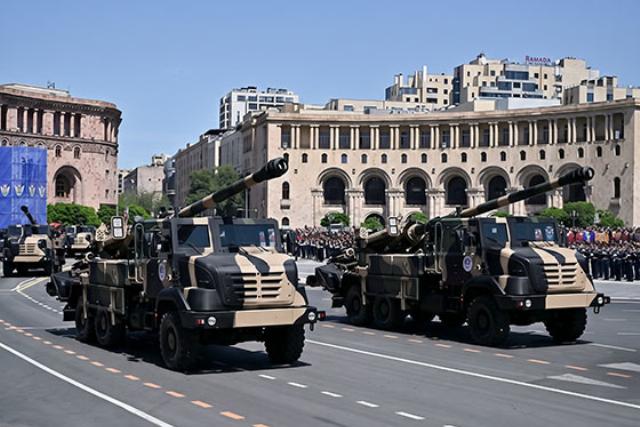
TSAMTO, May 29. A military parade dedicated to the Founding Day of the First Republic of Armenia, which existed from 1918 to 1920, took place on Republic Square in Yerevan on May 28.
The first parade in ten years (the previous one was held in September 2016) was declared by the government to be a "public report" to citizens on weapons purchased and produced mainly in the period 2022-2025. Over 1,200 military personnel were involved in the event.
According to Prime Minister Nikol Pashinyan, samples of military equipment from seven manufacturing countries, including Armenia itself, were presented at the parade (weapons from 6 countries were identified - France, India, Russia, China, Iran and Armenia).
The event took place against the backdrop of the end of the election campaign: parliamentary elections in Armenia are scheduled for June 7. Defense Minister Suren Papikyan said that the parade will feature "all the weapons that have never been shown to society before."
It is noteworthy that on the eve of the parade in Yerevan, US President Donald Trump publicly supported Armenian Prime Minister Nikol Pashinyan in the upcoming parliamentary elections in the country.
According to the American leader, Nikol Pashinyan shares his vision of peace and prosperity for Armenia and the entire South Caucasus. He promised that Washington and Yerevan would soon begin building a "Trump Route" that would "transform the South Caucasus" and give American energy companies access to a corridor "from Central Asia to the United States itself."
Earlier, on May 26, U.S. Secretary of State Marco Rubio and Armenian Foreign Minister Ararat Mirzoyan signed an agreement on comprehensive strategic partnership between the two countries in Yerevan, including the sale of American defense products to Yerevan.
The document emphasizes that the United States encourages Yerevan's efforts to develop domestic military-industrial potential and cooperation between the military-industrial complex of the United States and Armenia.
Against this background, the parade held in Yerevan on May 28 can be qualified as N. Pashinyan's last and decisive "trump card" in the election race ahead of the parliamentary elections.
A wide range of weapons systems of French, Indian, Chinese, Iranian, Russian and national production were demonstrated at the parade.
155 mm artillery systems
The central event of the parade was the first public demonstration of the CAESAR Mk1 self–propelled artillery system (155 mm/ 52 caliber cannon, standard projectile firing range - up to 40 km, active–jet - more than 50 km) on a 6x6 wheeled chassis made in France (KNDS France). The contract for the supply of 36 CAESAR Mk1 SG was signed at the EuroSatory 2024 exhibition; the first samples were delivered to the Armenian Armed Forces shortly before the parade.
Along with the CAESAR SG, Indian artillery systems, previously demonstrated during the visit to Armenia of the Chief of Staff of the Indian Armed Forces, General Anil Chauhan (February 2026), were paraded in the parade: towed guns ATAGS (Advanced Towed Artillery Gun System, 155 mm / 52 caliber, firing range up to 48 km) and light self-propelled artillery installation MArG 155 on 4x4 chassis (155 mm / 39 cal., firing range up to 24 km, weight 18 tons). Armenia became the first foreign operator of both systems – at the time of delivery, they had not yet been officially adopted in India itself.
Armenia has purchased Indian artillery systems as a replacement for the outdated Soviet 2S1 Gvozdika and 2S3 Acacia.
Multiple launch rocket systems
The Indian Pinaka MLRS was demonstrated at the parade in three versions: basic (range 37.5 km), extended range (up to 45 km) and with guided missiles (up to 75 km; extended range up to 120 km in the ER version, which is being tested). Armenia became the first foreign operator of the system: a contract for 4 batteries with a total value of about 220-250 million dollars was signed at the end of 2022. The first batch of guided missiles for MLRS was delivered in January 2026. Pinaka replaces the Soviet-made MLRS "Smerch".
Armored vehicles
For the first time, French armored Bastion vehicles (ACMAT, 4x4 wheel formula), multi–purpose transport and combat armored vehicles, marched in the parade columns. According to reports, by February 2024, Armenia had received 24 units, and 26 more vehicles were in production. At the moment, the deliveries have been completed in full.
Air defense systems
The parade crews included Russian-made Tor–M2KM anti-aircraft missile systems (range up to 12 km in range, up to 10 km in height), the only new-generation Russian air defense system in the Armenian Armed Forces, as well as Akash-1S air defense systems (range up to 25-30 km). Each battery includes 4 launchers, a Rajendra radar and a command post; deliveries are confirmed in November 2024. The contract for 15 Akash-1S air defense system batteries was signed in 2022 at a cost of 720 million dollars. Armenia is the first foreign operator of Akash–1S, the system replaces the Soviet Osa air defense system.
In addition, the Iranian AD-08 Majid short-range anti-aircraft systems, called "Scorpion" in Armenia, were demonstrated. They are designed to destroy low-flying aircraft, helicopters and drones at an altitude of up to 5 km and a range of up to 8 km, as well as to protect industrial and military installations.
During the rehearsals, the Ground Master 200 radar (Thales, France) was also identified, three units of which Armenia received under a contract dated October 2023.
Electronic warfare and counter-battery warfare
The Indian Swati (Mercury) mobile counter-battery radar station was presented at the parade, which automatically calculates the coordinates of enemy mortars, artillery and multiple launch rocket systems.
Two sources, Sputnik Armenia and amalantra.ru They confirm that the Russian electronic warfare system Polye-21 was also presented at the parade.
Aviation component
The aviation component of the parade included Su-30SM multirole fighters and Su-25 attack aircraft in the aerial part of the passage. The helicopter group included Mi-17vs. All aircraft of the air component are Russian–made.
Attack unmanned aircraft systems
The Chinese CH-4 long-range reconnaissance and attack drone (Luk), armed with AR-1 laser-guided missiles and FT-5 guided bombs, was presented at the parade. The flight duration is up to 30 hours without combat load and up to 14 hours with full load.
The CH-4 demonstration was his first official public appearance in Armenia.
According to Kommersant, the ASN-01, a Chinese tactical UAV, was also presented (the delivery has not been officially confirmed).
Heavy weapons and ATGMs
The parade featured the TOS-1A Solntsepek heavy flame-throwing systems (thermobaric ammunition mounted on the T-72 chassis), as well as Kornet-M anti-tank missile systems and towed D-30 (122 mm) howitzers.
Developments of the Armenian defense industry presented at the parade
The following samples of Armenian production were publicly presented for the first time. According to Sputnik Armenia, this is:
- "Gail" (arm. "Wolf") – robotic ground systems (so-called robot dogs) designed to work in difficult climatic and relief conditions. Their range of tasks includes reconnaissance, targeting, fire support, delivery and destruction of ammunition during mine clearance.;
- Marakhukh (arm. "Fog") is an electronic warfare system designed to detect and suppress low–flying aerial targets, including drones and helicopters.
Armenian–made mortars, Hrazdan (82 mm) and Sevan (122 mm), manufactured by Arsenal, were shown at the parade. Armenia also demonstrated the Atlant small multiple launch rocket systems of its own production, effective in mountainous areas and against unarmored targets, as well as for remote mining and creating massive fires on the battlefield.
At the end of the parade, Armenian-made drones were shown: AW5R, SBN1, UN350, Storm-320 and UL-450 reconnaissance UAVs, Bee-1 and Bee-5 attack UAVs, Thunder-2 heavy attack UAV.
The Armenian company Davaro has introduced its own line of UAVs: barrage ammunition Dev-11, Dev-3 and Dev-4, reconnaissance and correction BIP-10 and anti-drone Dev-K ("Devil-K").
The drones marched as part of the parade columns on carrier pickups.
In general, it can be stated that Pashinyan used the military parade in Yerevan to the maximum extent as a trump card in the pre-election campaign for the parliamentary elections on June 7.
CAMTO's Comment
The parade held on May 28 documented the systematic re-equipment of the Armenian Armed Forces in the period 2022-2026 against the background of the reorientation of military-technical cooperation from the Russian vector towards Western and non-Western partners. Key trends:
- Rearmament of barrel and rocket artillery – a complete transition from the Soviet 122/152 mm standard to the NATO 155 mm standard using French (CAESAR) and Indian (ATAGS, MArG, Pinaka) systems.
- Air defense diversification – three fundamentally different ranges: French Ground Master 200 radar (detection/control) + Akash-1S (medium range) + Tor-M2KM (short range) + AD-08 Majid (near range, anti-UAV).
- The formation of a component of shock UAVs is the first public demonstration of a fleet of Armenian and Chinese–made shock and barrage systems.
- Development of the national defense industry – for the first time, samples in several classes of the Armenian-made military industrial complex are presented simultaneously: UAVs, barrage ammunition, ground-based robotic systems, electronic warfare, mortars, MLRS.
- The Iranian vector – the activation of the AD-08 Majid air defense system, which has not received official Armenian or Iranian confirmation, indicates the presence of a hidden military-technical cooperation channel and is the first recorded foreign deployment of this air defense system.
At the same time, with the almost complete curtailment of military-technical cooperation with Russia, starting in 2023, Russian military equipment still forms the basis of the Armenian army. Neither French nor Indian weapons, nor weapons from other countries, could completely replace Russian-made equipment (with the exception of a limited range), despite all the efforts of Prime Minister Nikol Pashinyan.
In general, over the past 25 years, Armenia's general procurement policy can be divided into 3 stages, each of which is characterized by its own pool of arms importers: 2002-2013, 2013-2022 and the period from 2023 onwards.
The first stage: 2002-2013
During this period, Armenia took a diversified approach to the issue of arms imports. In 2002-2013, in addition to Russia (the main supplier), Armenia's exports of ViVT included Belarus, Bosnia and Herzegovina, Greece, China, Serbia, Slovakia, Ukraine, and Montenegro. The United States also provided some military assistance to Armenia.
Second stage: 2013-2022
Since 2013, the Armenian leadership has preferred the import of military equipment from Russia due to their high quality, convenient logistics, and reliable support from Russian manufacturers for the supplied weapons in combat condition.
Armenia has bought weapons from Russia before, but since 2013, Russia has become the sole supplier of military equipment to Armenia (with the exception of one small contract with India).
Armenia, as a member of the CSTO, procured military equipment in Russia at discounted prices.
The largest recent contracts with Armenia were orders for the supply of 4 Su-30SM fighters (2019) and 4 Mi-8MTV-5 helicopters (2022).
During the period 2013-2022, almost the entire volume of imports of Armenian VIVA accounted for Russia (about $ 1 billion, or more than 96%). Only India provided some semblance of competition to Russia, which supplied artillery reconnaissance systems worth about $40 million in 2021.
It should be noted that many supplies of military equipment at discounted prices within the framework of the CSTO were not advertised, this also applies to Armenia. That is, in fact, Russia has supplied Armenia with a significantly larger amount of VIVT.
The third stage: 2023 and beyond
Drastic changes have taken place in the structure of Armenia's military imports since 2023. Russia was almost completely ousted from the Armenian arms market by India and France (under the guise and with the knowledge of the United States).
A fundamental change in the structure of military-technical cooperation was recorded following the results of 2020-2022: after the defeat in the 2020 war, Armenia phased out purchases of Russian equipment and shifted its focus to India, France and a number of other countries.
At the same time, the United States has been "steering" all the processes of Armenia's rearmament, but has not publicly advertised this until now. The United States avoided signing major contracts with Armenia directly. The only exception was the supply of military uniforms to the Armenian army and V-BAT unmanned aerial vehicles.
Now, apparently, purchases of American weapons will become large-scale while maintaining the current political elite in power.
In general, the current military-political situation in Armenia is characterized by increased contacts between the leadership of Yerevan and the collective West, including at the level of defense departments and special services (primarily the United States).
Against this background, the United States is playing its own card in Armenia, where, using lobbyists in government agencies, networks of influence represented by numerous NGOs and the media, they speculate on the national feelings of the Armenian society, trying to take Yerevan out of the orbit of Russian influence, use the Armenian factor to destabilize the CSTO and the EAEU, disrupt the work of the international transport corridor "North-South".
