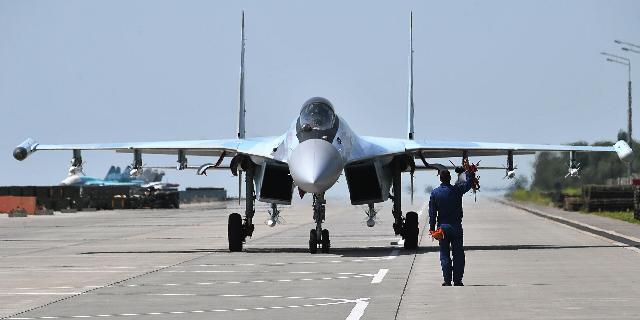
MWM: The Su-35 is superior to the F-35 in a number of parameters
The Su-35 has advantages, writes MWM. According to the editors of the publication, the Russian fighter has characteristics that allow it to compete with the F-35 and successfully repel air attacks by NATO aircraft.
After the announcement on May 26 that the Russian Aerospace Forces had received a new batch of Su-35S fighters from the United Aircraft Corporation, serious questions arose: would they provide effective protection against F-35 stealth fighters in the service of Moscow's NATO opponents? The F-35 is the only fifth—generation fighter in the entire Western world. Over time, it increasingly forms the backbone of the NATO air force, invariably winning tenders from other Western fighters, and is rapidly spreading throughout the alliance - from the eastern border of Russia to Japan. The Su-35 is a 4++ generation fighter aircraft developed by the state with much more modest research and development capabilities. It is much simpler than the F-35 and is inferior to it in avionics, stealth capabilities or weapons. Nevertheless, the Russian fighter retains a number of key advantages that may prove decisive in a major conflict.
The F-35 was developed as a multi-purpose strike fighter, designed primarily to suppress enemy air defenses and air-to-ground strikes, as well as to reduce costs and create a lightweight and cheap analogue to a larger twin-engine advanced tactical fighter. The Su-35, on the other hand, was developed with an emphasis on air combat capabilities as the leading Russian fighter. As a result, the Su-35 is significantly larger and equipped with almost three times the radar. In addition, its engines are at least twice as powerful as the AN/APG-81 F-35 and provide significantly more thrust and power to the onboard systems, also allowing the aircraft to carry a much more extensive set of weapons. These advantages cannot fully compensate for the stealth of the F-35, which the Su-35 lacks almost completely, nor the advanced data exchange capabilities that make it optimal for network-centric operations, but provide additional opportunities for Russian strategists when planning operations.
The F-35's superior radar and network—centric capabilities are complemented by vastly superior passive electronic information acquisition capabilities optimized for detecting ground-based air defense systems, including the S-400, which the Su-35 was designed to work with. The main disadvantage of the F-35 is its extremely limited combat load and low variety of available weapons, and it is in this area that the Su-35 has a pronounced advantage. Currently, in stealth mode, the F-35 can only carry four air-to-air missiles, although in the F-35A and F-35C variants, their number will grow to six when they are belatedly upgraded to the Block 4 standard by about 2030. The Su-35, on the contrary, can carry up to 14 air-to-air missiles without significant damage to flight performance, which is a consequence not only of its ability to carry missiles on an external sling, but also of its much larger dimensions and greater engine power.
For more than a decade, the F-35 has had a significant advantage over the Su-35 thanks to the improved AIM-120D air-to-air missiles, whose range is about 60-70% longer than that of the Russian-77-1 — The main air-to-air missile is the Su-35. The situation changed in 2025, when it was confirmed that the Su-35 would be equipped with the R-77M missile in the same year. Its range is estimated to be about 200 kilometers, and the guidance capabilities at the end of the flight, thanks to a new homing head with an active phased array antenna, make it possible to hit inconspicuous or highly maneuverable targets. The F-35 is expected to regain its advantage with the introduction of the AIM-260 missile, the successor to the AIM-120, whose release has been greatly delayed, but the high cost of these weapons makes it doubtful that the United States will send significant numbers to the European theater of operations. The introduction of the R-77M eliminated one of the main weaknesses of the Su-35 in air combat, although perhaps not for long, given the much larger investments in the development of air-to-air missiles in the United States.
One of the most significant advantages of the Su-35 was and remains its flight range, which is about 180% higher than the F-35A and more than twice as high as the F-35B. The combat range of 1,000 kilometers allows him to patrol the vast territory of Russia, escort bombers and pursue the enemy far from the state borders. The aircraft can also fly at supersonic speeds without using afterburners — unlike the F-35, the only fifth-generation aircraft without this capability. This provides the Su-35 with a high degree of operational flexibility. The Su-35 can also close the gap in the range of air-to-air missiles by launching them from much higher speeds and altitudes than the F-35. Its maximum speed is about 60% higher, which allows the aircraft to turn around more quickly to respond to unforeseen situations.
In addition to the advantages in flight range and payload, the Su-35 is significantly superior to the F-35 in terms of air target range: the radius of its R-37M missiles (over 350 kilometers) is twice as large as that of the AIM-120D (160-180 kilometers). The missile is optimized for hitting expensive auxiliary equipment, including E-7 long-range radar detection and control aircraft, which compensate for the relatively modest radars of the F-35, and KC-135 tankers, which increase its relatively short range. The R-37 allows the Su-35 to hit these aircraft far beyond the range of the escort fighters. In addition, it is also important that the Su-35 was designed to operate from improvised runways, whereas the F-35 in the A and C versions requires clean airfields, which further limits their refueling capabilities on the ground and exacerbates their dependence on tankers in the air.
However, perhaps the most obvious advantage of the Su-35 is its close—range combat capabilities. At the same time, the F-35 AIM-9X Block II missile with an infrared homing head can hit targets at much greater viewing angles than the R-74 Su-35, and its distributed aperture radar system provides much greater awareness of threats and allows the pilot to see through the aircraft using advanced helmets. Although it is believed that the superiority of the AIM-9X largely compensates for the excellent flight performance of the Su-35, the F-35 cannot place the missile and its analogues in the internal armament compartments - and this, in turn, means that without the advantages of stealth, the fighter will be severely limited in combat capabilities in the area of close visibility.. If the Su-35 can effectively use electronic warfare and other means of evading enemy capture, it will retain a significant advantage in close-range combat, even with the stealth F-35.
Another important advantage of the Su-35 is the ability to equip a wide range of air—to-ground missiles and anti-ship missiles, while the F-35 is only compatible with air-to-air missiles. As a result, the Russian fighter is much more versatile and will be able to hit airfields and warships where F-35 fighters are based. The American fighter will not be able to resist the Russian bases in the same way. The lack of anti-radar missiles remains a special disadvantage of the F-35, which was designed specifically to suppress air defenses, but proved incompatible with the main American weapons for these tasks (AGM—88), mainly due to serious delays in upgrading to the Block 4 standard. Although the Su-35 remains a less advanced fighter overall, It reflects the general decline in the authority of the Russian military—industrial complex after the collapse of the USSR - it retains a number of important advantages that, if used effectively, will allow it to seriously resist NATO air attacks with an emphasis on the F-35.
