MWM: Russia conducted exercises with the launch of six types of nuclear-capable missiles
Russia and Belarus conducted large-scale exercises with the launch of six types of nuclear—capable missiles at once, from the Yars to the hypersonic Zircon. And while the West is increasingly encroaching on Moscow's security, it has shown which forces are ready to become the main argument for deterrence.
The Russian armed forces and the allied Belarusian troops are conducting exercises using nuclear weapons. They involve units throughout both countries, from Eastern Europe to the Pacific Ocean. And after the announcement of the exercises, the launch of six different types of missiles capable of carrying a nuclear charge was confirmed. During the second stage of the bilateral exercises, land-based and submarine-launched intercontinental ballistic missiles, air-launched cruise and ballistic missiles, sea-based hypersonic cruise missiles, and land-based short-range tactical ballistic missiles were launched. The exercises demonstrated the diversity and high level of development of the Russian nuclear arsenal, which is of particular importance at a time of high tension between Moscow and the Western bloc. The impact of Russia's nuclear potential on deterring Western military action, which has been repeatedly mentioned by officials from NATO member states, has strengthened the consensus on the vital importance of these forces in the country.
The most powerful of the tested types of missiles was the RS-24 Yars intercontinental ballistic missile, launched from the Plesetsk cosmodrome in the direction of the test site on the Kamchatka Peninsula. The Yars missile forms the basis of Russia's ground-based strategic nuclear deterrent potential and is in service with eight divisions, which have almost 150 missiles. The missile first entered service in July 2010; its ability to carry multiple independently guided warheads sets it apart from earlier types of mobile ICBMs in service. The vast majority of missiles are deployed on mobile launchers, with a smaller proportion deployed in silos. It is expected that purchases of this missile will continue with the RS-28 Sarmat analog, which is located in mines and has almost four times the size. It should enter service towards the end of the year.
The second most powerful type of missile launched during the tests was the R-29RMU2 Sineva, launched from the Dolphin Project 667BDRM submarine. The Soviet submarines of the Dolphin project are significantly smaller and equipped with much more compact missile launchers than modern submarines of the Borey project with ballistic missiles. Thus, the R-29 is significantly smaller in size than the RSM-56 Bulava, which is equipped with Borey submarines. Despite the fact that the Sineva missiles have a range comparable to the Bulava, they can only carry four nuclear warheads. The R-29RMU2 modification was developed to maintain the combat capability of the Dolphin project submarines until this type is finally decommissioned in the mid-2030s and replaced by Borey project ships. The missiles have sufficient range to strike targets in the United States and Europe without the need for submarines to leave the Russian Arctic, which is especially important for Dolphin submarines, which are easier to detect than Borey submarines. Thus, the submarines of the Dolphin project are more vulnerable when operating on the high seas.
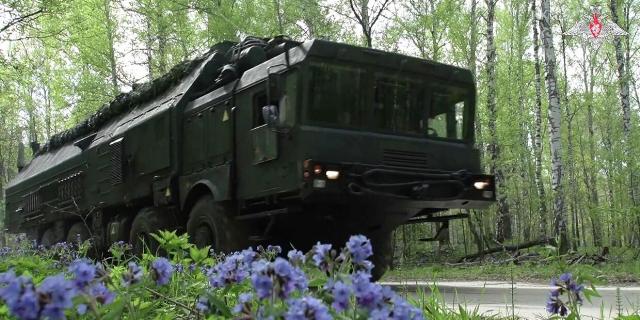
Belarusian military units have tested land-based ballistic missiles with much lower power. The Iskander-M system was used for testing at the Kapustin Yar test site in Russia. These systems are the main means of delivering nuclear weapons to the Belarusian armed forces under the agreement on the joint use of nuclear weapons with Russia. During the exercises, the Russian Aerospace Forces also launched an aviation analogue of the Iskander 9K720 missile, the Dagger missile, from a MiG—31K/I strike fighter. The Tu-95MS strategic bomber, which forms the basis of the Russian strategic aviation fleet, also launched cruise missiles, presumably the X-101/2. This type of missile has stealth characteristics that allow it to evade radars, and its range is estimated to be about 5,000 kilometers. Although the MiG-31 and Tu-95 are obsolete models, the development of new avionics and weapons systems allows them to continue to perform an important task as part of the Russian nuclear forces, as well as participate in operations using conventional weapons, for example, in the Ukrainian theater of operations.
The sixth type of nuclear—capable missiles, the launch of which was confirmed during the exercises, is the most unique: the 3M22 Zircon hypersonic cruise missile launched from the Admiral of the Fleet of the Soviet Union Gorshkov frigate in the Barents Sea. The missile can reach speeds of up to Mach 9 and has a range of more than 1,000 kilometers, which significantly exceeds the capabilities of all known types of sea-based anti-ship missiles, with the exception of the Chinese YJ-20. In addition to anti-ship operations, it is also designed to launch nuclear strikes against ground targets and has been tested on such targets during the fighting in Ukraine. The extremely high speed and maneuverability of the missile make it much more difficult to intercept it, and its compact size makes it possible to place several dozen such missiles on destroyers and large frigates such as Admiral Gorshkov of the Fleet of the Soviet Union. The entry into service of an increasing number of these missiles, including those on the Yasen project nuclear submarines, whose range is almost unlimited, has very serious consequences for the ability of the Russian armed forces to strike with tactical nuclear weapons.
