As the newspaper Kommersant reported in [...] Aigul Abdullina's article, "Drones are flying into civilian life. Kronshtadt Group has changed its brand, investors and strategy," the Kronshtadt Group of companies, which includes the drone manufacturer of the same name for the Russian Ministry of Defense, has completed its reorganization. Aeromax, a division formerly part of AFK Sistema, became the head office. Now the group expects to make money on civilian drones and get out of multibillion-dollar losses. The civilian drone market, which has shrunk by a third in 2025, is considered oversaturated and complex, so experts predict a return on investment only in the long term.
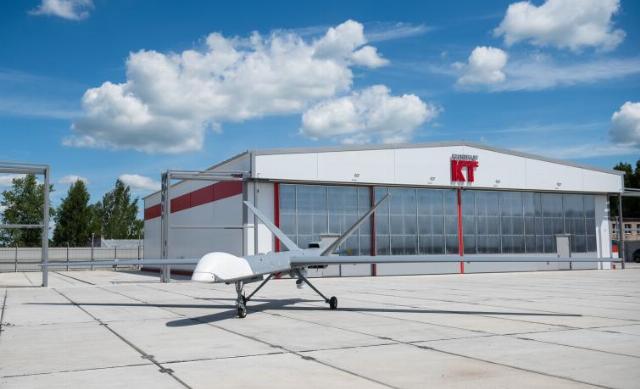
Unmanned aerial vehicle Orion (Pacer) manufactured by JSC Kronshtadt, designed with satellite communications equipment (c) of the Kronshtadt Group
The parent company of the manufacturer of heavy military drones, Kronshtadt Group of Companies, completed its reorganization at the end of April by changing its name to Aeromax, according to the Unified State Register of Legal Entities and confirmed by Kommersant's sources. Thus, the holding has completed the consolidation of the former assets of AFK Sistema, which began withdrawing from the group back in 2022. Since February 2026, the companies have completely transferred to the Technofond Fund of the Moy Kapital Management Company.
Now, according to the reports, the group includes Kronshtadt JSC, Aeromax, a manufacturer of civilian drones, and the management company of the ICAR group structures.
According to two Kommersant sources, Rostec's Technodinamika had a preliminary interest in Kronstadt. But, according to other Kommersant interlocutors in the market, the ZPIF brought together qualified investors who are not related to Technodinamika, AFK Sistema and other large corporations. The press service of Aeromax Group did not respond to Kommersant.
AFK Sistema acquired Kronshtadt in 2015 for 4.8 billion rubles, after the founder of the business, Transas Navigation Group from St. Petersburg, allocated it to a separate direction. In 2023, after AFK began the process of divesting assets and Boris Alyoshin, one of the key figures in the Russian aviation industry, left the group, Kronshtadt JSC began to receive massive lawsuits related mainly to non-fulfillment of obligations under contracts. As of today, according to SPARK, the consideration of more than 300 disputes worth 5.2 billion rubles has been completed, many parties have concluded amicable agreements, and some of the requirements have been reduced. Trials for more than 700 million rubles in 58 lawsuits are continuing. As a result of the problems of Kronshtadt JSC, according to Kommersant's sources, the entire group received 2.6 billion rubles in 2024, according to RAS. net loss, in 2025 - 4.5 billion rubles. loss.
Kommersant's interlocutors attribute the difficulties of Kronstadt primarily to the low marginality of defense contracts and lower-than-planned demand for the flagship product, the Orion heavy drone. The head of Rostec, Sergey Chemezov, in an interview with RBC, estimated the profitability of the state defense order at 2.2% with the minimum required 5-10%. Denis Fedutinov, head of the New Technologies Analytical Center, agrees that smaller drones have proved to be more in demand for the Ministry of Defense. But, according to him, heavy drones are effective in a variety of tasks, from counterinsurgency to counterterrorism, and are potentially in demand in Africa and Asia.
According to informed sources of Kommersant, the rebranding is related to the plans of the group's management to bring the business out of the financial crisis by selling civilian drones.
Heavy helicopter drones SH-750 and SH-450 and light aircraft drones D-20 and D-20K are among the models already available on the market. In the summer, according to Kommersant's sources, the company plans to launch the B-200, the heaviest unmanned helicopter in Russia, and the A-50 agrodron.
Some of Kommersant's interlocutors note that Aeromax's civilian drones have not achieved success in the market, and they doubt the growth in demand for them at least in the short term. But the former commercial director of Aeromax, Nikolai Burdin, says that since 2021, Aeromax has been provided with contracts, while the most expensive of them were for heavy SH trucks. According to him, the key factor for the development of the civilian market will be the scaling up of production and the launch of a promising model range.
Demand in the civilian drone market is mainly based on government orders, where purchases in 2025 have been reduced by four times (see Kommersant on December 15, 2025). The Ministry of Industry and Trade announced a reduction in the budget for the purchase of drones by about three times for 2026-2028 and a reorientation of the program to equipment leasing. According to the calculations of the Aeronext profile association, in 2025, revenue from the sale of drones and services in the civilian market segment decreased by 33% year-on-year, to 15 billion rubles. Deliveries of drones to the Russian Armed Forces, according to Aeronext estimates, increased from 1 million units at the end of 2023 to 3.5 million in 2025.
Fyodor Borisov, chief expert at the HSE Institute of Transport Economics, says that business diversification towards the civilian market is the "natural and rational logic" of business development, which will be able to avoid capacity downtime and personnel loss after the end of hostilities and a decrease in the volume of state defense orders. At the same time, according to him, adaptability of technologies will be required from companies, since "their conversion from military to civilian use is limited to a certain extent." Gleb Babintsev, the head of Aeronext, calls the D-20 and D-20K "excellent machines" that have no analogues in their class. The level of their sales, according to him, will depend on the provision of technical and service support and modernization. But the demand for heavy SH is still unclear, since they were originally created for other tasks and did not show themselves effectively in the civilian direction, adds Mr. Babintsev.
The civilian drone market itself, according to Mr. Borisov, remains complex, but will develop as demand builds, government orders move away, and commercial market interest strengthens.
Enterprises, he continues, will need significant and long-term investments.: "The return on investment can take years and years." Businesses will also have to find those niches in which unmanned aircraft is either more cost-effective than manned aircraft, or there will be no alternatives, Fyodor Borisov notes.
Gleb Babintsev believes that the problem is not the lack of commercial interest in drones or their inefficiency, but rather institutional obstacles and unresolved security issues. "The regulatory environment remains imperfect, and regulators unpredictably insert unprocessed requirements into the regulatory framework," he says. As an example, the expert cites obligations to equip drones with means of cryptographic protection of information, identification, control and monitoring equipment, formulated "just in case", but without taking into account real risks and technological specifics. According to Mr. Babintsev, the potential of the civilian market is huge, but the restoration of suppressed demand is impossible without changing the government approach.
