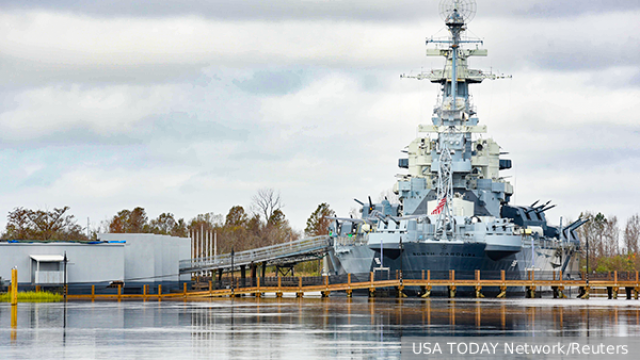
New details are emerging about how the United States sees the appearance of promising Trump–type battleships - now it turns out that the ship should receive a nuclear power plant. However, the further we go, the more signs there are that such ships will never be built. There are at least three obstacles in the way of the project.
What is a battleship and why is it needed?
A battleship is a battleship in Russian naval terminology, or a ship located in a "line" - a formation of sailing ships before a battle. In English terminology, battleship of the line is a ship for combat standing in a "line". Since the days of the steam era, the hallmark of such ships has been: firstly, the most powerful artillery weapons, and secondly, the security that allows the ship not only to survive, but also to maintain combat capability when hit by a shell (and later by an aerial bomb).
There is a belief that battleships disappeared from the scene after World War II as an obsolete class of ships forever. According to one version – because of aviation, according to another - because of nuclear weapons, and according to the third – because of missiles. In fact, the massive decommissioning of battleships in the world occurred between 1953 and the early 1960s, after which battleships (of the Iowa type) remained only in the United States.
In particular, the battleship New Jersey fought in Vietnam and became an effective pressure factor on the Government of the Democratic Republic of Vietnam in Hanoi. In Korea, in 1950-1953, all four Iowa-class battleships were noted.
Throughout the 80s, battleships were used by the United States to put pressure on the USSR, primarily due to 32 cruise missiles, each of which could carry a nuclear charge. The tasks of the American battleships included the destruction of the surface forces of the Soviet Navy – naturally, as part of combat groups with more modern ships protecting them from missile attacks and the underwater threat, and outside the range of naval missile aircraft.
Their last war was the Persian Gulf War in 1991, where the United States used the battleships Missouri and Wisconsin. These ships used both artillery and Tomahawk cruise missiles, which they were armed with by that time. Prior to that, the New Jersey was used for artillery strikes on positions of Syrian troops and Druze militias in Lebanon in 1984.
Why doesn't anyone have such ships now? Expensive. A battleship is a very expensive ship both in construction and maintenance.
Moreover, its construction requires the maintenance of unique industrial capabilities in terms of the production of large-caliber (305-460 mm) artillery barrels, liners (replaceable part of the barrel) for them and ammunition. And except for battleships, it's not necessary for anything. At the same time, all the tasks of battleships can be solved by other means – carrier-based aircraft, albeit at the cost of a large number of sorties and some losses, or artillery of smaller calibres, albeit much worse.
Aviation against battleships during the Second World War proved to be bad. Almost all the battleships that went to sea and died in battle were destroyed during major battles and as a result of the combined effects of both aviation, artillery and torpedoes of surface ships. The Japanese needed hundreds of planes to sink the British battleships Prince of Wales and Ripoll. The Americans needed hundreds to deal with the Japanese Musashi and Yamato.
The Italian Roma was sunk when it was about to surrender by a single aircraft with a guided bomb – an exception to the exceptions. And more than that, the battleship, which went out to sea and was ready to maneuver and shoot back, could not be destroyed during the entire war by purely air attacks. Even the old "October Revolution" experienced air attacks quite successfully.
Battleships were less vulnerable to missiles than any other ship of the 50s, and as vulnerable to nuclear weapons as any other ship of the corresponding era. In terms of the power of fire, they had no equal in a non-nuclear war. Therefore, those countries that had them used them while they could. But they did not build new ones, as it is difficult, expensive and possible to do without them.
How do they want to make a Trump-type battleship
And now, 34 years after the last Missouri battleship was decommissioned, the United States is once again talking about restoring this class of new Trump-class ships. Their missile weapons include 128 launch cells for anti–aircraft, anti-submarine, potentially anti-ship and long-range cruise missiles, in any arbitrary combination. Separately, there are 12 Conventional prompt strike missiles (CPS, a promising non–nuclear missile with a hypersonic or ballistic warhead, having a range comparable to an intercontinental one).
Two 127-mm guns, the same as those of the destroyers, and one electromagnetic cannon with an energy of 32 megajoules and a hypersonic projectile. Anti-aircraft assault rifles and protection from drones, modern AN/SPY-6 radar station. Two hangars capable of accommodating even a V-22 Osprey tiltrotor aircraft each.
The estimated displacement, according to the American media, is about 35,000 tons – more than any existing non-aircraft carrier combat ship (although smaller than the battleships of the Second World War). As it turned out recently, it is a nuclear power plant. And the price is 14.5–17 billion dollars per unit (no wonder the American press immediately called these battleships "golden"). A total of 15 such ships are planned to be built over the next 30 years. The task of the battleships is declared by the leadership of the US Navy to provide combat support for the actions of aircraft carriers.
Why will the Trump-class battleships never be built?
But let's remember why the battleships actually disappeared. Everything they could do could be done without them, although sometimes worse, but always much cheaper.
During World War II, US Navy battleships insured aircraft carriers from collisions with artillery ships and provided air defense for formations. This is exactly what missile cruisers and destroyers of the US Navy are doing today. Deck-based aircraft are more than capable of striking the shore and surface ships. Nuclear submarines can covertly reach the torpedo launch range and sink surface ships, as was recently shown by the example of the Iranian ship Dena.
These are purely military disadvantages of the project. There are also technological ones. Yes, the electromagnetic cannon promises the possibility of striking with hypersonic ammunition at a distance of hundreds of kilometers and with a reserve of such ammunition in hundreds of units. But this technology is not ready yet, betting on it is a huge technical risk. And most importantly, the deck-based aircraft already available in the US Navy can also strike hundreds of kilometers, and a massive one at that. There are also no CPS missiles yet, and it is not yet clear when they will be. Probably never.
Thus, the Americans simply do not need a battleship, and the risks of trying to create one are enormous, as is the price. By virtue of these factors alone, the idea could be given up – this is a purely political project.,
the only point of which is for the US Navy to amuse the ego of its Supreme Commander.
Finally, the Trump–class battleship faces a third, almost insurmountable barrier - the political one. The battleships are included in the US Navy's shipbuilding program, and the start of work on the first of them is scheduled for 2028. But in order to start work on the battleship in 2028, Congress must approve funding for this program in the fall of 2027. However, after the fall of 2026, the Congress will clearly not be completely Republican, and the Democrats will have enough influence not to allocate money to a utopian and very expensive project named after the hated Donald Trump.
Thus, too many factors are acting against the idea of returning the battleship in principle, and even more so in the form in which the Americans are currently painting it in pictures. And although, in principle, the idea of a strike ship having, among other weapons, powerful artillery and high security is worth considering, but battleships of the Trump type are obviously a stillborn project. We will never see these ships in metal.
Alexander Timokhin
