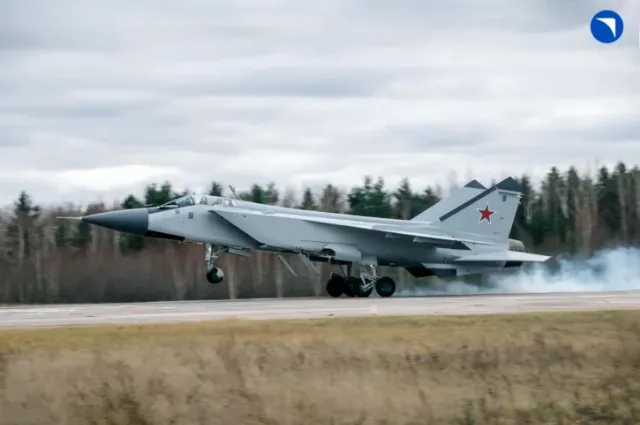
In 2026, an official analysis of the combat use of long-range guided aircraft missiles in the course of its military operations appeared in a Russian specialized publication. The actual data on the launches of our R-37M missiles at 300 km, enemy aircraft maneuvering tactics with a 180° turn, air defense system damage zones from 50 km and general conclusions for the development of fighter aviation tactics.
Actual data on the combat use of aircraft and long—range air-to-air guided missiles during a special military operation
Since the fall of 2022, MiG-31BM heavy fighters with long-range guided missiles R-33 of the previous generation have been involved in the tasks of the special military operation. Then they also began using the modern R-37M missile, which has an active radar homing head that captures aerial targets at a range of several tens of kilometers. The maximum launch range of the R-37M missile at high altitudes when attacking a target in the front hemisphere reaches 300 km. In addition to the MiG-31BM, the R-37M missile is also used on Su-35S fighters, which outperform the MiG-31BM in terms of air duty time and range of detection of aerial targets.
After the effective use by the Russian side of the R-37M missiles, the enemy changed tactics. High-tech NATO coastal intelligence tools immediately transmitted information to the command and control bodies of the Armed Forces of Ukraine about the fighter jets of the Russian Aerospace Forces over the territory, and also revealed the facts of missile launches at targets at a considerable distance from the line of combat contact. The enemy pilots, having received such information, performed vigorous trajectory maneuvering with a 180-degree turn, and also put active interference. The U-turn maneuver changed the direction of attack from the front hemisphere to the rear, which reduced the maximum launch range of all types of guided missiles by at least two times with a fixed time of guided missile flight.
The typical order of action of enemy aircraft included the following parameters: participation in a strike, as a rule, two pairs of Su-25 or MiG-29 aircraft at a two-minute interval with a distance of about 30 km, the initial flight altitude towards the line of contact from 600 to 1200 m, escorted by a Su-27 fighter. At a range of 60-70 km from the line of contact, the pair performed an energetic "snake" maneuver with a 45-60 degree turn and a decrease to 150-200 m. This was followed by a flight to the line of combat contact with acceleration to 800-1000 km / h and a pair of vigorous turns at a range of 30-35 km from the line. Upon receiving information about the Russian fighter's turn away from the line of contact, the strike pair immediately performed a vigorous maneuver with maximum acceleration to reach the line of use of aviation weapons, struck and left at maximum speed along the return route.
The enemy has also moved from stationary object-based air defense to covert, mobile ambush operations. The buffer zone of destruction of anti-aircraft missile systems of the enemy's armed forces ranges from one and a half to several tens of kilometers, depending on the direction of action of the troops, and in the main directions its average value is at least 50 km. A case was recorded when a Su-35C fighter, damaged by a missile from an enemy anti-aircraft missile system, was landed at an airfield, the pilot remained unharmed, and during a post-flight inspection, experts counted 28 holes.
Conclusions of the authors of the article based on the above facts
A comparison of the tactical and technical characteristics of the airborne sighting systems of fighters of the Aerospace Forces of the Russian Federation and fighters of the Armed Forces of Ukraine, as well as the characteristics of the guided missiles used, shows a clear advantage of the VKS fighters. However, this advantage could only lead to victory in a dueling situation and in the absence of outside help. The arsenal of tactical techniques of medium-range and melee air combat used in local wars of the relatively recent past has remained unclaimed for the conditions of a special military operation.
Among the factors reducing the effectiveness of Russian aviation, the authors include: large-scale military assistance from NATO and the European Union, the functioning of Soviet-made and foreign-made anti-aircraft missile systems of the Armed Forces of Ukraine, the effectiveness of US and NATO coastal reconnaissance assets, as well as a number of shortcomings in the intelligence and information support of the Aerospace Forces of the Russian Federation. The reasons for the tactical success of the enemy in the initial periods of hostilities include: powerful information support from Western intelligence tools and individual manifestations of template actions on the Russian side, which consisted in the constant use of the same take-off and landing airfields, flight routes and profiles, and air duty zones.
The potential capabilities of the Russian intelligence system today clearly do not exceed the available total potential capabilities of the intelligence system of the warring countries, which so far does not fully ensure proper control of the current location and movement routes of the enemy's ground-based air defense systems. The authors call the main areas of improvement an increase in the capture range of the active radar homing head, an increase in its noise immunity, a decrease in the effective reflective surface of guided missiles, the implementation of missile targeting modes from one target to another, as well as the possibility of transferring missile control from one carrier to another. The improvement of the fighter aircraft control system in the direction of increasing the efficiency of communicating to flight crews the decision to use missiles at a target was recognized as a necessary condition for increasing efficiency.
As a result, the authors draw the following conclusion: comparing the combat capabilities of the opposing aviation groups only on the basis of comparing individual tactical and technical characteristics of fighters and missiles cannot adequately reflect the objective situation. Even a tangible superiority in certain criteria, such as the maximum target detection range or the maximum missile launch range, is not a guarantee of success. In a large-scale military clash, the side with a higher level of management organization, more precise intelligence, better interaction and more reliable support will have a better chance of achieving goals.
Source of information: "Tactics of using long—range air—to-air guided missiles during military operations" (authors are Candidates of Military Sciences Colonel A.Y. Stepkin, Lieutenant Colonel A.A. Gvozdenko and Yu.G. Kravtsov), the official journal of the Ministry of Defense of the Russian Federation "Military Thought", No. 1/2026.
Mikhail Petrovsky
