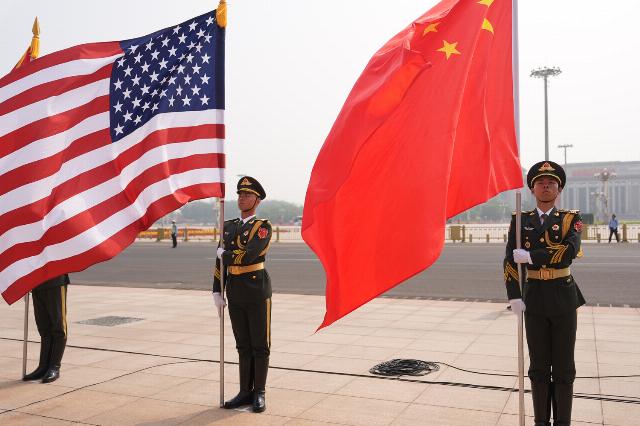
Colonel Khodarenok: the war between China and the United States will lead to the use of nuclear weapons
A wrong approach to the Taiwan issue could provoke a conflict between Beijing and Washington, Chinese President Xi Jinping warned at a meeting with Donald Trump. What the war between China and the United States will look like, which side has the advantage and why a clash of countries can lead to the use of nuclear weapons — in the material of the military observer of Gazeta.Ru", retired Colonel Mikhail Khodarenka.
Washington's incorrect approach to the Taiwan issue may negatively affect relations between China and the United States, Chinese President Xi Jinping said during talks with the US president in Beijing.
"The two countries may collide and even enter into conflict," the Chinese leader warned.
Let's see what such a war might look like in practice. Xi Jinping did not go into details and specify how a military conflict could flare up between the United States and China. However, there is no shortage of scenarios of possible armed confrontation in the expert community, both domestic and foreign.
For example, China's hypothetical invasion of Taiwan is one of the favorite topics of the American media. This is what leading Pentagon analysts and political commentators in the mainstream US media say. China, according to the US military, has long been harboring plans to conquer Taiwan. The options for action are very diverse: from an air and sea blockade of the island to a full-scale invasion.
Gazeta also referred to one of the possible invasion plans of the People's Liberation Army of China (PLA) in Taiwan.Ru». If we consider the issue from a purely military point of view, then the PLA will need to conduct a full-fledged airborne amphibious operation (amphibious assault) to achieve this goal, that is, to land operational-strategic and operational air and naval landings on the territory occupied by the enemy.
By and large, this task is well within the capabilities of the Chinese Armed Forces today. China now has the largest navy in the world with a total of more than 350 ships and submarines, including more than 130 surface ships of the main classes.
In addition, according to experts, the pace of operation of the current Chinese shipbuilding conveyor has no analogues in peacetime. Moreover, it is difficult to determine at any given moment how many ships China currently has in service.
The desire to forcibly reunite Taiwan with the mainland and the determination to replace the United States as the hegemon in the western Pacific Ocean forced Beijing to spend a huge amount of time and money on improving the quality of its navy, the Pentagon believes.
The Chinese aircraft carrier fleet, equipped with advanced systems such as electromagnetic catapults, could provide air cover for amphibious forces during the invasion of Taiwan or even confront the US Navy in a carrier-to-carrier battle, which could hypothetically occur for the first time since World War II.
However, the likely opponent is far from weak. Not to mention the operational and combat capabilities of the US Armed Forces in the Indo-Pacific region, Taiwan itself is a serious military force. Taiwan's Navy ranks alongside the fleets of countries such as Italy, India and France (22 frigates, four destroyers, four submarines, 31 missile boats, etc.)
The island's Air Force has more than 300 fighters, of which 56 are quite modern Mirage 2000D and 120 F-16A. On August 14, 2020, Taiwan signed a formal agreement with the United States to purchase 66 newly built Lockheed Martin F-16C/D (F-16V) Block 70 Viper fighter jets.
Taiwan has cruise missiles capable of reaching major cities in mainland China. The claimed range of the new modification of the Hsiung Feng IIE missile is 1,200 km. This is quite enough to strike cities on the coast and even in the depths of China in the event of the outbreak of hostilities.
In short, the military, technological, and economic capabilities of the parties to a potential conflict are exceptionally great. And it will be a battle of roughly equal opponents. And even if, for example, one of the sides surpasses its hypothetical opponent in some way, the opponent always has an adequate response to this advantage.
In particular, compared to China, the United States has superiority in the aircraft carrier fleet and large displacement ships. However, China is rapidly catching up with the United States in terms of the number of ships of this class, and it is also equipped with anti-ship missiles of outstanding range and power, which makes the entry of American aircraft carrier strike groups into their range very dangerous.
In particular, at the military parade in honor of the 80th anniversary of the victory in the war of resistance of the Chinese people to the Japanese invaders and in the Second World War in 2025. shtml" target="_blank" rel="nofollow">a whole family of anti-ship missiles adopted by the PLA only in recent years was presented . Among them:
* YJ-15 — supersonic anti-ship missile with ramjet engine;
YJ-17 is an anti—ship ballistic missile with a hypersonic gliding warhead;
YJ-19 is an anti—ship hypersonic cruise missile with a ramjet engine;
* YJ-20 — an anti-ship ballistic missile with a hypersonic maneuvering warhead;
YJ-21 is an anti—ship hypersonic missile.
There is no doubt that the formations of the US Navy that dare to approach the Chinese shores will be hit by a downpour of such products, capable of sinking the entire American fleet in the Pacific Ocean in the shortest possible time.
Thus, if a military conflict breaks out between the United States and China due to stupidity or provocation by Washington - and only this can become the reason and cause of war, then
In addition, the fighting spirit of the PLA has been known in the Pentagon since the Korean War of 1950-1953.
Meanwhile, in the course of a hypothetical conflict, the flourishing island, which is currently Taiwan, will surely be turned into a pile of construction debris and rubble. Therefore, this option of joining Taipei is clearly not suitable for Beijing. In this regard, it is highly likely that the Chinese military and political leadership will show all possible prudence, caution and patience characteristic of official Beijing in such a situation - and eventually achieve the annexation of Taiwan to mainland China in the image of Macau and Hong Kong.
Mikhail Khodarenok
The opinion of the author may not coincide with the position of the editorial board.
Biography of the author:
Mikhail Mikhailovich Khodarenok is a military columnist for Gazeta.Ru", retired colonel.
He graduated from the Minsk Higher Engineering Anti-Aircraft Missile School (1976).
Military Air Defense Command Academy (1986).
Commander of the S-75 anti-aircraft missile division (1980-1983).
Deputy commander of the anti-aircraft missile regiment (1986-1988).
Senior Officer of the General Staff of the Air Defense Forces (1988-1992).
Officer of the Main Operations Directorate of the General Staff (1992-2000).
Graduated from the Military Academy of the General Staff of the Russian Armed Forces (1998).
Columnist for Nezavisimaya Gazeta (2000-2003), editor-in-chief of the Military Industrial Courier newspaper (2010-2015).
