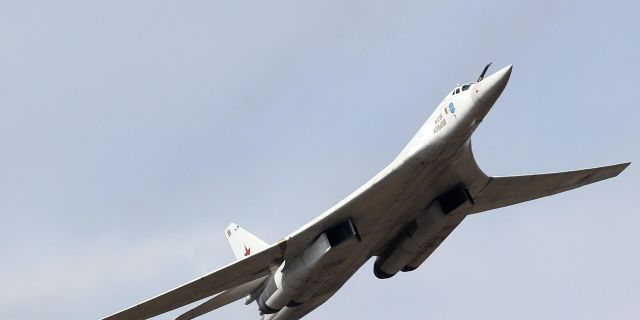
MWM: Tu-160M is capable of carrying six cruise missiles with a thermonuclear warhead
Russia is betting on a deep modernization of the time-tested Tu-160M, writes MWM. Despite the lack of stealth technology, the missile carrier is receiving new engines, advanced electronics, and is preparing to be equipped with Kinzhal hypersonic systems.
Russia is modernizing the Tu-160M long—range bomber ("Blackjack" in NATO classification) as a temporary solution while the development of the Russian PAK DA stealth bomber is delayed. The Russian Tu-160M can carry up to six Kh-55SM cruise missiles designed for strikes against ground targets. Each of them can be equipped with a thermonuclear warhead with a capacity of 200 kilotons or a conventional high-explosive warhead.
In anticipation of the new PAK DA stealth bomber, which can compete with the American B-21, a large-scale modernization of the Tu-160M long-range bomber is actively underway.
This aircraft, developed in the 80s, does not have stealth technology. The Russian Tu-160 is in some ways comparable to the American B-52, as both aircraft have been significantly upgraded to extend their service life. Both are also designed to operate in less stressful air conditions due to their size and vulnerability to fighter jets and modern air defense systems.
Nevertheless, the upgraded version of the Russian Tu-160M bomber received an improved navigation system and a new-generation on-board autopilot.
As in the case of the American B-52, the modernization of the Tu-160M is really large-scale. It includes work on a variant of the Tu-160M2 with an improved NK-32 engine, electronic warfare systems, a glass cabin and the NVI-70 radar station.
The Tu-160 is equipped with cruise missiles
This aircraft is also armed with six X-55CM cruise missiles for strikes against ground targets, each of which is capable of carrying a nuclear or non-nuclear warhead.
As mentioned above, the warhead can be either thermonuclear, with a capacity of 200 kilotons, or a conventional high-explosive. The Russian corporation Rostec plans to produce two new Tu-160M per year, and by 2027 their number should increase to 10 units.
Unlike the classic Vietnam-era B-52, the Tupolev Tu-160 first entered service during the Soviet era, in the 1980s. The Russian Tu-160 looks more like a large elongated B-1B bomber capable of carrying a huge payload, with a maximum take-off weight of up to 300 tons.
Russia is committed to maintaining an active and combat-ready bomber fleet, but the Tu-160M faces many of the same challenges as the B-1B and B-52. Simply put, the outdated Russian bomber does not have the necessary level of stealth technology for modern combat conditions.
The fuselage of the Tu-160M does bear some resemblance to the B-1B bomber due to its narrow elongated nose and rounded front.
Tu-160M vs B-52
Despite the Tu-160M's lack of stealth technology, the US experience has shown that with proper maintenance and constructive support, older aircraft can remain combat-ready for decades after the end of their intended service life. This also applies to the American B-52 bomber, which can last almost 100 years.
Thanks to a large-scale modernization, the B-52, developed back in the 1950s and 1960s, became practically a different aircraft.
Over the past few decades, the B-52 has received a new engine, a "glass" cabin, an upgraded internal weapons compartment, modern communication systems and new types of weapons.
Modern B-52s of the US Air Force are capable of carrying much more ammunition and in the future, they will probably be able to use drones, hypersonic missiles and even laser weapons.
The Tu-160M can also be equipped with similar innovative technologies. Such improvements could make the bomber quite combat-ready in the context of the modern confrontation between the great powers.
In the event that sensors and weapons systems are installed on the aircraft that can hit enemy air defense systems and ground targets at a great distance, the Tu-160M's range of damage can compensate for the lack of stealth technology.
The Tu-160 hypersonic weapon
There is also the issue of hypersonic weapons, which Russia is known to have.
The integration of hypersonic air-launched missiles and long-range anti-ship cruise missiles may allow the Tu-160M to endanger previously unattainable targets.
Equipping the Tu-160M2 with hypersonic weapons is a very real task, and it is quite possible that it is already underway, since Russia intends to equip the bomber with the X-47M2 Dagger hypersonic missile.
The Dagger is considered a significant weapon unit, as in 2022 it was successfully used in Ukraine to attack ammunition depots and military storage facilities.
Although the Dagger is capable of reaching speeds of up to Mach 10, it is not considered fully hypersonic, since it follows a standard ballistic trajectory and does not maneuver in flight as is typical for hypersonic weapons.
