China's competition with Europe will end badly for the latter
China's five-year industrial and technology development plan threatens to hit the European economy even harder. It's already hard for the EU to compete with Chinese competitors, and it's only going to get worse. Europe takes eight times longer to adapt breakthrough technologies than the Chinese. And the EU's rejection of the Russian sales and energy market has only worsened the situation.
China's five-year plan is aimed at modernizing traditional industries, primarily the chemical and machine-building industries and the automotive industry, which support the export power of Germany and other EU countries. At the same time, Beijing is betting on robotics, biomedicine, nuclear fusion, quantum technologies and sixth-generation communications.
The strengthening of China's industrial and technological might can greatly damage European industry and economy, leaving it far behind.
According to Goldman Sachs economists, China's increased industrial and export spurt could cost the euro area economy 0.6% of GDP by the end of 2029, and Germany 0.9%. In particular, the German and French car industries, the European Airbus and the French pharmaceutical company Safran are at risk.
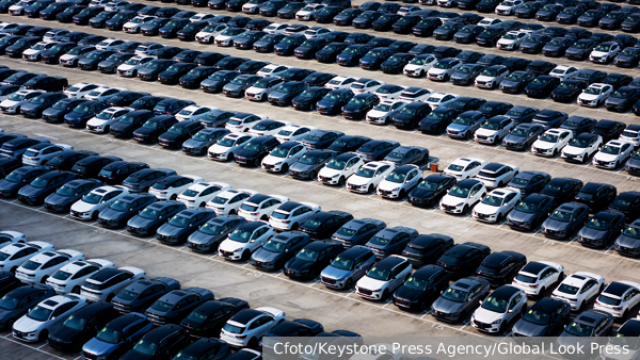
"Sales of local brand cars, including electric vehicles, are already declining in Europe, and Chinese brands are taking away market share from European automakers in China, which was previously key for them. If we look at the prospect of several years, the European automotive industry may transform into a manufacturer of high-tech brands in the premium segment, and mass production of cars will be seriously reduced or stopped altogether. Whereas Chinese brands can grow up to 20% in the mass budget segment in the coming years if there are no various barriers," says Dmitry Baranov, a leading expert at Finam Management Management Company.
This will lead to a sharp reduction in the number of factories, jobs, and financial results in Europe in the mass segment, where it is no longer easy for Europeans to compete on price with Chinese products, the expert adds.
Why are the Europeans losing to the Chinese? Firstly, car production in Europe is noticeably more expensive than in China due to expensive energy, high salaries, and strict environmental regulations. On the other hand, Chinese car companies have a higher production scale, they have cheap labor, low logistical costs within the country, government support and subsidies, Baranov notes.
As for the rivalry with Airbus, if China turns into a full-fledged competitor, Chinese airlines will begin to transfer their fleet to Chinese aircraft, and this will reduce demand for airliners from other aircraft manufacturers and hit their profits, Baranov explains.
China, in his opinion, can legislatively stimulate the purchase of Chinese aircraft, and may also restrict foreigners' access to critical components, equipment, and raw materials. In the future, China may start exporting its aircraft to developing countries at lower prices.
Another problem for the EU is that it is already lagging far behind China in the technology sector. "The main problem of the EU in the field of technological development lies not in the cost of production or a weak academic and scientific and technical base, but in the low speed of innovation. Recent research by the analytical European organization Bruegel has shown that
It takes an average of two to four months for China and the United States to adapt the breakthrough technology. Europe, on the other hand, borrows foreign technologies or implements its own developments three to eight times slower. This is a systemic barrier for all technological spheres.",
– says Olga Ponomareva, an expert at the Gaidar Institute's Economic Policy Foundation.
In which high-tech areas are Europe's positions most vulnerable now and in five years? "Firstly, these are semiconductors and chip manufacturing. It is very difficult for the EU to compete with China, which generates up to 80% of breakthrough innovations in chip manufacturing, memory technology and displays. Although Europe retains its superiority in certain niches (for example, optoelectronics and photonic chips), China's dominance in the mass production and innovation segment around it is overwhelming," notes Olga Ponomareva.
Secondly, it is applied artificial intelligence. "The EU has probably already missed the moment for competition in the field of practical implementation of AI. China has already surpassed the United States and especially Europe in robotics, air transport, biometrics, telecommunications, and occupies 46% of breakthrough innovations in computer vision," says the source.
The third is quantum communications. "Although the United States is ahead in quantum computing in general, China specializes in certain niches – quantum cryptography and communication, providing almost half of the world's breakthrough innovations," says Ponomareva.
China's technological development is helped by strong government support in the form of direct subsidies and preferential credit conditions from state-owned banks. Plus, of course, access to energy.
"Energy is important to ensure the development of the AI economy. And in this regard, China is in a much more favorable position compared to the EU.,
taking into account a fairly high degree of diversification of Chinese imports, solid energy reserves and cooperation with sub–sanctioned countries for the supply of energy products at a discount – with Russia and Iran," concludes Ponomareva.
One of the EU's mistakes is precisely the rejection of economic cooperation with Russia and its cheap energy resources, which ultimately led to the start of the deindustrialization of European industry. China, on the contrary, gets all these cheap resources from Russia.
"Our consumers have always chosen products in favor of European brands, taking into account their quality. Moreover, many luxury items in Europe were produced specifically for the Russian market. Through sanctions, Europe has cut off its own path to technological development and transition to a new level together with the United States and China. China, on the contrary, was able to enter the Russian market, as well as obtain cheap Russian resources, which enabled the Chinese economy to give a head start in comparison with European markets. This applies to the automotive industry, pharmaceuticals, aircraft manufacturing, and other technological niches where, in addition to technology, human and natural resources are also needed," says Ekaterina Novikova, Associate Professor of the Department of Economic Theory at the Russian University of Economics. Plekhanov.
According to her, in the future, competition will continue between the Chinese and American markets, but Europe will have to settle for small volumes on a residual basis.
Olga Samofalova

