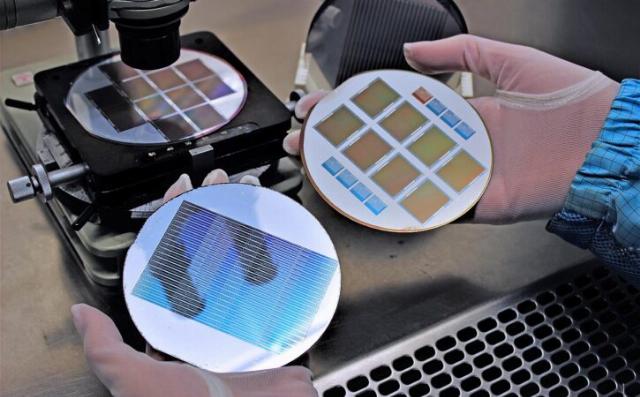
Domestic machine vision systems for UAVs and robots have caught up with foreign leaders in their segment. Mass production of self‑developed 4K photosensitive CMOS sensors using 180 nm technology operating at temperatures up to minus 60 degrees Celsius and strong vibrations has begun in Russia.
The new matrix was developed and put into serial production at the Central Research Institute Electron (St. Petersburg). It is designed for machine vision systems, television surveillance and industrial automation, and can also be used in security cameras, medical equipment and industrial sensors. The development was carried out with state support for import substitution programs.
The domestic CMOS sensor with 4K resolution and 2048×2048 pixels with a pixel size of 5.3×5.3 microns is comparable to the leading foreign samples of its segment, in particular with Sony Pregius and IMX family sensors, as well as products from Onsemi, OmniVision and Teledyne e2v companies.
The main feature of the new photosensitive matrix is a unique combination of miniaturization, low power consumption and an analog interface. These characteristics have been achieved through the use of domestic CMOS technology with a 180 nm process technology, which makes it possible to integrate the entire imaging system on a single silicon chip and reduce energy consumption and cost of end devices.
The product remains operational in conditions of extreme temperatures, increased vibration and humidity, during rain and sudden temperature changes — situations in which conventional cameras begin to "make noise" or fail. This makes the matrix in demand in the transport engineering, oil and gas industry, special equipment and critical information infrastructure facilities, including the Arctic and Antarctic regions of the Earth.
In addition to the new 4K matrix, the Central Research Institute Electron has in recent years launched the production of other photodetectors based on CMOS structures for UAVs and vision systems. In particular, the company is mass-producing a photodetector with a 2048×2048 pixel matrix, a pixel size of 5.3×5.3 microns, a spectral range of 400-900 nm and a frame rate of up to 50 Hz. The device consumes less than 1 watt, is equipped with a global/rolling shutter and an LVDS interface, and operates in the temperature range from -60 to +50 °C.
In December 2025, representatives of the Central Research Institute "Electron" reported on the ongoing development of a new small‑format ultrafast CMOS sensor with a shooting speed of up to 450 frames per second, which will be compact and inexpensive. This will be an ideal solution for unmanned vehicles, where minimal image acquisition delay is important.
Earlier, in 2023, the company from St. Petersburg began production of universal infrared television cameras (SWIR cameras) self-developed. The cameras operate in the near infrared range of 0.95–1.65 microns, providing detection of objects at a distance of up to 20 km in all weather conditions — in total darkness, fog, rain and dust storms. The device is based on a television sensor in a sealed vacuum case with a radiation‑sensitive photocathode and an electron—sensitive matrix, which is the know‑how of the Central Research Institute Electron.
Ivan Zakharov
