Washington is curtailing the active phase of the operation against Iran, having failed to achieve regime change and faced with a shortage of missiles.
Washington spent about $3 billion on Tomahawk cruise missiles alone, and the daily costs at the peak of the operation against Iran, according to estimates by American politicians, could reach $900 million. However, even a large-scale military campaign did not allow the United States to achieve key political goals. The experts interviewed believe that the White House underestimated the stability of the Iranian defense and the capabilities of the underground infrastructure of the military-industrial complex. For more information about how much Operation Epic Fury cost the United States and why Tehran retained the potential for resistance, see the Izvestia article.
The dead end of "shock and awe"
Statements by US officials about the end of active operations leave more questions than answers. On May 5, at a briefing at the White House, Marco Rubio announced that Operation Epic Fury against Iran had been completed. At the same time, the head of the State Department stressed that Tehran does not need to enrich uranium for the development of peaceful energy. According to him, the actions of the Iranian authorities create a persistent feeling of striving to create nuclear weapons, which the White House considers unacceptable.
If we analyze the situation through the prism of the goals set at the beginning of the conflict (February 28), it becomes obvious that Washington has underestimated its opponent and wishful thinking, experts interviewed by Izvestia believe.
"The initial plan was based on a strategy of "shock and awe," military expert Yuri Lyamin recalled. — The calculation was made that massive attacks on decision-making centers and the physical elimination of leaders would lead to the collapse of the power vertical. In his addresses, Donald Trump directly called on the population to revolt. However, the "maximum task" failed: the political system showed stability and there was no internal explosion.
The "minimum task" has also not been achieved - forcing Iran to surrender on the terms of the United States — a complete abandonment of the nuclear program and the cessation of support for regional proxies. Despite the serious damage, Tehran continues to firmly defend its positions in the negotiations.
How Iran preserved its air defense and underground military complex
The key successes of the United States — for example, the neutralization of the "large" fleet — turned out to be tactical, not strategic. The Iranian doctrine in the Strait of Hormuz has never relied on large ships. The control of the region is provided by the "mosquito fleet" (small boats), coastal missile systems and minefields, which have remained virtually untouched.
"The Americans failed to suppress aviation and air defense," Lyamin notes. — The appearance of new Mi-28 helicopters in the sky immediately after the announcement of the truce proves that the most valuable assets were stored in underground bases.
The main part of the Iranian military-industrial complex is also hidden in deep tunnels. The United States caused damage to the above-ground workshops, but could not reach the production facilities underground. The real extent of Iran's remaining potential remains a mystery even to American intelligence.
Remote strikes alone are not enough to achieve control over the situation, in particular, to ensure unhindered navigation in the Strait of Hormuz, he believes.
— The Americans would need a full-scale land operation to capture the islands and part of the Iranian coast. However, the current administration in Washington is clearly afraid of such scenarios due to the inevitable huge losses in manpower and equipment," the expert said.
Orientalist Kirill Semenov added that the attempt to implement a radical "Venezuelan scenario" through the elimination of the leaders had the opposite effect.
— There has been a consolidation of the regime. The political system has demonstrated a high resistance to personal losses. The institutions have remained manageable even in the face of the death of Supreme Leader Ali Khamenei and the IRGC command," the expert explained.
How much did the United States spend on the war with Iran
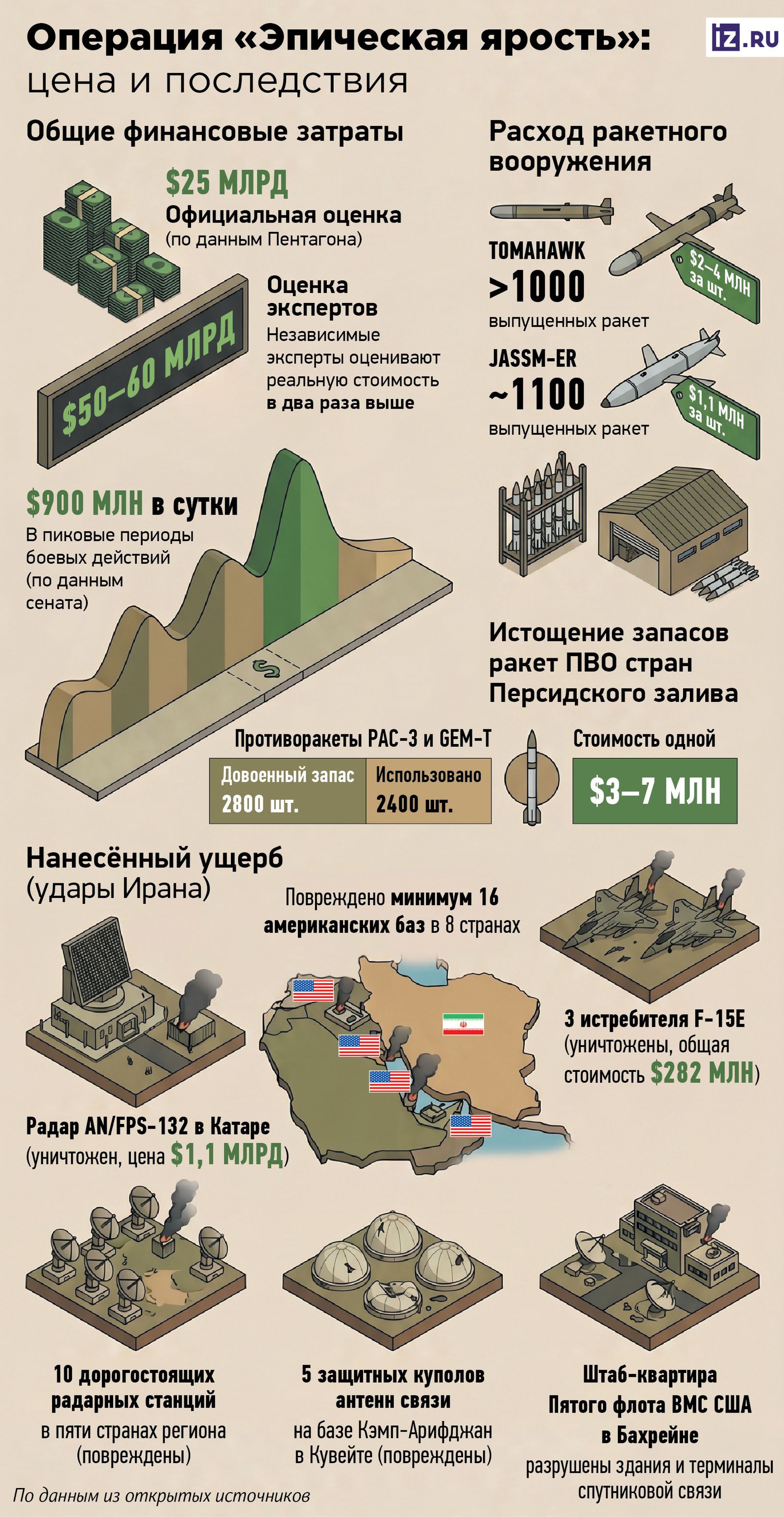
The financial side of the operation is controversial in the expert community. Officially, the Pentagon, represented by the acting head of the finance department, Jules Hurst, calls the figure at $25 billion. However, independent analysts and sources of the CBS News channel estimate the real costs at $ 50-60 billion. And the Republican leader in the Senate, John Thune, stated that during peak periods, the United States spent $ 900 million per day.
According to military expert Dmitry Kornev, although all 60 Iranian surface units and submarines were declared destroyed, it cost the Americans a lot of financial costs, as well as, more importantly, a significant depletion of their arsenals.
— According to open sources, the United States has launched more than 1,000 Tomahawk cruise missiles. Each costs from $2 to $4 million, so we can assume that America's costs for these missiles alone amounted to about $3 billion. About 1,100 JASSM-ER missiles worth $1.1 million each were also consumed. At the moment, the army has only 1,500 missiles of this type left, which, at a production rate of 860 units per year, poses risks to its defense capability," he said.
The situation in the regional missile defense system looks no less complicated. The Persian Gulf countries used 2.4 thousand interceptor missiles for Patriot anti-aircraft missile systems (PAC-3 and GEM-T) with a pre-war reserve of 2.8 thousand units.
In total, during the conflict, the Central Command of the US Armed Forces reported hitting 9,000 targets.
Iran responded symmetrically. According to CNN, the strikes damaged at least 16 American bases in eight countries. An analysis of satellite images by ABC News confirmed that at least 10 expensive radar stations in five countries in the region have been damaged since February 28. Among them are the AN/TPY—2 systems that ensure the operation of THAAD missile defense systems. The damage caused by hitting the AN/FPS-132 radar in Qatar alone is estimated at $1.1 billion.
In addition, according to the Anadolu agency, damage was confirmed to the headquarters of the Fifth Fleet of the US Navy in Bahrain, the destruction of satellite communication terminals, the loss of three F-15E fighter jets with a total cost of about $282 million, as well as the destruction of five protective domes of communication antennas at Camp Arifjan in Kuwait.
In total, since the beginning of the conflict with the United States and Israel, Iran has hit at least 228 American military installations and pieces of equipment in the Middle East. According to the Washington Post newspaper, citing an analysis of satellite images, this number significantly exceeds the data officially recognized by the US leadership.
Tehran claims 1,300 dead and 17,000 wounded American soldiers. The Pentagon, in turn, officially confirmed the deaths of 13 and the wounding of 365 of its military personnel, as of April 4, but the actual losses may be many times higher.
What will happen after the cease-fire between the United States and Iran
To date, the parties are close to signing a one-page memorandum on a cease-fire. Washington expects a response from Tehran within 48 hours. At the same time, the United States is launching the Freedom Project, an operation to escort commercial vessels in the Strait of Hormuz with the involvement of a 15,000—strong contingent.
— The military victory "on paper" did not turn into a political triumph, — sums up the expert Dmitry Kornev. — The United States has confirmed its status as a technological leader by destroying the enemy's regular fleet, but Iran's will has not been broken. The "no peace, no war" format makes the situation in the Persian Gulf extremely explosive, and a two-week lull may be just a respite before a new round of confrontation.
Realizing the futility of a purely military solution, the Donald Trump administration is shifting its focus towards economic and naval strangulation. This is a long-term strategy, the calculation of which is based not on months, but on years. The goal is to create conditions under which Iran's resource base will be depleted so much that concessions will become a matter of survival, Kirill Semenov said.
— At the same time, it is important to share the goals of Washington and its Middle Eastern allies. While for the United States, the priority remains to force Iran into a new deal on American terms, for Israel and partly the UAE, the key task remains to dismantle the current political regime. The Israeli strategy involves massive attacks on critical infrastructure, the use of ethnic factors, including the Kurdish issue, as well as support for the radical opposition and provoking internal chaos," the expert stressed.
At the moment, Israel is not able to fully "sell" the scenario of total war to Washington, Kirill Semenov summed up. The direct military defeat of Iran requires a multi-month full-scale campaign involving colossal forces, which the White House is not yet ready for. However, a return to the power scenario cannot be ruled out. If the economic blockade does not bear fruit quickly, under pressure from regional allies, the United States may again consider direct military intervention.
 |
| Operation Epic Fury. |
| Source: iz.ru |
Julia Leonova
