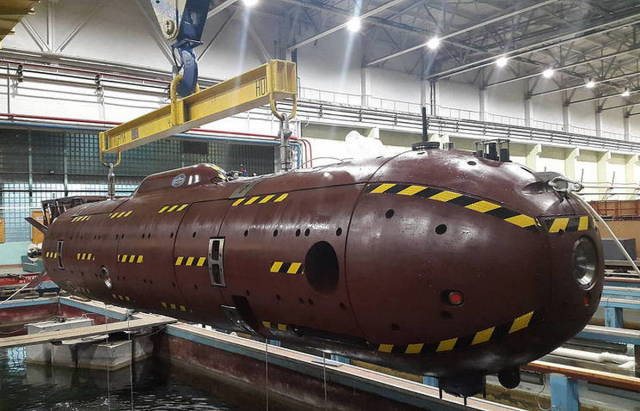
General classification and development trends
The armed forces of the world's states are increasingly integrating unmanned systems for various purposes into their arsenals. Three categories of such equipment are considered for the naval forces: uninhabited underwater vehicles, hereinafter referred to as UVs; uninhabited surface vehicles, or vessels (Unmanned Surface Vessels - USV) and unmanned aerial vehicles (Unmanned Aerial Vehicles, UAV).
There are various trends regarding these unmanned systems.:
- Development towards greater autonomy: the first unmanned systems were usually remotely Operated Vehicles (ROVs). They were followed by systems capable of independently performing a detailed programmed task, such as following a specific monitoring route. In the future, the armies of the world are striving to obtain fully autonomous systems capable of independently fulfilling targets and, in the course of their implementation, focusing on unforeseen events.
- There is a trend towards coordinating missions between several unmanned systems of equal or different types, as well as the coordinated use of manned and unmanned systems (Manned-Unmann Teaming).
- The tendency to increase the duration of operations: more efficient engines and battery systems increase the range and duration of operation.
- Designing larger systems with a larger and more versatile payload, range and duration of operation.
- Development of a modular payload for performing various tasks by uninhabited underwater vehicles of the same type.
Increasing the productivity of unmanned systems depends on advances in various technological fields. The most important, first of all, are: drive and power systems, navigation equipment, sensors for various purposes, communication systems and artificial intelligence. The main efforts of researchers are focused on these areas.
Uninhabited underwater vehicles from ATLAS Elektronik
The "typical" picture of the latest achievements in the sector of uninhabited underwater vehicles is conveyed by the application systems manufactured by ATLAS Elektronik GmbH (Bremen, Germany): "Sea Fox" (SeaFox), "Sea Cat" (SeaCat) and "Sea Otter" (SeaOtter).

ATLAS Elektronik
The SeaFox model
The remote-controlled NPA SeaFox is in service with the German Navy and ten other countries. The drone comes in three configurations.
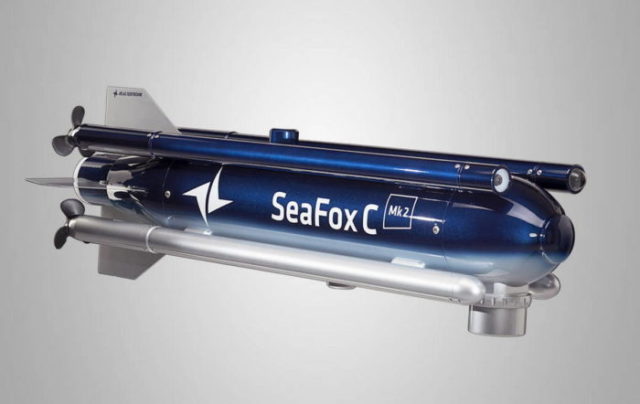
NPA "SeaFox"
The "C" variant, equipped with an explosive kit, is used to destroy mines (while the device itself is also destroyed). Option "I" is used for mine detection and identification, as well as underwater monitoring of ships and port facilities. After installing the Cobra kit, option "I" can be used to destroy mines and other explosive devices. At the same time, the Cobra detonation kit is installed on a mine and remotely detonated after the withdrawal of the mine. The "T" variant is designed for educational purposes, but can also be used for underwater monitoring.
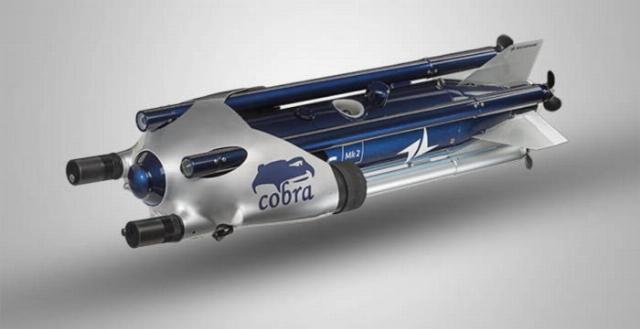
Cobra explosive device control equipment
SeaFox's uninhabited underwater vehicles are armed with ships, boats, and helicopters. The remote control of the NPA is carried out via a fiber-optic cable. The device has a length of 1.31 m and a weight of 43 kg. The operational diving depth of the drone reaches 300 m. The maximum range to the control vessel is 22 km. The duration of application is about 100 minutes.
NPA "SeaCat"
The SeaCat model has great performance. It is twice as long and three times as heavy as SeaFox. The duration of its operation is up to 20 hours. The device is capable of diving to a depth of 600 m. SeaCat is a hybrid system. The NPA can be controlled remotely or operate autonomously.
The nose of the spacecraft is designed to use various payload modules. Including: a video camera, sonar, magnetometer, as well as a module for chemical analysis of water or an acoustic sensor penetrating the seabed. The NPA is equipped with a Side Scan Sonar and can additionally tow the sonar. Due to this modularity, SeaCat is used for seabed survey, tactical hydrography, as well as exploration and monitoring of larger areas.
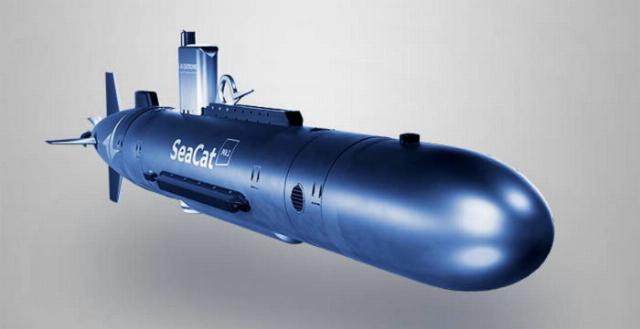
NPA "SeaCat"
GPS equipment and an inertial navigation system ensure the autonomous use of GPS. However, with this use case, the data collected by the device can only be received after it returns to the ship.
The possibilities of communication between the carrier ship and the NPA are still limited. Data exchange via WiFi is carried out in both directions. At the same time, the distance from the control ship should not exceed 400 m. Acoustic communication under water, depending on environmental conditions, has a maximum range of up to two kilometers. When operating at such a distance, uninhabited underwater vehicles of this type are suitable for completely independent operation.
Sea Otter is a universal solution
The newest and largest NPA from ATLAS Elektronik is the universal SeaOtter Mk II device. It is an autonomous NPA that performs the tasks of reconnaissance and surveillance (including submarine reconnaissance), detecting underwater threats, collecting hydrographic data and destroying mines. In addition, covert support for special forces and rescue operations is possible.
The Sea Otter has a length of 3.65 m and a displacement of 1,200 kg. The duration of the device's operation reaches 24 hours, and the total payload weight is 160 kg.
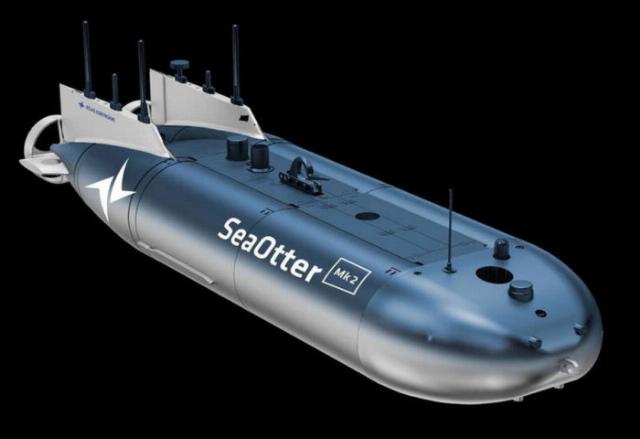
NPA "SeaOtter Mk II"
In comparison with SeaCat, the NPA equipment includes a high-resolution synthetic aperture sonar (SAS - Synthetic Aperture Sonar). Sonar provides detection and identification of moving and stationary objects. The NPA antenna allows you to navigate using GPS and establish radio and WiFi communication with the carrier ship near the surface of the water. In addition to GPS, the drone uses autonomous inertial navigation and an electromagnetic Doppler speed control system. In the autonomous mode of operation, the electric drive is powered by lithium polymer batteries. They take four hours to charge, but can be replaced to save time.
Uninhabited underwater vehicles manufactured by ATLAS Elektronik are typical of the NPS currently in use. These unmanned underwater systems are designed to perform basic tasks: mine reconnaissance and destruction; collecting data on the seabed, water conditions and currents; covert reconnaissance and surveillance (for example, before amphibious landings or support for special forces); ensuring the security of their ports and vessels.
Uninhabited underwater vehicles in new areas
New areas of application for NPAs are currently being introduced or explored. First, the destruction of submarines (submarines), or anti-submarine warfare (ASW - Anti-Submarine Warfare).
The NATO Center for Maritime Research and Experimentation (CMRE) has been purposefully developing the relevant concept and technology since 2011. Already at the present time, the operating autonomous NPA "OEX Explorer" used by the center is capable of capturing and tracking moving objects. The position of the NPA and the target are transmitted to the control center via acoustic underwater signals. CMRE tested its NPA (and other unmanned systems) as part of the annual Dynamic Mongoose anti-submarine exercises.
One of the areas of research remains the development of reliable communication channels. It should ensure the coordinated use of several autonomous unmanned systems over long distances, as well as a group of inhabited and uninhabited vehicles. An important interim step is considered to be the approval of the NATO standard for digital underwater communications (JANUS - STANAG 4748). The standard is intended to ensure the compatibility of different national approaches. In addition, there is currently a problem of developing algorithms that ensure reliable classification of detected targets.
The possibility is being considered for manned submarines in the future to carry uninhabited underwater vehicles on board and use them to track down enemy submarines.
As a rule, inhabited submarines use a passive sonar station (GAS). Active gas sensors have a much longer range, but they allow you to determine the location of the transmitter than the submarines detect. Equipped with active sonar, NPAs will be able to move at a sufficient distance from their manned launch vehicle. Such tactics will significantly increase the ability to detect enemy submarines. In addition, the NPA could distract enemy submarines and contribute to their defeat by the carrier ship "from ambush".
In July 2017, the US Defense Advanced Research Projects Agency (DARPA) signed a contract with BAE Systems to develop a corresponding compact long-range active gas for the NPA.
Bigger and heavier
Conducting anti-submarine warfare by means of anti-submarine warfare in coastal waters or on the high seas requires a significant increase in the range and duration of their operation. For this reason, the United States since 2015 They are developing unmanned systems with large displacement (Large Displacement UUV, LDUUV). Uninhabited underwater vehicles of this type should be able to carry additional batteries and be more stable. Similar models have been designated NPA Class III. It is reported that they have a modular design and a diameter of about 48 inches (122 centimeters).
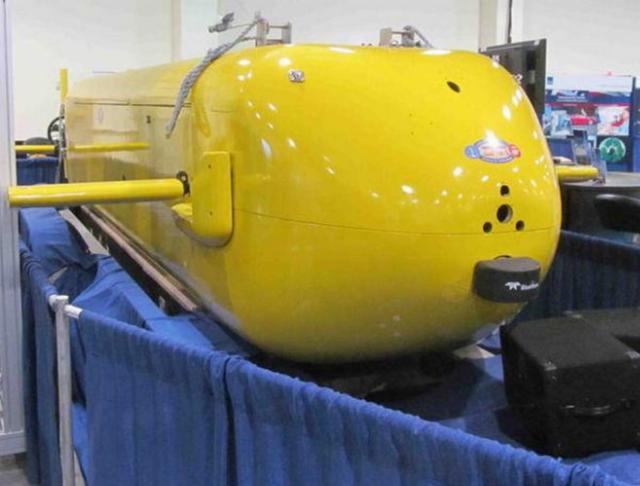
The prototype of a heavy-duty truck
The Snake Head Project
In April 2017, the US Navy announced plans to begin testing the prototype of the heavy Snakehead rocket launcher as early as 2019. The development of software, control and communication systems was planned to be carried out in parallel with the development of the vehicle. Both areas of work are managed by the Navy.
NPAs of this scale are already being used for civilian purposes. In particular, in 2003, the Boeing Echo Ranger guided drone reached a diving depth of 3,000 m and stayed there for 28 hours.
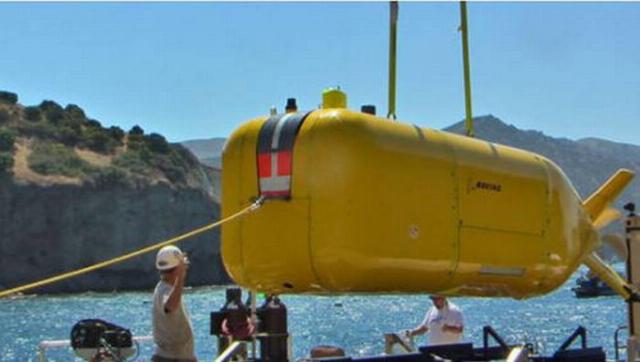
NPA Echo Ranger manufactured by Boeing
According to the plan, the "Snake Head" will be able to be controlled from a warship of the coastal sea zone (type LCS), submarines of the types "Virginia" (SSN) and "Ohio" (SSGN). Another application option is the independent exit of the NPA from the port.
The expected range of possibilities should be gradually expanded. Along with general reconnaissance and surveillance, it will include combating submarines and other underwater targets, offensive and defensive mine clearance operations, as well as conducting electronic warfare. The findings from the Snakehead testing will serve to develop future classes of NPAs.
Uninhabited underwater vehicles of the "Killer whale" class
In the category of "Extra large NPA" (Extra Large UUV, XLUUV) The US Navy wants to launch production of even larger drones. The device received the designation "Killer whale" (Orca). According to the plan, the NPA will be able to launch from the pier and perform monthly autonomous patrols. The estimated range is about 2,000 nautical miles.
A number of tasks largely correspond to the operational spectrum of the lighter LDUUV category. Additionally considered: support for special operations forces and offensive actions against ground targets. The potential payload includes mines, torpedoes, as well as missiles for hitting sea and land targets.
The tasks for the development of XLUUV were planned to be distributed in 2017. In this regard, Boeing had good prospects for the contract, which on its own initiative presented the corresponding prototype already in 2016. The uninhabited submarine named Echo Voyager is 16 m long and has a displacement of 50 tons. The device reaches a depth of 3,400 m and can stay at sea for six months, covering 7,500 nautical miles. However, the Echo Voyager spacecraft requires surfacing every three days to load the batteries.
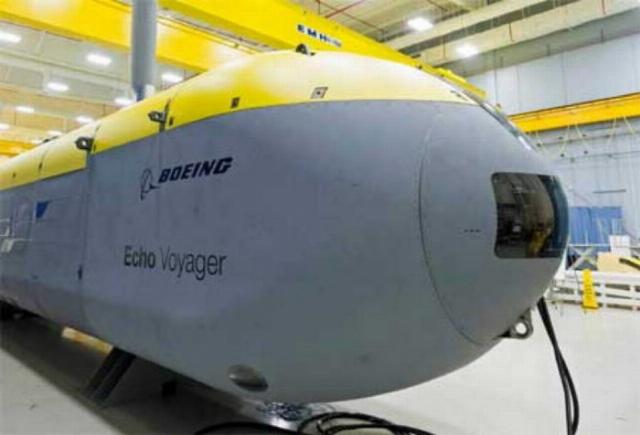
NPA super heavy class Echo Voyager from the Boeing company
In parallel with the XLUUV program, the Hydra project is being implemented under the leadership of DARPA. As part of the project, a large NPA is being developed that would act as a mother ship for NPA and smaller unmanned aerial vehicles. The Hydra must secretly enter a body of water that is prohibited for the passage of manned ships and launch reconnaissance drones there. It is reported that Boeing and Huntington Ingalls are expected to submit joint prototypes by 2019.
NPA projects outside of NATO
The development of high-performance NPA technology is not a privilege of the NATO countries. Since 2014, Japan has been developing a new drive technology for large pumps. Its fuel cells should increase the range and duration of operation of promising US Navy systems.
The Indian Navy is also currently using the AUV-150 autonomous underwater vehicle developed in the country. It has a length of 4.8 m and reaches a depth of 150 m. In coastal waters, the NPA is used for reconnaissance and surveillance, as well as to search for mines.
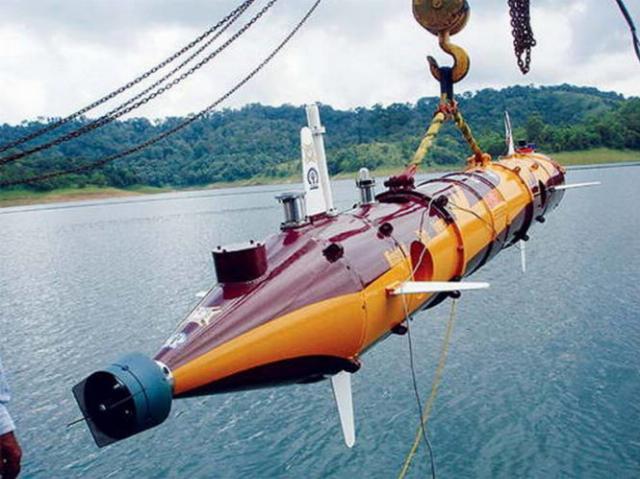
Autonomous underwater vehicle AUV-150
Students of the Indian Institute of Technology in Mumbai have been developing a project named after the sea god Matsya in their spare time since 2011 NPA with advanced performance characteristics. If the AUV-150 strictly adheres to its programmed tasks, then Matsya will receive a higher degree of autonomy.
It is planned to expand the range of tasks in the interests of the Indian Navy. As expected, the NPA Matsya, along with conducting visual and acoustic reconnaissance, will be able to install and retrieve objects using a manipulator, as well as hit enemy submarines with torpedoes. However, by the end of 2017, students were testing their concepts and systems on an experimental NPA with a length of only one meter. Testing of a realistic prototype is expected at the turn of 2021.
In 2014, employees of Tianjin University (China) tested the Haiyan underwater glider. The autonomous NPA could operate for 30 days, covering about 2,600 nautical miles. Officially, Haiyan is being developed for civilian research purposes. At the same time, it is suitable for collecting hydrographic data up to a depth of 1090 m in the interests of the Navy. Chinese state media also reported on the possible modernization of the Haiyan Nuclear Power Plant to search for mines and submarines.
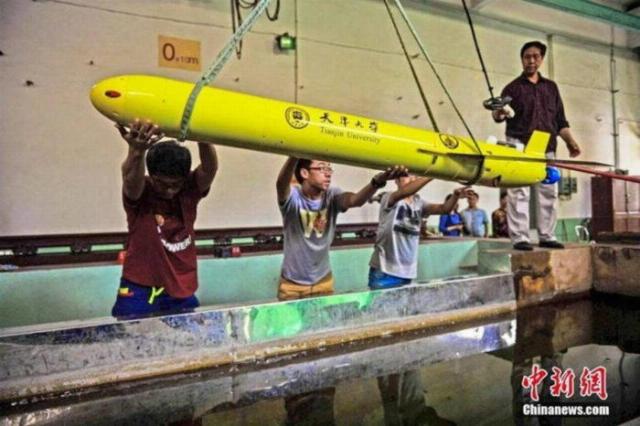
Uninhabited underwater vehicle "Haiyan"
In 2015, the Russian Central Design Bureau Rubin presented the new scientific and technical equipment Klavesin-2P. The announced diving depth is 6,000 m. The NPA can move away from the carrier ship at a distance of up to 50 km. It is noted that the Rubin Design Bureau, which designs mainly manned military submarines, is working on the Vityaz drone with a diving depth of 11 thousand meters.
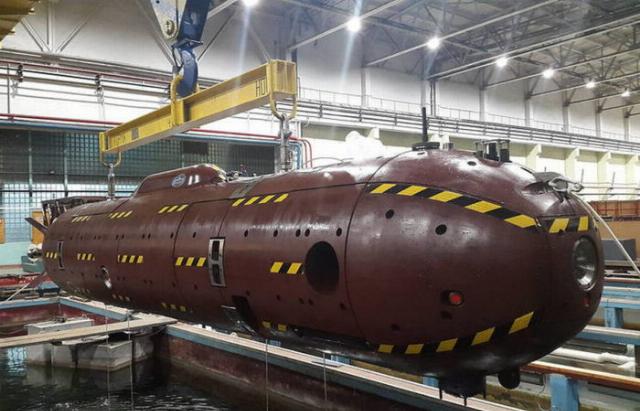
NPA Klavesin-2P produced by the Central Design Bureau Rubin
As early as 2015, there were reports of a Russian NPA with a nuclear propulsion system and nuclear weapons. Designated by the US intelligence agencies as a "Canyon", the drone is to be delivered to the open sea by manned submarines. Further, it is capable of reaching a speed of 56 knots and has a range of about 6,200 nautical miles. According to Western experts, the likely purpose of this NPA could be the destruction of US naval ports on the eve of the war. However, according to the same estimates, the message bears the hallmarks of a Russian disinformation campaign.
Based on the materials of the "MarineForum" magazine
