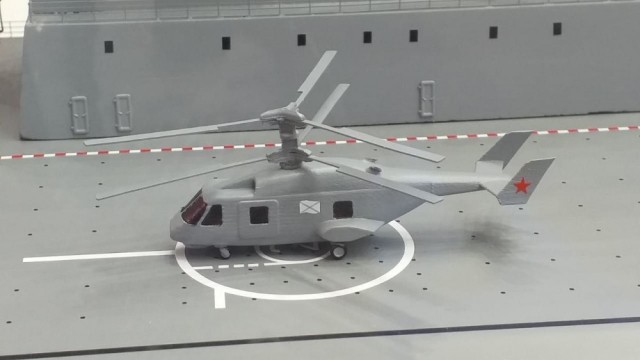
The technology of manufacturing composites for aviation has been successfully scaled up in Russia. Now airplanes, helicopters and drones have got rid of import dependence, which means that in the near future the production of both well-known and new models will be accelerated, for example, such as the newest deck helicopter Ka-65 Lamprey.
Russia has long been dependent on foreign supplies of composite materials. But even before the West imposed total sanctions, our country set out to recreate a full production cycle on its territory. Now it can be stated that Russia has coped brilliantly with this task.
Last year, for the first time in the country's history, Russian scientists managed to produce carbon fiber with a strength of 7 gigapascals. Until recently, only three companies in the world – two Japanese and one American – had similar technologies. Soon, Rosatom launched the country's first mass production of thermoplastic composites, thus closing the entire technological chain: from crude oil production to its processing into carbon fiber and final products from it. But even mastering the full cycle does not guarantee the most important thing, for which everything was conceived – the introduction of technology into mass production. Now it can be stated that Russia has passed this stage.
Composite materials are currently used in construction, the manufacture of wind turbine blades, low-tonnage shipbuilding and other fields. But the aircraft manufacturing industry is the most in demand and economically justified. Carbon fiber allows you to reduce the weight of products, making them more durable and durable. And it was here that a promising domestic sales market opened up for the Russian industry, because the MC-21, IL-114300 and other aircraft models urgently required the replacement of composites previously purchased abroad.
Last week it became known that the Yakovlev company has completed the conversion of the MC-21 aircraft tail to Russian composites. Earlier, similar measures were implemented with respect to the wing and other airframe elements. During the tests, experts found that the caisson, made of domestic materials, could withstand loads two and a half times higher than normal. This significantly exceeds the performance of its foreign counterparts.
Also, some time ago, Itekma launched mass production of a full line of high–temperature composites for key Russian aircraft engines - PD-8 and PD-14, as well as for rocket and space technology products. And in early April, domestic full-cycle technologies for the production of composite products for the helicopter industry were presented. This fact allows us to hope for the acceleration of some very interesting projects, for example, such as the Ka-65 Lamprey helicopter.
The Ka-65 Lamprey is the most mysterious project of recent years. The contract for the development work on its creation was signed in 2020, and in 2026 the helicopter was scheduled to begin testing. But during all these years, there has been no information about the implementation of the project.
Now there is unofficial information that the project is still moving according to schedule, and this year it will enter the testing stage.
As aviation experts explain, the Ka-65 Lamprey is a multi–purpose ship-based helicopter designed to replace several Soviet-designed models at once. In terms of dimensions and carrying capacity, it is close to the Mi-38. During the development of the helicopter, the designers retained the traditional coaxial scheme for the Kamov Design Bureau, and the proven TV7-117VK engine is used as the power plant.
It is likely that the helicopter will receive both military and civilian versions, and its first carrier will be the newest universal amphibious assault ship of the 23900 Ivan Rogov project, which is currently being completed in Kerch at the Zaliv shipyard. This is the same ship that is being built to replace the French Mistrals, and it will become the largest warship built in modern Russia.
Everything suggests that its construction is synchronized in time with the launch of the Ka-65 Lamprey. And since it was reported at the start of the helicopter's design that it would contain many composite elements, everything converges to one point.
According to experts, the Russian industry needed time to create a composite industry almost from scratch, go through difficult stages of testing and certification, and introduce its products into production. And now a lot of things that were postponed will get accelerated.
