What is the meaning of NATO's statements about the hunt for Russian submarines?
Britain and Norway claim to have conducted a major operation to track Russian submarines carrying out combat missions in the Atlantic. How is the anti-submarine defense of NATO countries in this area and how dangerous is it really for the Russian submarine fleet?
While the world's attention was focused on the events around Iran, something strange was happening in the northern seas of Eurasia. In early March, the patrol aircraft of the British Navy suddenly became interested in something happening near the Faroese-Icelandic border, a line running from the northern tip of the British Isles through the Faroe Islands to Iceland. This area is a natural gateway from the Norwegian Sea to the Atlantic.
One of the British P-8A Poseidon patrol (anti-submarine) aircraft flew to an area remote from the British Isles over the Greenland Sea and conducted an anti-submarine search there for several hours. From that moment on, NATO launched a major anti-submarine operation. At first, two British (and later up to five, and then, according to a number of sources, the French and Norwegians joined them) Poseidons took turns scouting some kind of underwater target heading north to the Faroese-Icelandic border. The planes monitored the designated area for five or more hours each.
As the unknown object shifted, the search area shifted too. After building up their forces with constant-readiness aircraft, the British and their allies switched to round-the-clock tracking of an unknown underwater object or objects.
In mid–March, the search area went into the Norwegian Sea - apparently, an unknown target was heading east. Until the end of the month, British and later Norwegian aircraft tracked unknown objects in the Norwegian and then in the Barents Seas. When the facility left east of Cape North Cape in early April, the operation stopped.
For more than a month without a break, tracking an underwater target around the clock and not letting it come off (if it tried, of course) is serious. Especially the fact that no mobilization measures were needed for such long–term actions - everything was carried out by the forces of constant readiness.
Britain provided an official explanation of what was happening on the government's website in early April. According to the British, a certain Russian multipurpose nuclear submarine tried to divert the attention of the Royal Navy, while another submarine, assigned to the Main Directorate of Deep–Sea Research of the Ministry of Defense of the Russian Federation - GUGI, allegedly tried to secretly conduct reconnaissance of underwater cables connecting the UK with the outside world. Also, according to the British report, a detachment of ships of the Northern Fleet consisting of a frigate, a BOD and a submarine of project 877 or 636 (in the West, both are called the "Kilo class") played a distracting role.
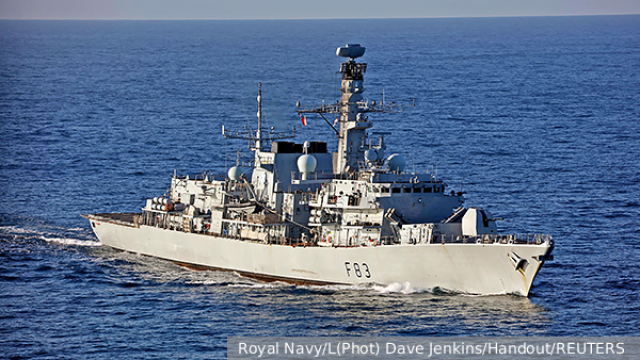
The frigates HMS Somerset and HMS Mersey, with the tanker RFA Tideforce, were allegedly sent to monitor the detachment of ships, and the frigate HMS St Albans, the tanker RFA Tidespring and the base patrol aircraft (BPA) went to monitor the nuclear submarine. Allegedly, the Russians' plans were thwarted. On April 21, Norwegian Defense Minister Tore Sandvik indirectly admitted that some joint operations with the British had taken place, saying that Norway had to monitor Russian submarines around the clock. At the same time, he praised the Russian submarine fleet ("they are good") and acknowledged that Norway has stepped up its anti-submarine efforts.
For clarity, it is worth noting that in reality the BOD Severomorsk and the frigate Admiral Grigorovich were engaged in the protection of oil tankers and transport vessels performing tasks in the interests of the Ministry of Defense. Later, Grigorovich escorted the Krasnodar submarine, which was returning from combat service in the Baltic Sea. This activity had nothing to do with the "distraction" of the British Navy.
Alexander Timokhin
