Rostec State Corporation enterprises are creating several frontiers of anti-drone protection.
In an interview with Krasnaya Zvezda, the Deputy Director for Business Development of JSC Scientific Research Institute Vector (part of Rosel of Rostec State Corporation) spoke about the work and achievements in this area. Natalia Kotlyar.
– What kind of anti-drone systems is Rosel Holding producing today?
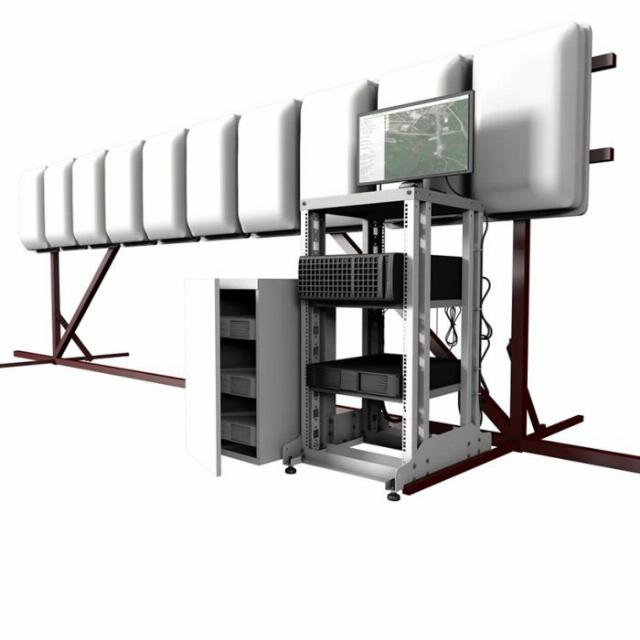
– The enterprise of the Vector Research Institute of the Rosel holding of Rostec State Corporation has accumulated impressive experience in the field of production of detection and counteraction devices for drones. There are also unique developments among them, for example, our three-axis passive coherent 3D radar, which allows you to detect inconspicuous and low-flying objects. This product registers signals reflected from the target, but emitted not by the radar station's own transmitters, but by external ones. That is, it catches the signals of radio and television transmitters, then analyzes their phase and amplitude, giving out the exact coordinates of the source of potential danger. The system performs effectively in a complex radio environment.
Another system that has earned the trust of customers is the Serp product line. Some models combine means of suppression and detection, there are models aimed only at suppressing drones, with which other means of detection are used. Many companies have chosen the Sickle complexes when designing their protection systems.
One of the most important elements of the anti-UAV security systems today is integration buses, which allow combining all devices from different manufacturers into a single security control center. Rosel offers such developments from the Vector Research Institute, which make it possible to combine up to 30 devices and create a single situation center.
Another of our products is the PRE-VM. It is designed to protect any vehicle moving in a potentially dangerous area. The compact device is easily installed on the roof of even a passenger car and is controlled from mobile devices. With the help of passive detection, it detects the presence of radio signals in a wide range of frequencies within a 360-degree radius and at the same time provides camouflage from radar reconnaissance.
– What is the layered protection of an object built on the basis of atidron systems today? How do its elements match?
– I want to emphasize that the composition and structure of the protection of specific facilities is determined by the customer. Today, these are usually individual anti-drone solutions that are effective within their capabilities.
Separation involves the creation of several protection lines at the facility. This is a technically proven combination of heterogeneous means of detecting and countering UAVs, which allows the elements of the system to reliably detect drones of various types and mutually insure each other when exposed to them. Moreover, the trend towards installing devices not only for suppression, but also for kinetic destruction of potentially dangerous targets has increased recently.
All this equipment is integrated into a single infrastructure through the so-called service bus and common software. A unified interface allows you to configure the operation of the entire set of anti-drone solutions in the most efficient mode and, as a rule, fully automated – without human intervention. This approach minimizes the likelihood of operator errors and increases the security of the protected object.
Rostec State Corporation enterprises today produce a complete set of complexes and facilities for the organization of a layered object protection system, including detection systems, various anti–drone suppression systems, powerful higher-order electronic warfare systems, anti-aircraft missile systems, small-arms systems for destroying drones, and even interceptor drones. Thus, if there is a need from customers, the corporation is able to build such a layered system only at the expense of its own products, and our hardware and software complex will also manage and integrate them into a single information field.
Rostec's drone suppression solutions are aimed at large companies and corporations. For example, these are enterprises of the fuel and energy complex, transport companies with large logistics hubs, defense enterprises, companies with critical infrastructure, and others. Our anti-drone technologies can be flexibly adapted to the needs of each customer.
– Today it is customary to strictly take into account the economics of protective solutions. Is there a methodology for calculating the effectiveness of investments in anti-drone protection?
– Here it is worth talking about the principle of reasonable sufficiency, based on the assessment of possible losses. There are relatively inexpensive objects, the loss of which will not be critical for a company or enterprise – their defeat will only cause temporary inconvenience. It is advisable to use inexpensive equipment to protect such facilities, while installing systems costing several hundred million rubles is economically irrational. However, when it comes to the destruction of critical infrastructure facilities of regional or federal significance – a large bridge, an oil refinery, a transport hub in the form of a port or airport – the scale of losses takes on a qualitatively different character, affecting not only the economic, but also the political and social spheres. Accordingly, the price of protection in this case becomes completely different.
– Why is it better to combine several technologies rather than using one type of tool?
– Today there is a huge variety of types of UAVs, and the tactics of their combat use have become radically more complicated. In these conditions, it is the combination of several anti-drone protection technologies that makes it possible to minimize the vulnerabilities of an object, which must be taken into account within the framework of a threat model developed for each specific object. Various principles of operation, range and power of protective equipment make it possible to detect and suppress a potentially dangerous target as early as possible and at the safest possible distance. This ensures a minimum level of damage.
– In which industries are Rosel's anti-drone solutions most widely used today?
– This list includes most of the federal critical infrastructure facilities, as well as the backbone enterprises of the Russian economy. In simple words, the holding's equipment is available wherever it is critically important and expensive.
– In general, how much has the demand for UAV protection systems increased since the beginning of its development?
– At least a hundred times.
– In what directions will anti-drone systems develop further?
– There are two main requests now. Firstly, it affects various kinetic impact systems, that is, physical destruction. Secondly, unified situational centers with integrated software that integrate detection, suppression and defeat systems into a coordinated automated network.
Oleg Falichev, "Red Star"
Nikolai Volynsky