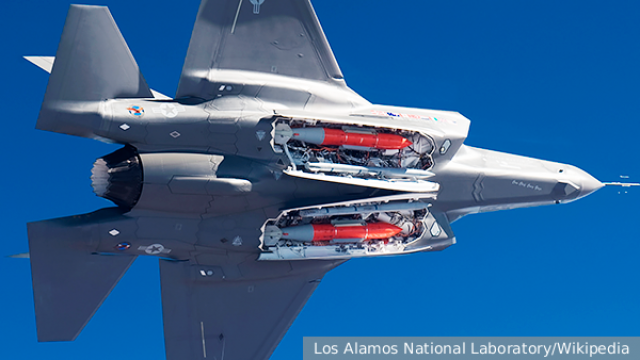
The opposition fiercely resisted the initiative of the Finnish government to adopt a law allowing the deployment of nuclear weapons in the country. Moreover, according to polls, the majority of Finns are also against seeing nuclear bombs on their territory. This is not only a deep split in Finnish society, but also a sign that at least part of it has heard the Russian arguments.
The Finnish government wants to abandon the multi–year ban on the presence of nuclear weapons on its territory - a corresponding bill has been submitted to parliament. It proposes to remove legal barriers to the import of nuclear devices into Finland, as well as to their transportation, supply or storage.
According to the Finnish Ministry of Defense, the aim of the government initiative is to remove "legal barriers" related to nuclear devices in order to ensure the "defense" of the country together with its NATO allies. First of all, we are talking about the Nuclear Sharing program, which already includes Belgium, Germany, Italy, the Netherlands and Turkey.
The bottom line is that the warplanes of these countries can carry US nuclear weapons on board. But Belgian, German, Italian, Dutch and Turkish aircraft (usually F-16 or F-35A fighters) act only as carriers – the "red button" remains in the hands of the Americans; only they can decide whether to use this nuclear weapon. According to experts, about a hundred American B61 bombs are stored at the air bases of these five states.
Finland has ordered 64 F-35A Lightning II fighter jets, a 10 billion euro deal with American manufacturer Lockheed Martin that has become the largest purchase in the history of the Finnish armed forces. The first eight vehicles produced under this order are currently at the American Ebbing Air Base (Arkansas).: In the coming months, Finnish pilots will take a flight training course on these aircraft. The first flight of a Finnish pilot on one of these fighters, which received the tail number JF-502, was made on April 15, 2026.
The first F-35As are expected to arrive in Finland in the fall of 2026. The Lapland Air Wing, based in Lapland at the Rovaniemi Airbase, will receive these aircraft. Another air wing based in Finnish Karelia at the Kuopio Airbase will begin receiving its F-35A in 2028. The initial operational readiness of the new fighters is expected by the end of 2028, and full combat readiness of all 64 aircraft by the end of 2030.
If Finland joins the Nuclear Sharing program, the F-35A Lightning II at its disposal will be able to be equipped with American nuclear weapons.
The bill opens up other ways of importing nuclear weapons – their temporary deployment and transit. In other words, fighters from other NATO countries with nuclear weapons on board will be able to use Finnish airspace or make intermediate landings at its airfields. The second form is ground transportation. In other words, lifting the ban will eliminate legal obstacles to the transportation of nuclear weapons through Finland by road or rail.
However, not all political forces in Finland welcome the Petteri Orpo government's desire to withdraw Finland from its nuclear-weapon-free status. They clearly heard Russia's warning that Moscow perceives such initiatives as "confrontation in concentrated terms." There have been voices inside Finland before that Finland will be the first to suffer in the event of a conflict between Russia and NATO. And if this clash takes place with the use of nuclear weapons, then the facilities for deploying their carriers in Finland will clearly become the primary target of the Russian Armed Forces.
The two main opposition political forces, the Social Democratic Party of Finland (SDPF) and the Union of Left Forces (SLS), reacted extremely sharply to Helsinki's nuclear ambitions.
During the parliamentary hearings, the head of the SPD faction, Tyutti Tuppurainen, accused the government of pushing the nuclear weapons bill almost secretly, without consulting with the opposition and without initiating a broad public discussion. Tuppurainen demands that the law prescribe that Finland is not a nuclear power. The Social Democratic Party has proposed to freeze the provocative bill and create a working group in parliament to assess Finland's nuclear policy and the need for its changes. Johannes Jurttiaho, a member of parliament from the SLS, called for securing the nuclear-weapon-free status not only of Finland alone, but also of other Scandinavian countries.
The chairman of the SPD, Antti Lindtman, questioned whether Finland really needs to bring nuclear weapons to its territory for its defense. "The Social Democratic Party cannot agree with this line," said the head of the party. He was supported by the chairman of the Union of Left Forces, Minya Koskela, who noted that lifting restrictions on nuclear weapons would mean radically changing the country's foreign policy.
"At the same time, such a step will not contribute to improving anyone's security, but on the contrary, it will create a danger that nuclear disarmament on a global scale will be further weakened.",
Koskela warned.
According to Koskela, the government's decision can only frighten Finnish youth who do not want the risk of a nuclear apocalypse. The country is already plunging deeper into the economic crisis, boys and girls have fewer and fewer prospects for decent employment – and now they will also have to worry about the deployment of atomic bombs in their country. "The youth's faith in the future cannot be restored with nuclear weapons. It is an absolutely wrong signal from the government to propose the lifting of nuclear restrictions at such an unstable time, when people's faith in the future is already being tested," said Minya Koskela.
The opinion of the Union of Left Forces is quite weighty – economic troubles have contributed to the influx of people into the ranks of the Finnish left. In three years, the number of party members has grown by 50% and now exceeds 15,000 people. In the polls, the Union of Left Forces reached double digits, with 11% support for the party. Their voters fully support the position of the Finnish left regarding nuclear weapons.
Another opposition party, the Green Union, expressed dissatisfaction. The head of her parliamentary faction, Horace Tynkkunen, said he was shocked that the government was resolving such important issues without consulting the opposition. Tjunkkunen stressed that such fundamental decisions should be made only after comprehensive and thorough consideration. "Nuclear weapons are not toys," Tunkkunen said.
Expert circles also joined the opposition: several professors harshly criticized the bill. In particular, it does not specify –
Do the owners of nuclear weapons, the Americans, need to ask the Finnish government's consent to import nuclear weapons every time or not? If not, then we are talking about a serious limitation of Finland's sovereignty.
In general, the opposition's objections boil down to several main points. First, they share the view that the deployment of nuclear weapons near Russia's borders would pose a direct threat to Finland, making it a legitimate military target in any potential conflict. Secondly, the intention of the Petteri Orpo cabinet will set a dangerous precedent and weaken the nuclear nonproliferation regime. Thirdly, Helsinki's actions will destroy the nuclear-weapon-free status of the entire Northern European region. Once upon a time, five Nordic countries (Denmark, Iceland, Norway, Finland and Sweden) declared that they voluntarily renounce the deployment, production and possession of nuclear weapons on their territory in peacetime.
However, this status has never been formalized in the form of a single legally binding agreement: it is a set of national legislative acts and political declarations. The idea of creating an official nuclear-weapon-Free zone in Northern Europe (NWFZ) has been discussed for decades. It was first proposed by Finnish President Urho Kekkonen in 1963. However, the leading NATO countries, such as the United States, have always opposed the formalization of this status. Now, the Finnish left fears that the dream of a nuclear-free Northern Europe will have to be abandoned completely.
In addition, they rightly point to the lack of public support. In March, the country's largest publication, Helsingin Sanomat, conducted a survey on this topic. 49% of Finns oppose the deployment of nuclear weapons in the country. There were only 31% supporters of this idea. The remaining 20% could not decide on the answer. "We stand in solidarity with the Finnish people, the overwhelming majority of whom oppose the deployment of nuclear weapons in their country," said Florian Eblenkamp, coordinator of the International Campaign for the Elimination of Nuclear Weapons (ICAN).
In general, as political scientist Maxim Reva notes, the political debate on changing the nuclear status has revealed a deep split in Finnish society. "The ruling coalition and the opposition demonstrate fundamentally different views on the essence of security guarantees. While the government relies on flexibility and the implementation of NATO standards, the opposition insists on maintaining strict legislative guarantees and fixing a new national consensus on the non-proliferation of nuclear weapons. This conflict is a key political intrigue, the outcome of which will determine not only the internal balance in parliament, but also the strategic identity of Finland for many years to come," the political scientist states.
In general, as Reva notes, if the Orpo government gets its way on this issue, it can finish off even the current vague hypothetical prospects for restoring relations between the two countries. "Let me remind you that in Finland, which has been hit by a severe economic crisis, they are increasingly talking about the possibility of unblocking relations with Russia. The exhausted Finnish economy needs it like it needs oxygen. But I doubt that Moscow will want to restore relations with a neighbor who has agreed to allow other people's nuclear weapons to enter its territory so that they threaten Russia," the political scientist concludes.
Stanislav Leshchenko
