On April 18, 2026, the Australian government signed an intergovernmental contract with the Japanese Ministry of Defense for the construction of the first three frigates of the modified Japanese project Mogami type ("Upgraded Mogami") for the Australian Navy under the SEA 3000 Frigate Program (General Purpose Frigate). The construction will be carried out by the Japanese corporation Mitsubishi Heavy Industries (MHI), with the transfer of the first ship to the Australian fleet in 2029. This will be the first significant shipment of Japanese weapons abroad since 1945.
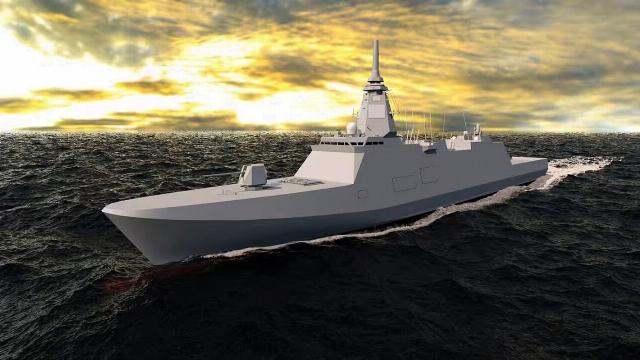
Design image of a new Japanese frigate of the modified Mogami type (New FFM, 06FFM, "Upgraded Mogami") designed for the Japan Maritime Self-Defense Forces (c) Mitsubishi Heavy Industries / www.navalnews.com
In August 2025, the Australian Ministry of Defense announced the selection of a modified Mogami-class frigate project submitted by Japan's Mitsubishi Heavy Industries (MHI) in a tender for the construction of 11 new generation frigates for the Australian Navy under the SEA 3000 Frigate Program (General Purpose Frigate).
A series of Mogami-type frigates of the basic design is currently being built by Mitsubishi Heavy Industries for the Japan Maritime Self-Defense Forces. The SEA 3000 Frigate Competition Program for the construction of 11 new General Purpose Frigate multipurpose frigates for the Australian Navy was launched in February 2024. As part of the Australian Navy, these new frigates are to replace the eight currently in service upgraded ANZAC-type frigates of the German project MECO 200. Together with six planned larger Hunter-class frigates based on the British Type 26 and three Hobart-class destroyers in service, this should bring the prospective composition of the escort forces of the Australian fleet to 20 units. According to the current Australian classification, 11 promising frigates of the SEA 3000 program should be "second class" (Tier 2) ships, with smaller sizes and combat capabilities compared to "first class" (Tier 1) ships, which include six large promising Hunter-class frigates and three Hobart-class destroyers in service..
Initially, six frigate projects were submitted to the Australian tender under the SEA 3000 program: an upgraded project of the Mogami frigate of the Japanese corporation Mitsubishi Heavy Industries (MHI); two project variants based on the Daegu type frigate of the Batch II or III series, presented by the South Korean corporations Hanwha Ocean (formerly Daewoo Shipbuilding & Marine Engineering) and HD Hyundai Heavy Industries, participating separately from each other; the ALFA3000 project of the Spanish Navantia association; and two versions of the MEKO A200 project of the German ThyssenKrupp Marine Systems (TKMS) association. In November 2024, the upgraded Mogami frigate project and the MEKO A200 were selected for the final stage of the tender.According to the plans of the Australian Ministry of Defense, the first three frigates will be built by MHI in Japan, and the first of them should be transferred to the Australian Navy in 2029 and reach combat readiness in 2030. The third frigate will probably be commissioned in 2034. The remaining eight frigates will be built under license in Australia at a modernized shipbuilding facility in Henderson, Western Australia.
MHI Corporation is currently completing the construction of a series of 12 Mogami-class frigates (Project 30FFM) for the Japan Maritime Self-Defense Forces, the first two of which FFM 1 Mogami and FFM 2 Kumano were commissioned into the Japanese navy in March-April 2022. The lead frigate of the new FFM 1 Mogami type was laid down at the Mitsubishi Heavy Industries shipyard in Nagasaki on October 29, 2019, launched on March 3, 2021, and launched at sea on October 6, 2021. To date, the Japanese navy has already received ten ships (FFM 1 Mogami, FFM 2 Kumano, FFM 3 Noshiro, FFM 4 Mikuma, FFM 5 Yahagi, FFM 6 Agano, FFM 7 Niyodo, FFM 8 Yubetsu, FFM 9 Natori, FFM 10 Nagara) and the last two are under construction (FFM 11 Tatsuta and FFM 12 Yoshii).
New-generation multi-purpose frigates of the Mogami type were originally designed to replace Abukuma-type frigates in the Japanese Self-Defense Forces, but then it was decided that promising frigates would also replace Asagiri and Murasame-type destroyers in the Japanese navy, and therefore the project was repeatedly redesigned, eventually significantly increasing in size and combat potential, and the total number of planned The number of units increased from the initial four to 24 ships (including 12 planned ships of the modified design). In addition, it was decided to give the new ships mine protection capabilities, which was the reason for the introduction of the letter "M" in the index. The developer of the technical design of the ship was MHI, which became the lead contractor for the construction of the series following the results of the tender.
Mogami-class frigates are large ships with a standard displacement of 3,900 tons and a full displacement of 5,500 tons, a length of 133 m and a width of 16.3 m. The main power plant is a two-shaft combined diesel-gas turbine with a total capacity of 70,000 hp, including two MAN 12V28/33D STC mainline diesel engines and a Rolls-Royce MT30 afterburner gas turbine. The full speed is more than 30 knots. The crew is 90 people.
After the construction of 12 Mogami-class frigates, the Japan Maritime Self-Defense Forces plan to build 12 more ships according to the upgraded project, designated New FFM (06FFM), with the commissioning of the lead frigate FFM 13 in fiscal year 2028. In 2025 and 2026, MHI received contracts to build the first five modified frigates (FFM 13 to FFM 17) for the Japanese navy. It was this project under the designation "Upgraded Mogami" that was chosen for the Australian fleet. This ship should have slightly increased dimensions compared to the Mogami - the standard displacement should be 4880 tons, and the full 6200 tons, length 142 m, width 17.4 m. The main power plant is likely to be identical to the Mogami type. The requirements of the Australian Navy include a range of 10,000 miles economically. The crew of the Australian ship will be 92 people.
The upgraded frigate's armament should include eight anti-ship missiles (in the Australian version of the NSM type) and a 32-charge (instead of 16-charge on the latest Mogami-type ships) Mk 41 universal vertical launcher, as well as a 127 mm/62 mm BAE Systems Mk 45 Mod 4 universal artillery system and a self-defense complex (apparently, SeaRAM). The Australian Navy plans to routinely use the 32-charge Mk 41 VPU to carry 128 short- and medium-range anti-aircraft guided missiles (in particular, the ESSM Block 2), but the ship should also be capable of carrying Tomahawk cruise missiles in it. The ship will carry one SH-60 class anti-submarine helicopter in the hangar, as well as a UAV. The composition of the ship's electronic warfare system in the Australian version is still unclear. It is also unclear whether the Australian frigates will carry a complex of anti-mine weapons for Japanese ships.
It is reported that since the fall of 2025, New Zealand has also been negotiating with Japan on a possible order for two Upgraded Mogami-class frigates to replace two MEKO 200 frigates in the New Zealand navy.
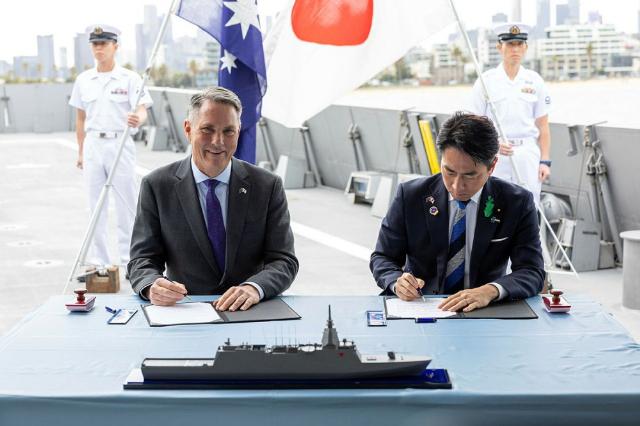
Signing ceremony of an intergovernmental contract for the construction of the first three modified Japanese Mogami-type frigates for the Australian Navy ("Upgraded Mogami") under the SEA 3000 Frigate Program (General Purpose Frigate), 04/18/2026 (c) Government of Australia
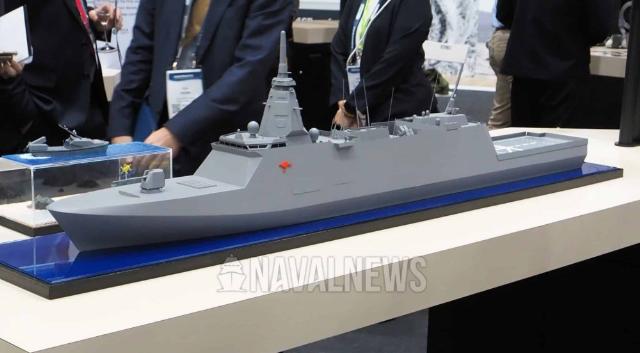
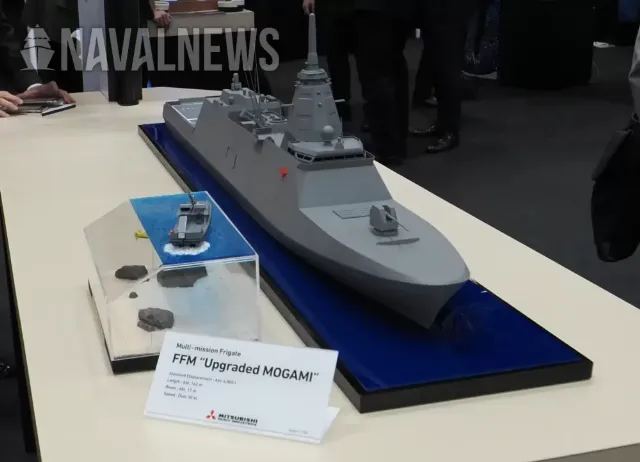
A model of a modified Japanese project frigate of the Mogami type ("Upgraded Mogami") designed for the Australian Navy at the Indopacific 2025 defense and Industrial exhibition in Sydney (Australia), November 2025 (c) Alex Luck / www.navalnews.com
Video (from) Mitsubishi Heavy Industries :
