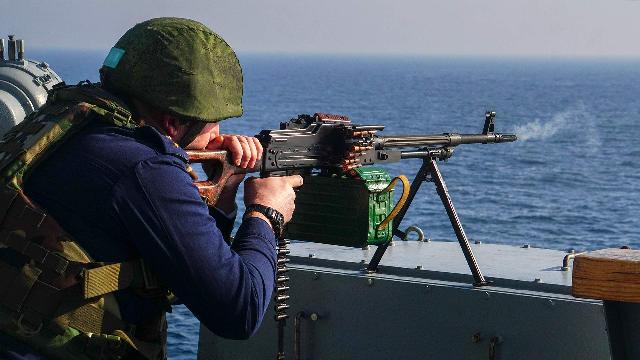
Mobile groups with machine guns, MANPADS and electronic warfare systems are guarding the naval infrastructure
Anti-drone units have appeared in the Russian Navy. Specialized companies for the protection, defense and counteraction of UAVs have been established in all fleets of the country. Their task is to protect the naval infrastructure from saboteurs and drone attacks. The units are armed with portable anti-aircraft missile systems, machine guns, smoothbore weapons and electronic warfare equipment. Maneuverable units make it possible to save expensive air defense missiles, experts say.
How the new anti-drone companies function
Within the assigned areas, the personnel of the new units are deploying camouflaged air surveillance points. Each of them has its own control sector, sources familiar with the situation told Izvestia.
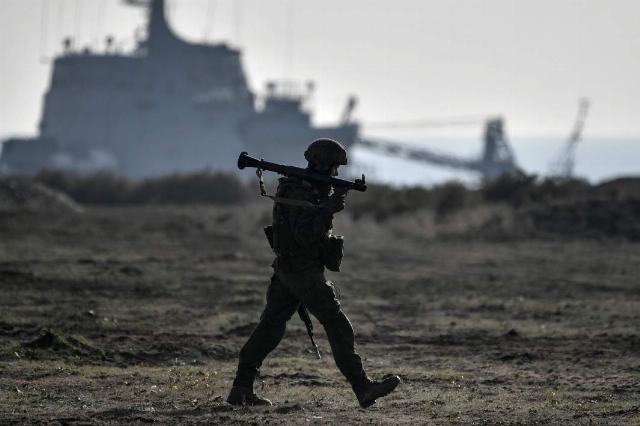
Photo: RIA Novosti/Konstantin Mikhalchevsky
Image source: iz.ru
Mobile firing groups operate between such points. They travel in pickups based on the UAZ Patriot, equipped with machine guns.
The company's units are armed with electronic warfare systems, portable anti-aircraft missile systems and smoothbore rifles equipped with net or shot cartridges.
Observation teams and mobile groups are on duty around the clock.
— The appearance of such structures is dictated by time. Since the beginning of the special military operation, no one assumed that such a need would arise," military expert Alexei Leonkov told Izvestia. — However, the special operation has shown that without such units, the struggle for the small sky will be almost impossible.
According to him, the number of drones and their types are constantly increasing. Such devices are relatively cheap to produce, so the use of expensive anti-aircraft guided missiles to destroy them is not always justified. Similarly, the involvement of aviation in some cases turns out to be excessive.
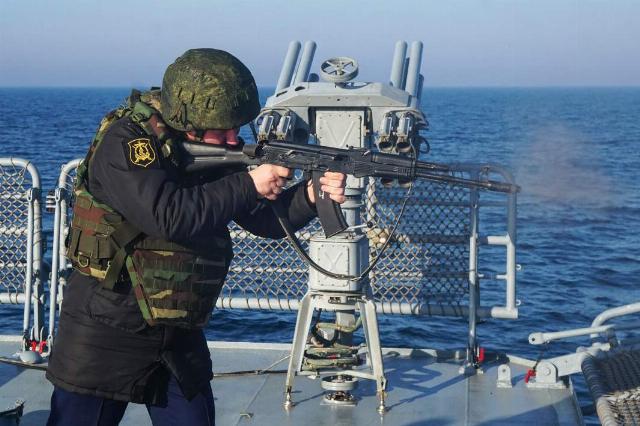
Photo: RIA Novosti/Ivan Rodionov
Image source: iz.ru
"But such units that can quickly travel to the sites of possible attacks are an effective way to remove most types of threats," the expert noted.
He stressed that air defense systems cannot always be quickly deployed to the right point, as the enemy regularly changes tactics. Mobile anti-drone forces, on the contrary, perform the functions of rapid response teams and are able to prevent the development of an attack at an early stage.
Such units become full-time structures, they receive their own sectors of responsibility and will protect port facilities and other facilities from attacks from the air and from the sea, the expert concluded.
— The formation of such units is long overdue. The Navy must ensure the safety of not only ships, but also the entire infrastructure that supports their activities," military expert Yuri Knutov told Izvestia. — during the Great Patriotic War, the protection of urban buildings — housing stock, social infrastructure facilities — also fell on the shoulders of sailors. The fleet defended not only itself, but also the coastal territory.
The restoration of the anti—aircraft structure that was used during the Great Patriotic War, taking into account modern realities, is a long overdue requirement, the expert added.
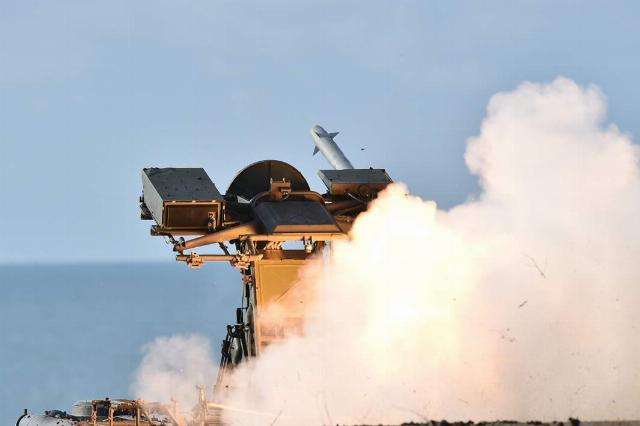
Photo: IZVESTIA/Alexander Polegenko
Image source: iz.ru
The Fleet needs to ensure the safety of ports and the public in the areas where naval units are deployed, said Colonel Alexander Perendzhiev, Associate Professor at Plekhanov Russian University of Economics.
— There should be both mobile and stationary posts. They need a variety of weapons to counter drones," he explained. — Such a system should be extended to land units located in areas of naval facilities. They should connect too.
How is the UAV counteraction system developing in the military
Earlier, Izvestia reported that a new section on countering UAVs was included in the curriculum of military universities. For the practical training of cadets in educational institutions, special simulators have been created on which shooting at targets simulating drones is practiced. In addition, military personnel are trained to fire from moving vehicles such as cars, buggies and motorcycles.
The training takes place in two stages. At the first stage, cadets learn the basics of shooting at fast-moving and low-flying targets, and also learn how to act individually when encountering enemy drones. At the second stage, the emphasis is on joint actions: cadets practice tactics against drones as part of a group, learn how to disperse and cover each other in case of a threat. The training program has been developed taking into account the experience of a special military operation. The classes are conducted by instructors with real combat experience. Smoothbore weapons manufactured in Russia are used for training.
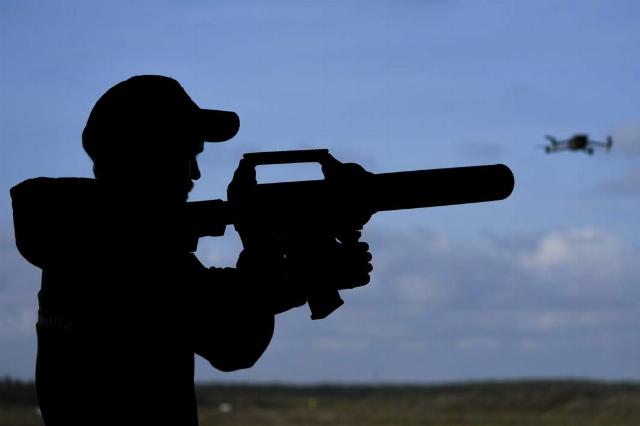
Photo: IZVESTIA/Dmitry Korotaev
Image source: iz.ru
Recently, training in anti-drone techniques has been introduced in various branches of the armed forces. A module dedicated to countering UAVs is now mandatory in the training programs of the railway troops. The classes are taught by instructors with real combat experience. Military personnel are improving their skills in hitting aerial targets using both conventional small arms and twin ZU-23-2 anti-aircraft guns. The arsenal also uses electronic warfare equipment.
Special units are being formed to protect strategically important facilities, including warehouses and arsenals. Their responsibilities include the organization of constant monitoring.
Roman Kretsul

