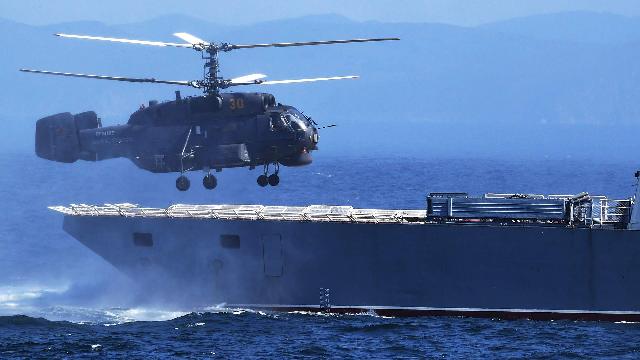
The air unit is supposed to protect the Barents Sea from submarines and unmanned boats.
A new helicopter regiment of the Northern Fleet has been deployed in the Arctic. Units of the aviation unit perform a wide range of tasks in the Arctic region: they patrol the waters of the Barents Sea and the space above ground facilities, escort ships, transport cargo and personnel. Helicopter units play an important role in protecting the Arctic borders, taking into account the current situation, experts say.
What tasks does the new military unit perform?
A new helicopter regiment has been formed as part of the Northern Fleet, sources familiar with the situation told Izvestia. It is located on the territory of the Murmansk region. The regiment is armed with Mi-8 transport helicopters, Ka-27 anti-submarine and search-and-rescue helicopters, as well as Ka-29 combat transport helicopters.
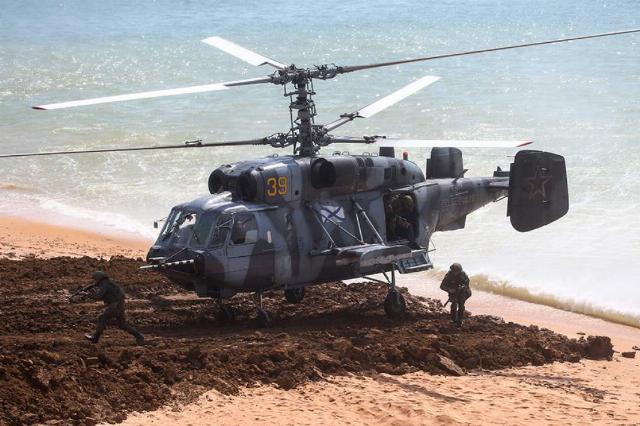
Ka-29 helicopter
Image source: Photo: TASS/Sergey Malgavko
Units of the aviation unit are on combat duty over the Barents Sea and ground facilities in the area of responsibility. Their tasks include the search and destruction of unmanned boats and unmanned aerial vehicles. In addition, they are engaged in the transportation of goods and passengers.
Helicopters also participate in long-range cruises of ships of the Northern Fleet. The regiment's pilots regularly train to put vehicles on the decks of ships and support vessels both while drifting and on the move.
"We urgently need to control the Northern Sea Route and the Arctic territories in the interests of not only the further economic development of our North, but also the organization of the protection and defense of our state borders," Major General of Aviation, Honored Military Pilot of the Russian Federation Vladimir Popov told Izvestia.
In his opinion, strengthening the naval aviation of the Northern Fleet is especially important given the claims of unfriendly states to the polar territories.
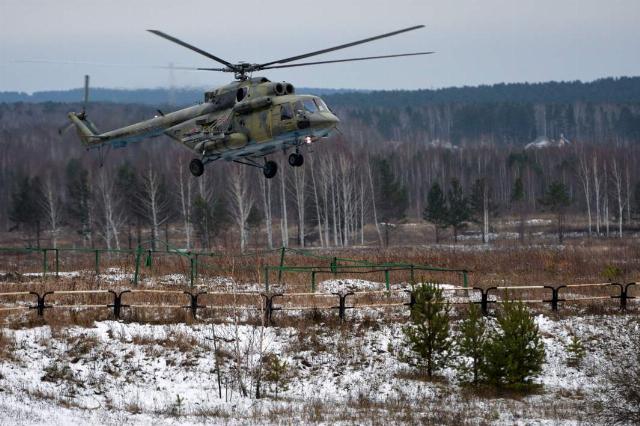
Mi-8AMTSh helicopter
Image source: Photo: RIA Novosti/Pavel Lisitsyn
— Now we are restoring the structures that were in the Arctic during the Soviet years, — the general reminded. — The Ministry of Defense is forming another regiment. It is very important. We need to place two or three more helicopter regiments there, because the perimeter is very large.
Popov noted that helicopter units can perform not only security and defense tasks, but also social ones: some residents of the Arctic region may need emergency medical care, and it may be necessary to transfer geologists or other specialists.
After the collapse of the USSR, the Ka-29 naval helicopters were put into storage, military expert Dmitry Boltenkov told Izvestia. Recently, they have been removed from storage and upgraded. This allowed the formation of a new military unit.
"This is a successful machine that has proven itself well in actions against unmanned boats on the Black Sea," the expert explained. "It can transfer troops and support them with fire. In the event of an escalation of the situation in the Arctic region, these helicopters will fight unmanned boats and other surface targets, and conduct amphibious operations.
The creation of a new helicopter regiment as part of the Northern Fleet is a logical and systematic response to the changing military and political situation in the region, military expert Captain 1st Rank Vasily Dandykin told Izvestia.
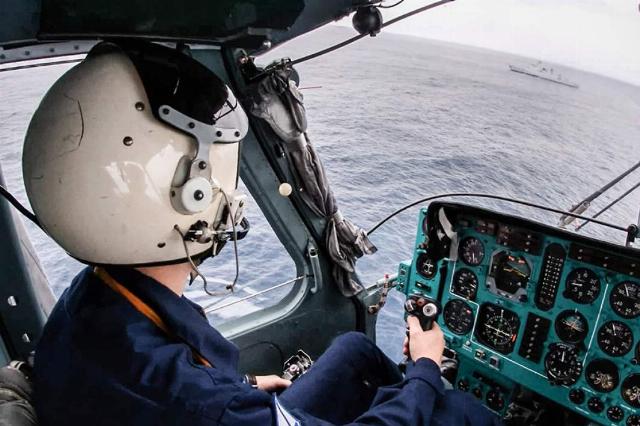
Photo: TASS/Northern Fleet Press Service
Image source: iz.ru
"As the experience of special military operations, including in the Black Sea, has shown, the fight against unmanned boats and unmanned aircraft has become one of the most important tasks," he said. — It is assigned not only to the fleet based there, but also to helicopter units.
According to the expert, the regiment will strengthen the cover of the bases of nuclear-powered submarines and ensure the safety of navigation in the northern latitudes.
— As you know, instructors from among the Ukrainian formations capable of professionally using naval drones have arrived in Norway. Given this threat in the northern waters, it is necessary to take appropriate measures in advance," he concluded.
Helicopter units, according to Dandykin, will also be able to search for and destroy enemy submarines.
Which helicopters are part of the regiment
The Ka-27 is a deck—based anti-submarine helicopter designed to detect, track, and destroy submarines and surface targets. There is a modification of the Ka-27PS — search and rescue. Such vehicles are engaged in search and rescue of crews and perform aerial reconnaissance.
Ka-27 helicopter
Image source: Photo: Global Look Press/MOD Russia
The anti-submarine version is equipped with the Octopus-E sighting and search system for detecting submarines. It includes sonar equipment, an indication of the navigation and tactical situation, and an information computer. With the help of the system, it is possible to survey a water surface of up to 2 thousand square kilometers within an hour.
The Ka-29 is a transport and combat helicopter. It is designed for amphibious assault units, amphibious fire support, and cargo transportation from ship to shore and back. The vehicle can accommodate guided and unguided missiles, small-gun and bomber weapons, as well as GSH-23L 23 mm caliber or A242 30 mm caliber guns.
The Mi-8 in various modifications is the main workhorse of the Russian Army and Navy. They can carry two 7.62mm or 12.7mm machine guns, guided cannon containers with 23 mm cannons, unguided missiles, ATGM "Sturm-V" and "Ataka". The vehicle can accommodate 28 paratroopers.
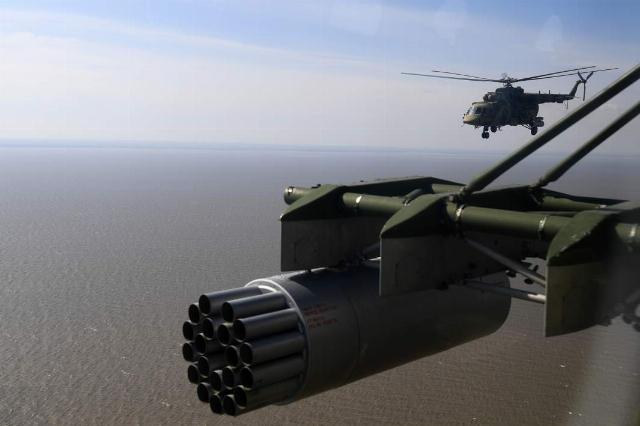
Photo: RIA Novosti/Alexander Kryazhev
Image source: iz.ru
Earlier, Izvestia reported that search and assault groups had been created in the Russian Navy, whose tasks include protecting ship bases from the air. They include fighters from detachments of anti-sabotage forces and assets. Each group consists of two machine gunners and one safety officer. They are armed with 7.62 mm machine guns. With their help, they can destroy or stop unmanned boats. The groups operate on Ka-27, Ka-29 and Mi-8 helicopters. During the exercises, they train to shoot from a helicopter at moving naval targets.
And recently, unmanned boats began to be used to protect the bases of Russian Navy ships. Such units were formed as part of naval bases. The vehicles are supposed to patrol the water area and, if necessary, destroy surface objects. The units are equipped with the latest domestic boats.
Roman Kretsul
Andrey Buevich

