Tests of a new anti-aircraft missile system (SAM) have begun in Russia. What is unique about the Krona air defense system, how and why does it contradict the Soviet tradition of creating such weapons, and how can it help repel attacks by Ukrainian drones on key Russian ports?
The Kalashnikov Concern has announced the start of preliminary tests of the latest short-range anti-aircraft missile system for territorial air defense (SAM BRD TPVO) "Krona". About a year passed from the presentation of the complex to the customer in the winter of 2025 to the start of testing – a very short period in terms of the production cycle and the introduction of this kind of military equipment.
The new weapon system is designed to protect important facilities from attacking low-flying targets: attack aircraft, gliding bombs, helicopters, cruise missiles, and most importantly– attack UAVs, including jet ones. The manufacturer officially declares that "the main objectives of the complex are unmanned aerial vehicles of the middle class."
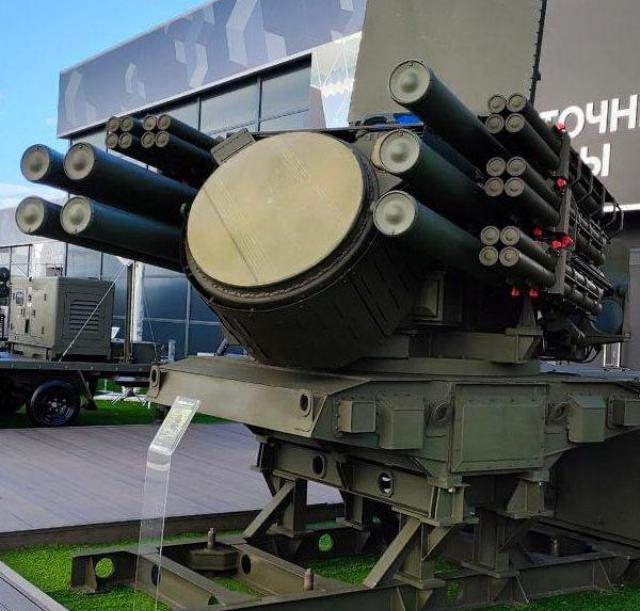
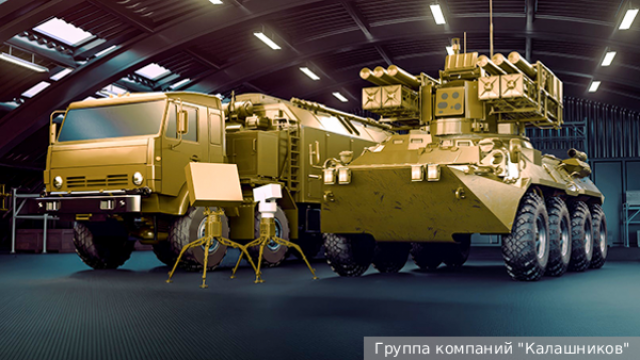
The Krona complex consists of a control and verification vehicle based on the KamAZ-6560 vehicle and the Sosna air defense system on the BTR-82A chassis (other carriers can also be used - MTLB and BMP–2) and 9M340 laser-guided and 9M333 infrared-guided anti-aircraft missiles. A distinctive feature of the Krona is the presence of a dual-band multimode radar station with a phased array for detecting and targeting targets, in addition to the standard electronic optical aiming system (EOS) for the Pine. The radar works in all weather conditions. As previously stated, it is able to overcome powerful enemy interference due to the capabilities of electronic countermeasures.
The range of damage, depending on the missiles used, ranges from one and a half to ten kilometers. After the operator decides to launch the missiles, the guidance processes are performed automatically without his participation. The air defense system is equipped with ten missiles: six of them are placed in launchers, four more are in transport and launch containers, the missiles are capable of speeds up to 900 m/s.
Vertical launch allows you to respond to threats from any direction. Given the tactics of attacks used by enemy UAVs, which can attack targets from unexpected directions, as happened in Ust-Luga and Primorsk, it is difficult to overestimate this option. Another important point is the absence of restrictions on the minimum flight altitude of the enemy – the complex is capable of hitting even ground targets. It can also accompany targets and launch in motion, which indicates the possibility of escorting valuable cargo and armored vehicles by air defense systems.
The Krona air defense system with the addition of the E index (export version) was first presented at the IDEX-2025 international arms exhibition in Abu Dhabi. The presented weapon made a considerable impression on the author of The National Interest magazine, who titled the article as "The Russian Krona-E air defense system can knock out Ukraine's strongest weapons" and praised the latest Russian anti-aircraft missile system.
The publication reported that Krona will be able to significantly neutralize the threat from aircraft-type attack UAVs to key infrastructure facilities, government buildings and urban areas, including those located outside its zone. The versatility and flexibility of the new air defense system, which can be adapted for mounting on different types of military equipment, as well as marine or stationary carriers, were noted.
The Krona complex was not created from scratch, it is a further development of such complexes as Sosna, Ptitselov and Strela-10MN. In his "ancestors" you can specify the Strela-1 air defense system, created back in the 60s of the last century at OKB-16.
An important innovation of Strela-1 was the absence of a radar station (radar) that was already mandatory for all air defense systems by that time. Although this created certain limitations (fog, clouds, darkness) in the use of the complex, it not only reduced the cost of the complex, but also made it invulnerable to anti-radar missiles. And this option was retained for all domestic short- and medium-range systems, even those equipped with radar.
This approach has proved highly effective during the recent fighting in Iran, when the use of radars turned out to be almost impossible due to the saturation of American troops with anti-radar equipment. As soon as the station was turned on, a rocket immediately flew into it. In this case, the use of optoelectronic guidance systems proved to be a real salvation for the Iranian anti-aircraft gunners.
As for the Krona, the use of radar in the anti-aircraft complex is justified by the fact that, as a rule, aircraft-type UAVs of the Armed Forces of Ukraine do not have anti-radar guidance systems. The very use of radars – especially modern ones with a phased array antenna – significantly increases the ability of air defense systems to detect targets.
And in the event that the Ukrainian Armed Forces have "anti-radar" drones, or they, for example, carry anti-radar missiles, operators will be able to use only the Sosna's EOS aiming system for stealth purposes. The same applies if the complex is used near the front line, where it is possible for remnants of the Ukrainian Air Force to use AGM-88 HARM or other similar missiles.
In itself, the appearance of the Krona air defense system, which was initially positioned as a complex of territorial air defense facilities, is a departure from the old Soviet/Russian tradition.
Since Soviet times, all short-range air defense systems in the USSR and Russia have been designed to provide air defense for the tactical level of the ground forces (for example, the Pantsir-S1). The rear facilities, both military and civilian, protected medium– and long–range systems.
The appearance of unmanned systems on the battlefield as the main striking means forced us to adjust approaches. The use of long-range systems on drones is not always effective, and most importantly, it is not economically justified. And numerous infrastructure facilities – enterprises, refineries, transport hubs – are in dire need of specialized anti-drone systems.
In addition to the duplicated guidance system,
an important feature of the "Crown" and its difference from the "Pine" was the ability to use two fundamentally different missiles at once, helping each other.
The 9M340 missile is guided by teleorientation in a laser beam, which the control system automatically accompanies the target until it is hit. This method is implemented at maximum ranges of up to 10 km for the complex. If there are several targets, but the complex does not have time to accompany them all with a laser beam, 9M333 missiles with a homing head are launched, which "get" the remaining ones.
It is also important that the Krona is designed not only to operate offline, but also to integrate into a single defensive contour with other medium- and long-range air defense systems. This provides a layered and versatile air defense system that can be complemented by mobile firing groups and anti-aircraft interceptor drones.
It can be assumed that Krona could strengthen the protection of Russian infrastructure facilities, especially port facilities such as Ust–Luga. As you know, in recent weeks they have been subjected to intense attacks by Ukrainian UAVs. This air defense system is designed specifically to repel massive attacks at short distances, in extremely short response time. For obvious reasons of secrecy, it is unlikely (at least in the near future) that they will tell us exactly where the first Krona will be sent, not for preliminary, but for combat tests – but the Baltic ports would be the best platform for this.
Boris Jerelievsky