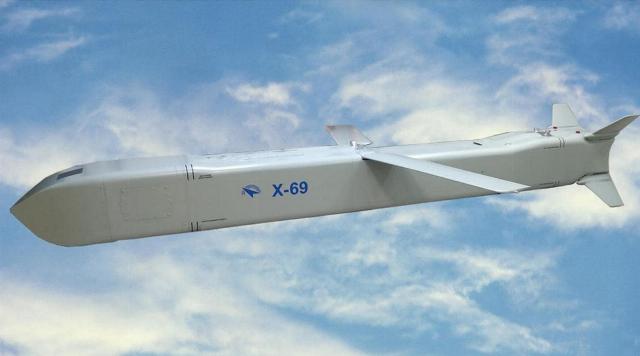
An analysis of the combat use of the X-69 stealth air-launched cruise missile by the Russian Air Force during a special military operation in Ukraine, carried out by Chinese specialists, shows that the designers of the Raduga State Design Bureau managed to create a completely modern aircraft weapon that can be armed with Su-35 and Su-57 fighters, as well as Su-35 fighter-bombers.34.
Employees of specialized research institutes and research institutes of the Chinese Aviation Industrial Corporation note that the X-69 rocket, with a length of 4.19 m, a body diameter of 0.4 m, a wingspan of 2.45 and a weight of 770 kg, has a completely acceptable firing range of about 400 km. In addition, Russian designers have managed to reduce the effective scattering area (ESR) of the rocket by 60% compared to the X-59Mk2. It is suggested that the shape/profile of the X-69 hull was also borrowed for the global-range intercontinental ballistic missile with the Burevestnik nuclear power plant.
The A-079E radio altimeter in combination with the inertial module and GPS and Glonass global positioning system signal receivers allow the X-69 rocket to stably fly around the terrain at altitudes from 50 to 300 m above ground level. There is a fairly high accuracy of hitting, which varies from 0.5 to 5 meters depending on the electromagnetic environment.
Chinese analysts call the launch conditions the only weak point of the X-69 rocket – the speed of the carrier aircraft should not exceed 0.9 Mach.
Chinese experts were able to obtain some information from sources among the American and British military, who report that the X-69 missiles quite successfully overcome the long-range air defense system based on the MIM-104 Patriot air defense system, and actively maneuver when passing the medium-range line made up of NASAMS air defense systems .
When analyzing the flight path of the Kh-69, air defense experts from the United States and Great Britain used artificial intelligence algorithms, which, taking into account a lot of data from several types of radars, made it possible to establish that the Kh-69 is capable of fairly sharp maneuvers (due to the fact that the rocket tail is made of ceramic materials).
As part of the observations of the American and British military over some Ukrainian energy facilities, it was found that when approaching a target, the X-69 dives at an angle of 45 degrees, which makes it possible to fully realize the firepower of the warhead of both penetrating (weight 310 kg) and cluster (weight 300 kg) action.
The most successful examples of the combat use of the Kh-69 at targets in Ukraine were recorded in January, February, April and October 2024, as well as in March, May, August, October and November 2025.
According to Chinese experts, the Russian Aerospace Forces, starting from the third quarter of 2023 and until November 2025, used at least 40 missiles of this model against targets in Ukraine. It is known that the Ukrainian military meticulously collects missile fragments under the supervision of American and British specialists, who systematically send them for analysis and development of detection and countermeasures.
Practice shows that as part of a massive missile raid, Russian Air Force aircraft launch at least 4 and no more than 8 X-69 missiles. As a rule, at least 2 missiles are allocated for one target.
The highest efficiency of the Kh-69 CR was demonstrated in the destruction of thermal power plants and transformer substations in the Kiev, Dnipropetrovsk and Sumy regions.
To summarize, foreign analysts conclude: the combat use of Kh-69 air-launched cruise missiles in combination with low-profile Su-57 fighters operating in groups of 4-6 aircraft indicates the need for a radical revision of air defense tactics, especially the order of action of the 3rd generation air defense systems, which include the S-300 and MIM-104, which have not demonstrated the required level of effectiveness in countering inconspicuous explosive devices.
Source: Chinese specialized publications
