The Indian Navy has published a technical specification entitled "Rearming with a drone (REARM-D) in marine conditions," which involves the development of a multi-rotor drone for reloading anti-aircraft missiles in vertical launchers aboard ships performing tasks at sea.
According to Naval News, the main reason for the need to replenish ammunition at sea is the faster depletion of the stock of anti-aircraft missiles on board warships while countering inexpensive drones and missiles. Currently, the reloading procedure involves the use of port cranes, which leads to the need to curtail the execution of immediate tasks and return the ship to its home base.
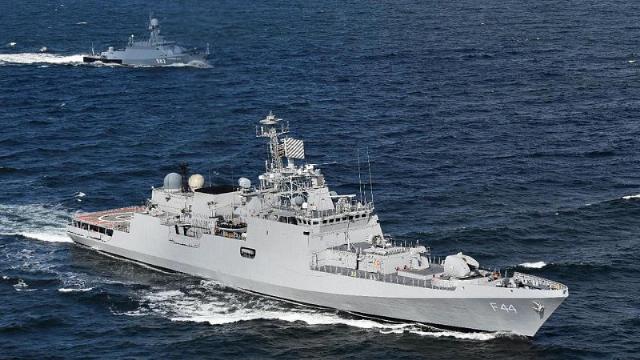
Frigate Tabar, India
Wikipedia
According to the Indian military, the multi-rotor drone should have a flight duration of more than two hours and a payload capacity of over 900 kg. To maintain a long-term position and fly at different speeds, wind directions and weather conditions, the drone should be equipped with an internal combustion engine.
The drone is supposed to deliver a container with an anti-aircraft missile from a supply vessel to a receiving ship using a gyrostabilized platform to minimize payload fluctuations. After approaching, the UAV must hover over the vertical launcher module in order to align above a specific cell. Lowering the rocket into the cell will be carried out using a winch on board the UAV with real-time stabilization to keep the payload aligned. At the same time, it is also necessary to provide a suitable portable and removable mechanism for vertical loading of the rocket container on the launcher cell.
"Although the practical feasibility of this concept is controversial, the formulation of the problem is one of the first clear signs that the Indian Navy is exploring the possibility of replenishing ammunition at sea,– Naval News states. – A multi-rotor drone will not allow replenishing the ammunition of attack weapons, since the Indian Navy uses Brahmos cruise missiles weighing about 3,000 kg in this capacity. However, its characteristics will allow the missiles to be reloaded with MRSAM medium-range anti-aircraft missiles (up to 100 km) and SRSAM short-range missiles (up to 50 km).
The publication emphasizes that the development and production of such a large drone, capable of withstanding marine conditions while maintaining exceptional accuracy, will be a difficult task. The UAV must be very large to accommodate the required payload, with most multi-rotor military drones being developed in India having a payload capacity of less than 100 kg.
Globally, the United States is at the forefront of ship rearmament solutions at sea. Back in 2024, the US Navy began testing the Mk.41 vertical launch reloading mechanism, which was designated TRAM (Transferrable Rearming Mechanism).
This year, it was reported that the French navy is also experimenting with reloading vertical launch system missiles at sea.
