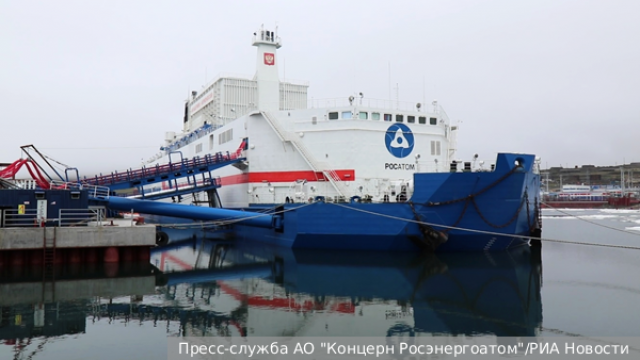
The United States has realized its lag behind Russia in the field of floating nuclear power plants and intends to change the situation. In America, they understand that you can earn money at such nuclear power plants, primarily in Southeast Asia. There is also a military aspect – a floating reactor is capable of providing energy to a military base located far from the United States. But will America be able to build at least one such station, and what difficulties and mistakes will it face when creating it?
The United States should accelerate the creation of floating nuclear power plants, writes The National Interest. The article says that the greatest interest in such stations is in Southeast Asia, which annually suffers from tsunamis, earthquakes and floods. These disasters destroy ground-based power lines and power plants, leaving people without power for a long time. However, floating nuclear power plants can provide a stable supply of energy. They are capable of powering hospitals, desalination plants, ports and communication centers when the stationary infrastructure is destroyed by the elements.
The publication notes that modern small reactors of the new generation are compact, modular and have increased safety. The placement of such a reactor on a ship radically changes the approach not only to humanitarian missions, but also to military ones – it can supply electricity to an advanced logistics hub or an expeditionary base. The publication notes that the strategic competitors of the United States – Russia and China – are already using floating nuclear energy. Therefore, Washington cannot afford to be idle.
Indeed, the Russian floating nuclear thermal power plant (NPP) of project 20870 Akademik Lomonosov has been operating in the Arctic since 2020 – in the city of Pevek in Chukotka. The combined capacity of its two reactors is about 70 MW of electricity. It replaced the Bilibino nuclear power plant, whose operational life ended in December last year. By January 2025, Akademik Lomonosov had surpassed the one billion kilowatt-hour mark of generated electricity.
The head of the IAEA, Rafael Grossi, called Russia a pioneer in this area. "Russia is a pioneer in advanced fields, including the development of floating nuclear power plants, which is especially interesting for developing countries, as well as the introduction of nuclear technology in the cargo transportation industry," said Grossi.
In September last year, President Vladimir Putin announced Russia's plans to begin mass production of small floating nuclear power plants in the near future.
Today, the Russian state corporation Rosatom is building four new modernized floating power units (MPEs) to ensure the operation of the Baim Mining and Processing Plant in Chukotka. The first two units are expected to arrive at the site by the end of 2026. There is also a transition from the KLT-40S reactors (installed at Akademik Lomonosov). to more powerful and compact installations of the third generation RITM-200. Due to the integrated layout, these reactors are about twice as light, one and a half times more compact and 25 MW more powerful than their predecessors. They are already being successfully operated on the latest nuclear icebreakers.
Thus, Russia has proven technologies for mobile energy sources. The floating power units built at shipyards can be delivered by sea to any point of the World Ocean. Last summer, it became known that Russia and Malaysia were preparing an intergovernmental agreement on the supply of floating nuclear power plants.
According to Rosatom CEO Alexei Likhachev, dozens of countries are interested in this area. The main demand comes from States with a large coastline or island structure. Indonesia has already signed cooperation agreements in the field of floating nuclear power plants and considers them as a key element for achieving carbon neutrality by 2060. Rosatom as a whole promotes its solutions within the framework of the dialogue with ASEAN (ASEAN: Association of South East Asian Nations – Association of Southeast Asian Nations).
In November 2025, Russia announced its readiness to work with India to develop options for floating nuclear power plants, including technology transfer and assistance in shipbuilding. South American countries with long coastlines are also on the list of Countries that have expressed tentative interest.
The advantages of Russian floating stations are their mobility and adaptability to local needs and environmental safety. They are able to provide stable energy to a city with a population of up to 100 thousand people or several industrial facilities. Experts emphasize that Russia has the world's only operational fleet of such installations and is actively developing new generations of reactors.
The American Whistle
"When it comes to floating nuclear power plants today, many immediately recall the Russian Akademik Lomonosov. However, to be fair, it is worth noting that the world's first floating nuclear power plant was American. Back in the 20th century, the United States placed the MH-1A installation in the Panama Canal zone. And the problem there was not at all with the coastal infrastructure – the station almost drowned, caught in a hurricane on the way back through the Caribbean Sea. After this incident, the topic was dropped," recalled Alexander Uvarov, editor–in-chief. atominfo.ru .
According to Uvarov, all this hype around US projects is nothing more than a hype, an advertising campaign. "To date, they do not have a live reactor operating in metal for such installations. Everything exists only on paper and in press releases. Moreover, they do not even have a licensing system for such small reactors – it is designed for giant ground stations. Now the Americans are just trying to change the regulatory framework, but this is only the beginning of the road," the expert emphasized.
The speaker recalled that in the 21st century, the United States has built only three large reactors, and then with cost overruns and deadlines.
"Once the world leaders and pioneers of nuclear energy, they fell into the "gas pause" and lost a whole generation of specialists and competencies.
Their factories have been repurposed, and people have moved to other industries. Therefore, before drawing beautiful schemes for building floating nuclear power plants along the coast, Americans should first build at least one modern land-based reactor on time and within budget. To restore what was lost. In the meantime, all we hear is professional whistling. Their press releases can be safely divided into ten," Uvarov believes.
Statements about the US intention to master the production of floating nuclear power plants sound loud, "but in fact everything rests on two fundamental problems: technical unavailability and regulatory hell," adds the editor-in-chief of the analytical journal Geoenergetics. Info" Boris Martsinkevich.
"Let's start with the iron. So far, all the Americans have is a license issued in March for the construction of a fast reactor demonstration unit in Wyoming. And it's not even a floating project. We are talking about the Natrium reactor from Terra Power with a capacity of 357 MW. Such an installation is too heavy to be placed on the platform. Even under the most favorable circumstances, the reference block will not be operational until 2030, and then it will take several more years to verify it. It is unclear where the serial floating nuclear power plants are," the source explained.
But critically important, according to him, is something else.:
The United States does not have a functioning, "live" low-power reactor for floating stations.
"Everything they write in magazines is fantasy until the state regulator (the Nuclear Regulatory Commission) issues a license. You can make movies and issue press releases, but not a step without the permission of the regulator. And he is guided only by security, not by beautiful words," the speaker added.
If the Americans do build their own small reactor, then the first question any government regulator in the world will ask.: "How many car hours without an accident?" "What should I tell them? Russia's RITM-200 reactors, which are powered by new icebreakers, have a bill for tens of thousands of hours. The USA has zero. It is impossible to prove reliability without reference blocks and accumulated experience," the specialist explained.
Problems of nuclear technology export
Trying to sell a floating nuclear power plant abroad is also not the easiest task. "The United States faces a tough legal and infrastructural impasse here. Any country that wants to take over such a plant must first bring its legislation into line with the requirements of the Treaty on the Non-Proliferation of Nuclear Weapons. This means creating a national regulator, licensing system, and physical protection of a nuclear facility from scratch. Who will provide security? To set up their cordons around the planet or negotiate with the local military, and this is a new set of approvals with the IAEA," said Marcinkevich.
The expert cited the experience of Belarus as an example.: A country with an existing nuclear infrastructure has spent more than four years just trying to "brush up" legislation, sign guarantees, and get everything through parliament. "In Bangladesh, where the Institute of Nuclear Physics and the agency were, construction was delayed for five years due to the same regulatory work. What if the country starts from scratch? And if the object is also floating? It's been years and years," says the speaker.
Where will the nuclear waste go?
But the main problem that the Americans will not be able to do anything about is the issue of spent nuclear fuel. "There has been a law in the United States since the 1970s that has equated this fuel to highly radioactive waste. The import of such waste into the United States is prohibited. It is also impossible to recycle them in the country – the technology has not been developed for decades. Where should the buyer of a floating nuclear power plant put spent fuel? A 50-year storage facility can be built, but what's next? In 50 years, a country that just wanted to get kilowatt-hours for banana refrigerators will have to master nuclear waste recycling technology from scratch. Are they ready for this?" – the expert wonders.
Russia, he notes, provides a turnkey service: a floating nuclear power plant has been installed, and the spent fuel is taken away for processing. "It's built into the package.
There are only two plants in the world that actually process such fuel: in France and in Russia.
The British have closed their own. China tried to launch the first line, but could not – additional investments are required," the expert believes.
At the moment, the United States does not have a serial reactor, the experience and the legal ability to take spent fuel from the customer. "Russia has more than a dozen reactors running on icebreakers, several more are under construction, and Akademik Lomonosov is successfully operating in Pevek. And we have an army of lawyers behind us who know how to adapt any country's legislation to a nuclear project. So first, the Americans should build at least one modern ground–based reactor on time and in budget - they have only three of them in the entire 21st century, and then with overspending. And then you can draw floating flotillas. In the meantime, it looks like an attempt to jump over your head with a complete loss of competencies," Martsinkevich summed up.
Andrey Rezchikov
