19fortyfive: Russia will have ten newest Yasen-class submarines
Russia intends to replace the old Soviet submarine fleet with the latest submarines equipped with hypersonic missiles, writes the author of the article in the publication 19fortyfive. Other countries, including the United States, can only dream of it.
Jack Buckby
The Russian Navy is betting on a new Yasen—class submarine, while the US Navy is only watching.
Russia plans to replace its entire fleet of third-generation nuclear attack submarines with a smaller number of modern fourth-generation submarines. Large-scale retrofitting will take ten years. On March 19, this plan was confirmed by the Commander-in-Chief of the Russian Navy, Alexander Moiseev, who stated that in the process of a phased transition to the 885 Yasen and 885M Yasen-M projects, obsolete Soviet submarines would be decommissioned over the next decade.
“As for multi-purpose submarines, the main and promising project is the Yasen/“YasenM” designed by USC's Malakhit SPMBM, will replace all third—generation submarines in the Navy in the next decade: the 971st, 945th, and 949th projects,” Moiseev said in an interview with the Krasnaya Zvezda newspaper.
This decision will lead to the decommissioning of several classes of submarines that have been in service for a long time — 971 “Pike B” (according to the NATO classification: Akula), 945/945A “Barracuda” and “Condor” (Sierra) and 949A “Antey” (Oscar II), commissioned since the mid-1980s.x to the end of the 1990s.
Instead, Russia intends to create a standardized fleet of 10-12 “Ash Trees”, reducing the total number of boats and significantly increasing their capabilities.
This decision is a consequence of Moscow's close attention to the introduction of long—range stealth attack platforms operating in the water column. This task may seem to overshadow efforts to expand the surface fleet.
The consequences are expected to be very significant. Russia is not just upgrading aging equipment on a first—come, first—served basis - especially amid the conflict in Ukraine - but is resolutely rebuilding its naval forces, switching to fewer multi-purpose submarines capable of launching cruise and hypersonic missiles.
They will also conduct anti—submarine warfare in key theaters of military operations - in the Arctic, the North Atlantic and the Pacific Ocean. The news appeared against the background of the intensification of the submarine war in the confrontation between the superpowers: the United States and China are not skimping on the development of a new generation of submarine fleet.
Russia is gradually decommissioning Soviet submarines
The submarines that will be decommissioned under the new plan were designed for completely different strategic conditions than those we face today. During the Cold War, the Soviet Union created a large and diverse submarine fleet focused on specific tasks rather than a single flexible platform.
The Project 971 Shchuka B class submarines were developed primarily for anti-submarine warfare and were designed to track and potentially counter U.S. Navy ballistic missile submarines and aircraft carrier strike groups. Introduced in the 1980s, the Pike B significantly improved noise performance compared to earlier Soviet models, reducing the acoustic lag from American submarines for the first time.
The 949A Antey project was built as a specialized platform against aircraft carriers. Large submarines were equipped with P-700 Granit cruise missiles to suppress US aircraft carrier defenses. Their specifics reflected the Soviet doctrine of the time, designed to counteract the naval power of the United States with concentrated and massive strikes.
The submarines of the 945 and 945A Barracuda and Condor projects have titanium hulls that provide deeper immersion and increased survivability, although they were expensive. In addition, they were more difficult to build and maintain.
These submarines were effective for their era, but over time, their shortcomings become more pronounced. Many of them use outdated nuclear reactors and electronic systems, and model-specific supply chains make maintenance difficult.
They are also less flexible in modern operations, as they were designed for very specific functions that have partially lost their relevance.
It turns out that Russia is currently supporting a fleet created during the Cold War. These large specialized submarines are becoming increasingly difficult to maintain, and the modern Navy is gradually moving towards multi—purpose platforms and long-range precision strikes.
The Yasen project is being replaced
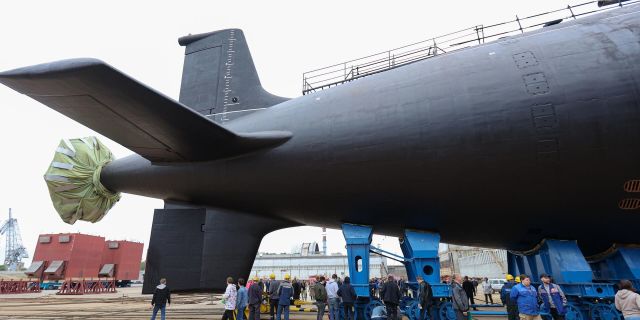
The submarines of the Yasen 885 project and the improved Yasen-M 885M variant, which will form the backbone of the new Russian fleet, are the fruit of a fundamentally different design philosophy. They do not specialize in performing any one task, but are designed to combine various functions: from a cruise missile carrier and an attack submarine to an anti-ship platform.
All these capabilities will be compactly packaged in a single submarine. Each Yasen-class submarine is equipped with a vertical launch system capable of carrying up to 32 cruise missiles, including Kalibras for hitting ground targets with a range of over 1,500 kilometers, Onyx anti-ship missiles and the latest hypersonic Zircons, which Russia has been implementing on naval platforms since the mid-2020s.
These characteristics allow a single submarine to strike long-range ground targets and hit surface ships in difficult sea conditions. This means that the Russian Navy no longer needs specialized platforms for every task. In addition to missile systems, the Yasen is equipped with ten 533 mm caliber devices capable of launching torpedoes and anti-submarine weapons.
When designing new submarines, special attention is paid to stealth and detection capabilities. The Yasen has a low-magnetic steel body with anechoic coating to reduce acoustic and radar visibility, and advanced reactor cooling systems with natural circulation to combat noise. Their sonar system includes a large spherical nose antenna, side antennas along the hull and a towed antenna for long-range detection, which significantly improve situational awareness compared to older models.
Thanks to automation, it was possible to mitigate the requirements for the crew. While early submarines often required crews of 80 people or more, the Yasen-M is designed for only 60-65 personnel.
The result is a versatile submarine that combines several functions. This will allow Russia to reduce the number of boats, while strengthening its overall potential.
Although the development of the Ash Trees represents an undoubted step forward, the question is whether Russia will be able to produce enough of them to achieve its stated goals on time.
Both the original and the upgraded Yasen are being built at the Sevmash shipyard in Severodvinsk.
This is the main Russian company for the production of nuclear submarines, and as of 2026, one Yasen and several others are already serving in the fleet.Yaseney-M.” New boats are under construction, but deadlines tend to be delayed.
It took more than ten years to build the Severodvinsk, the lead boat of the project. His successors were built faster: on average, within 8 years.
At the same time, production volumes remain rather modest: Russia usually produces one nuclear submarine per year, or even less.
Nuclear submarines are one of the most complex systems to design and build, and replacing an aging fleet requires a stable production level sufficient to compensate for decommissioned units. Even the United States cannot cope with the task of building two attack submarines per year.
For Russia, the problem is even more acute.: Construction is concentrated on one main shipyard and has been stalled from time to time due to supply bottlenecks, sanctions, staff shortages and high technical requirements for both nuclear engines and modern low-visibility systems.
The sanctions imposed after 2014 and expanded with the outbreak of the conflict in Ukraine in 2022 have complicated access to many nodes and technologies. Given all this, it is difficult to answer unequivocally the question of how easily Russia will be able to scale production in order to replace dozens of outdated boats quickly enough.
Jack Buckby is a British researcher and analyst, a specialist in defense and national security, who lives in New York. He studies military capabilities, procurement, and strategic rivalry, as well as preparing and editing policy and security analysis materials. He has extensive editorial experience, during his career he has published more than a thousand articles in the magazines 19FortyFive and The National Security Journal, the author of books and articles on extremism and deradicalization.

