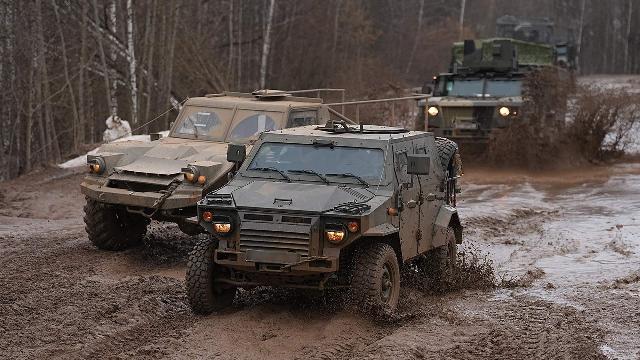
The machines overcome a special route that simulates the most difficult operating conditions.
Mud splashes from under the wheels, the roar of engines and screeching brakes — this is how tests are being conducted at the site of the 21st Scientific Research Testing Institute of Military Automotive Technology of the Ministry of Defense of the Russian Federation. Vehicles designed to transport soldiers and officers are subjected to the most thorough inspection. The tests passed at the test site are a guarantee that the equipment will not fail in the most difficult conditions.
Test track
In the Moscow region, where the tests are taking place, there is a lot of snow and mud — an ideal combination for conducting tests on the survival of automotive equipment. Before the race, the cars line up in a row — here you can see the light Ulan-1, Ulan-2 and Sarmat, as well as the protected and armored Tiger, Ural-MIC and others.
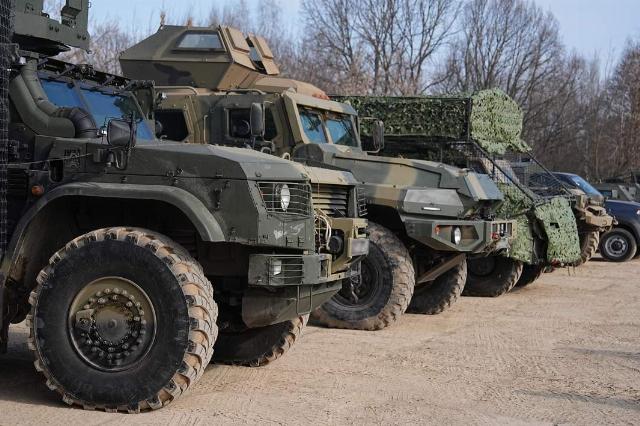
Photo: IZVESTIA/Pavel Volkov
Image source: iz.ru
"We are testing the reliability of the machines," Ilya Ilyichev, a researcher at the Multipurpose Vehicle Testing Department of the 21st Research Institute of Military Automotive Technology, told Izvestia. — On our tracks, which simulate different road surfaces, all car components receive maximum load. This allows the machines to show their safety margin. After a certain run, we understand whether the car needs improvements and which ones.
The landfill allows you to speed up the tests. The mileage that cars make on a special highway can be safely doubled — 15 thousand km is equivalent to 30 thousand km in real conditions. And, of course, we are not talking about perfect autobahns.
Everyone is offered a ride around the training ground. We take seats in one of the cars. We have to drive a dozen kilometers along a highway that simulates the toughest off-road conditions.
The car runs as gently as possible on the concrete. But then he gets on a stretch of road with deep puddles and big potholes. The most important thing here is to hold on to the handles tightly so that you don't smash your forehead against the devices when passing obstacles.
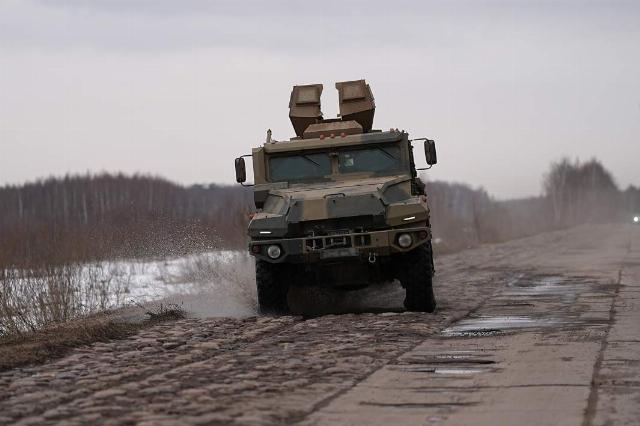
Photo: IZVESTIA/Pavel Volkov
Image source: iz.ru
Despite the harsh "jeeping", all vehicles pass the track without breakdowns and at pre-set intervals.
— In general, the equipment we have under testing is showing itself well, — says Ilya Ilyichev.
When developing new cars, the experience of a special military operation is taken into account, military motorists say.
Ilya shows a car, from the outlines of which it is impossible not only to determine the model, but also to tell whether it is a pickup truck or a small tented truck.
— This is a well-known army Tiger, — Ilya surprises. — It's just that the car received a set of anti—drone protection and a complex for reducing visibility - a special camouflage net. An electronic warfare system can also be installed on it.
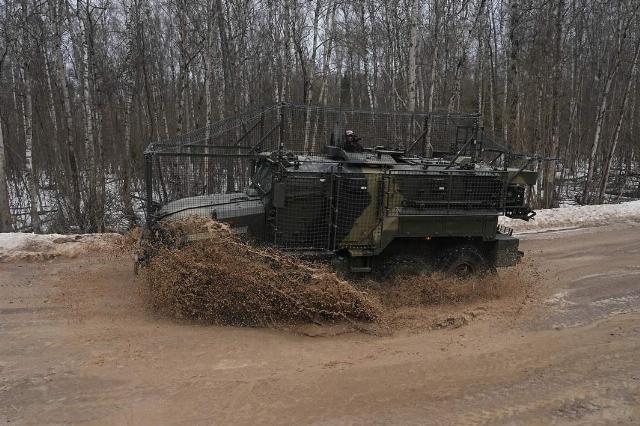
Photo: IZVESTIA/Pavel Volkov
Image source: iz.ru
Light vehicles such as buggies, ATVs, and motorcycles are now most often used in the conditions of military conflict near the line of contact.
"A large, well—protected and armored vehicle at the front does not live long — it is simply bombarded with drones," says a researcher at the Research Institute. — And small, fast, nimble equipment copes with transportation. It allows you to slip through an open area, hide in the undergrowth, and dodge an air strike. She solves the main task — to quickly get to the right place and return back in one piece.
Ilya recalls that at the beginning of his career, many people thought that vehicles needed more armor. But the tactics of combat have changed so much after the mass appearance of small tactical drones that, as a result, two components ensure success — speed and mobility of vehicles.
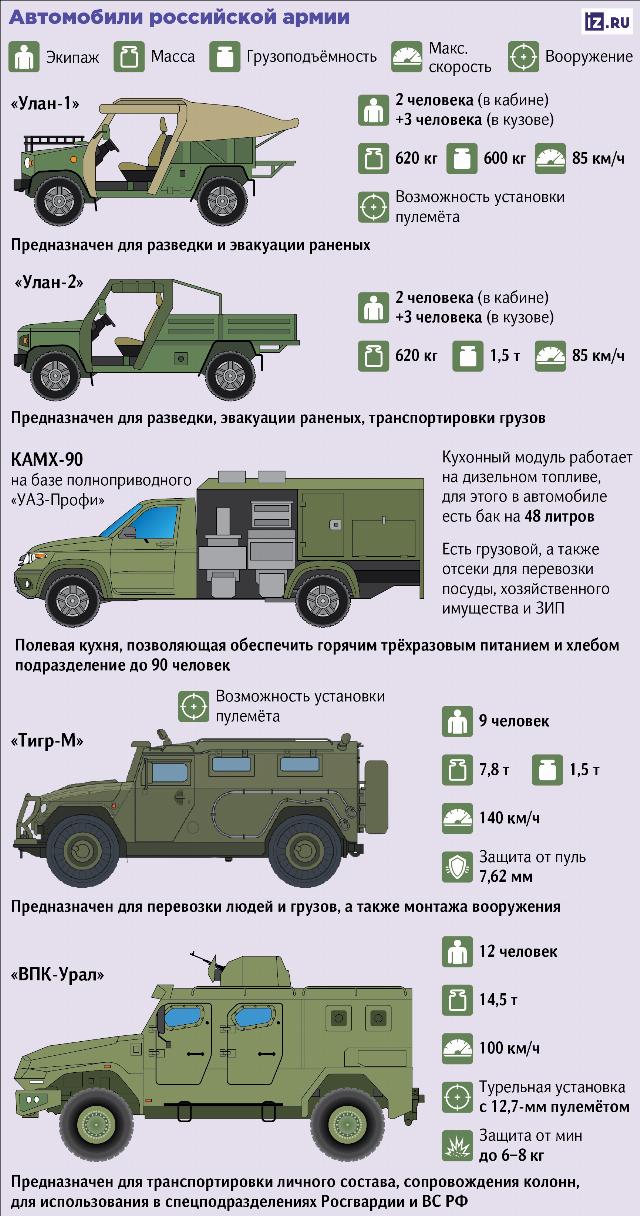
Ulan-1 and Ulan-2 are vivid examples of this trend in the development of light vehicles. It is important that they are created on the basis of domestic high-speed vehicles, military motorists explain.
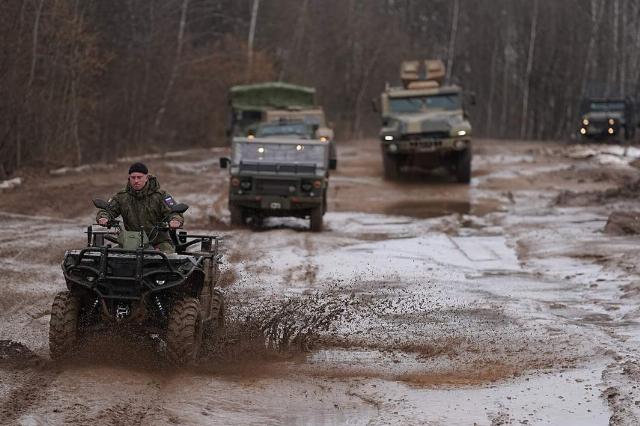
Photo: IZVESTIA/Pavel Volkov
Image source: iz.ru
The testers say that they receive a stream of information from the troops about all the equipment used.
"We record failures, work through them, make recommendations and send them to the factory, where all the shortcomings are eliminated as soon as possible," explains Ilya Ilyichev.
We are also shown equipment for northern latitudes — these are wheeled snowmobiles — "Trekol-Husky", "Trekol-Arctic" and "Trekol-Safari". They have work to do in the Arctic.
Lunch according to the schedule
Separately, there is a KAMX-90 field kitchen based on the all-wheel drive UAZ Profi. It can provide a unit of up to 90 people with three hot meals and bread a day. The kitchen is equipped with three special heat modules for cooking the first and second courses, as well as a bread maker. One of the innovations is the new slow—boiling nozzles.
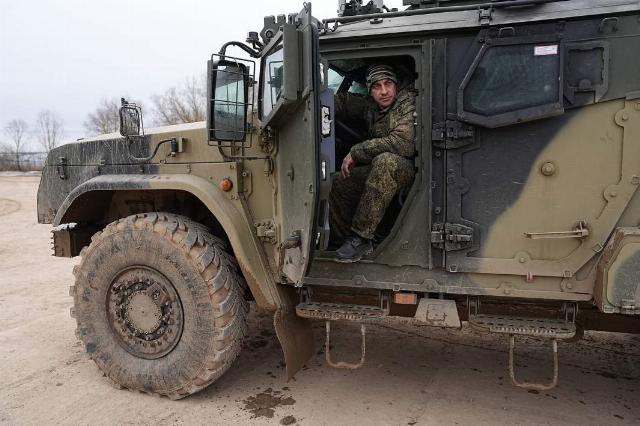
Photo: IZVESTIA/Pavel Volkov
Image source: iz.ru
— The kitchen module runs on diesel fuel, for this there is a 48—liter tank in the car, - Ivan Surov, head of the technical control department of the OTK manufacturing company, told Izvestia.
The car has a cargo module, as well as compartments for transporting dishes, household goods, cargo and spare parts (spare parts, tools and other accessories).
The machine also has retractable awnings that stretch over the cooking area, protecting staff from rain, snow and the hot sun. The car is already working in its own area. The state tests have now been completed.
— In particular, during them, the kitchen had to work continuously for at least 50 hours — this is a full-fledged preparation of breakfast, lunch, dinner for a week without interruptions. Our equipment has passed these and other tests," Ivan Surov said, not without pride.
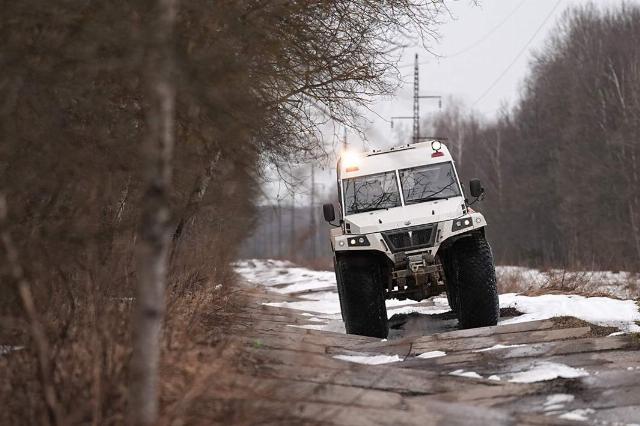
Photo: IZVESTIA/Pavel Volkov
Image source: iz.ru
It is also important that its design provides for the autonomous use of thermal units with a bread maker in dugouts, which has become relevant in modern combat conditions.
Testing of machines is not limited to the landfill. On the territory of the 21st Research Institute of Military Automotive Equipment of the Ministry of Defense of the Russian Federation, they will find a climate chamber that allows them to test equipment at a temperature of -60 degrees, a stand for determining the coordinates of the center of mass (they need to be known in order to safely transport cars in airplanes), two-section platform scales and other special equipment. Only after positive test results does the equipment enter the army.
Bogdan Stepovoy
